Super-Kamiokande Neutrino Detector
Inside Mount Ikenoyama in Japan within an active zinc mine is a remarkable tank of ultrapure water which is the world's most sensitive neutrino detector as of 1999.
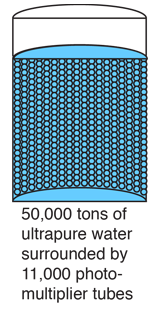 |
The 50,000 tons of water in the tank detector is so pure and transparent that light passes 70 meters before its intensity drops to half, compared to a few meters in a typical swimming pool. The 11,000 hand-blown photomultiplier tubes are half a meter in diameter and coated inside with a thin layer of alkali metal to detect the Cerenkov radiation from the interactions of either electron neutrinos or muon neutrinos. 罐中探测器内的50,000吨水非常纯净且透明,光在其中传播70米后其光强会降至一半,这与普通游泳池中几米的光传播距离相比要大得多。罐中装有11,000个手工吹制的光电倍增管,直径为半米,并在其内部涂有一层薄薄的碱金属,以探测中微子与电子中微子或缪子中微子相互作用产生的切连柯夫辐射。
Kearns, Kajita and Totsuka report the detection of 5000 neutrino events in two years of measurement. From the nature of the interactions of cosmic rays in the upper atmosphere, two muon neutrinos are expected for every electron neutrino, but they found a ratio of only 1.3 to 1. Their interpretation of this result is that the deficiency is caused by "neutrino oscillation" in which a number of muon neutrinos are transmuted into tau neutrinos which are undetectable. Neutrino oscillation has been hotly debated over the past few years because its existence implies a mass for the neutrinos. Further detailed analysis of this data from Super-Kamiokande is consistent with neutrino oscillation, so this is the first clear experimental evidence supporting a non-zero mass for the neutrino. Kearns、Kajita 和 Totsuka 报告了在两年的测量中检测到 5000 个中微子事件。根据宇宙射线在大气上层相互作用的性质,每有一个电子中微子就应该有 2 个缪中微子,但他们测到的比率为 1.3:1。他们对这一结果的解释是,这种不足是由中微子振荡造成的,即一部分缪中微子被转化为不可探测的塔中微子。中微子振荡在过去几年中备受争议,因为它的存在意味着中微子具有质量。来自 Super-Kamiokande 的这一数据的进一步详细分析与中微子振荡一致,因此这是支持中微子质量非零的首个明确实验证据。
|
| Does the neutrino have any mass?
中微子有质量吗? |
| Accident at Super-Kamiokande
超神 Kamiokande 事故 |
Particle concepts
Reference
Kearns, et al.
| HyperPhysics***** Quantum Physics
HyperPhysics ***** 量子物理 | R Nave |