Color Temperature
Suppose you want to produce an image which gives an accurate rendition of the colors of an object. The first problem is that the visual colors of the object depend upon the light which illuminates it, since the object partially absorbs and partially reflects the different colors in the illuminating light. You could say "illuminate the object with white light", but the question "What is white light?" is a non-trivial one.
In terms of the basic color characteristics hue, saturation and brightness, white light would be considered to be light of zero saturation (achromatic) and high brightness. Since there is no single light source that can be said to produce perfectly white light, the approach of color research has been to map the human perception of color on a C.I.E. Chromaticity diagram. This diagram shows that there is a region of visual perception that you could label as "white", but not all whites are equal.
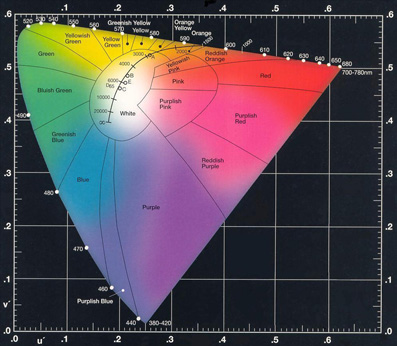 | This chromaticity diagram maps all the colors that are visible to the human eye, although its representation on a page or a computer screen is never completely accurate because such display processes cannot cover the full range of the human eye. Note that toward the center of the diagram is an area labeled "white", an area where the colors are so unsaturated that they approach white. The colors at the edge of the diagram are fully saturated. 这个色度图显示了人眼可见的所有颜色,尽管其在页面或计算机屏幕上的表示从不完全准确,因为这样的显示过程无法覆盖人眼的全部范围。请注意,图的中心区域标有“白色”,该区域的颜色非常不饱和,接近白色。图的边缘处的颜色则完全饱和。 |
The curved line drawn through the white region shows the chromaticity of very hot incandescent objects referred to as blackbody radiators. The numbers along the curve are the absolute temperatures of the hot object in Kelvins. 通过白色区域画出的曲线表示非常热的白体辐射的色度。曲线上标注的数字是该热物体的绝对温度,单位为开尔文。 |  |
A hot object emits radiation which is distributed according to a universal blackbody radiation curve, so it represents a stable standard for comparison with the spectral distribution and perceived color of any light source. For any light source which is approximately white, we can define a "color temperature" as the temperature associated with the blackbody radiator at the point on the curve closest to that source's location on the chromaticity diagram.
It will be evident from the illustration above that sources with very high color temperatures will have more blue content, and those with low color temperatures will have more yellow content. Williamson and Cummins suggest a color temperature of about 2800K for a 100w incandescent bulb, a color temperature of 4870K for direct sunlight and 6770K for light from an overcast sky.
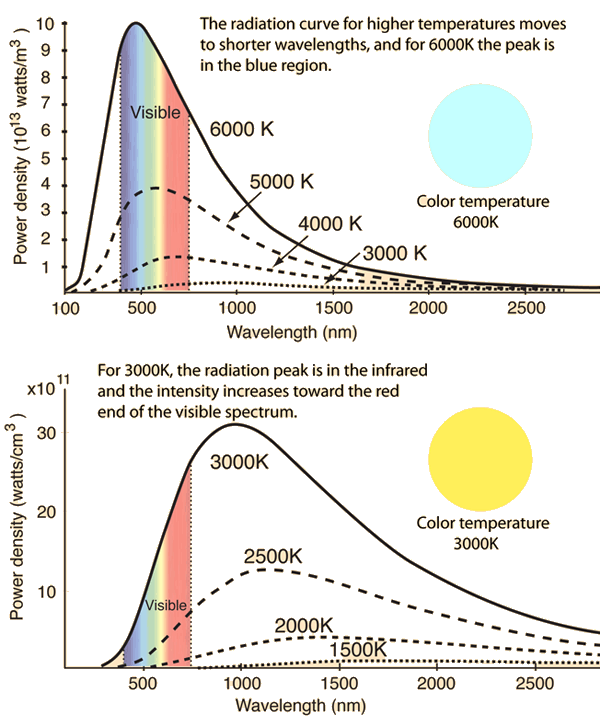
This is an attempt to illustrate the origin of the difference in color for different temperature hot objects. None of the colors should be taken as accurate - this is a qualitative description. The colors representing the color temperatures 3000K and 6000K are far too saturated, but hopefully they serve to communicate the general nature of the difference for blackbody radiators of different temperature.
To provide some reasonable standards for color measurements, three standard illuminants A, B, and C have been used. They are shown on the chromaticity diagram section above. Illuminant A is a blackbody at 2854K, closely approximated by a 500 watt incandescent bulb. Illuminant B is direct sunlight at noon on a clear day with a color temperature of 4870K. Illuminant C is skylight on an overcast day with color temperature 6770K.
References:
Williamson & Cummins
p74, 200
| HyperPhysics***** Light and Vision
HyperPhysics ***** 光与视觉 | R Nave |

