Bilingual edition: English is preserved and Chinese follows each unit. Terminology uses the confirmed v20260916 glossary; automated semantic review remains traceable.
中英双语版:英文原文完整保留,中文紧随对应单元;术语采用 v20260916 确认表,自动语义审校结果可追溯。

The 1976 CIE Chromaticity Diagram
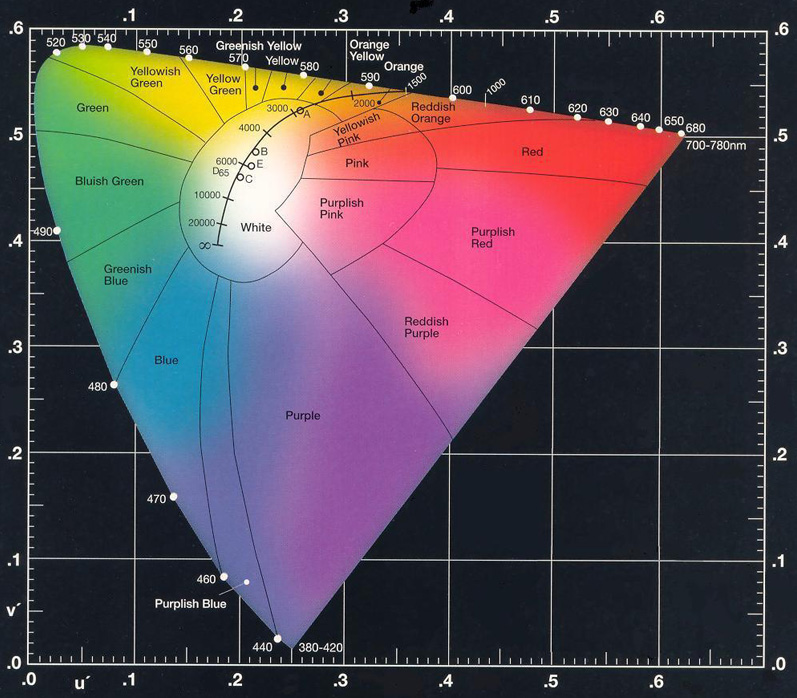
1976年CIE色度图

Image courtesy of Photo Research, Inc.

When the description "CIE Chromaticity Diagram" is used, it typically refers to the standard diagram established in 1931. Two revisions have been made since then - one in 1960 and one in 1976. All three contain the same information, just scaled differently. Conceptually, the big advantage attributed to the 1976 diagram is that the distance between points on the diagram is approximately proportional to the perceived color difference.

当使用“CIE 色度图”这一描述时,通常指的是1931年制定的标准图。此后进行了两次修订,分别发生在1960年和1976年。三张图包含的信息相同,只是比例不同。从概念上讲,1976年的图的主要优势在于,图上各点之间的距离大致与人眼感知的颜色差异成正比。

The CIE system characterizes colors by a luminance parameter Y and two color coordinates x and y which specify the point on the chromaticity diagram.

Blackbody curve on the CIE Diagram
黑体曲线在CIE图上
CIE系统通过一个光亮度参数Y和两个色度坐标x和y来表征颜色,这两个坐标指定色度图上的一个点。

References:

参考文献:

The Color Phenomena site gives the conversion relationships between the 1976 CIE standard and the previous CIE-1931 and CIE-1960 standards, which are still in use.

颜色现象网站提供了1976年CIE标准与之前CIE-1931和CIE-1960标准之间的转换关系,这些标准仍被使用。
Photo Research, Inc. 提供的图片
Index

CIE concepts

Color measurement concepts
索引 CIE 概念 颜色测量概念
 
HyperPhysics***** Light and Vision
HyperPhysics ***** 光与视觉
R Nave
Go Back
返回


Blackbody Curve on CIE Diagram

黑体曲线在CIE图上

Image courtesy of Photo Research, Inc.

Shown above is an enlarged section of the 1976 CIE Chromaticity Diagram to show the path of a blackbody radiator that is caused to increase in temperature. As a heated object becomes incandescent, it first glows red, then yellow, white, and finally blue. This occurs because the wavelength associated with the peak radiation of the blackbody radiator becomes progressivley shorter with increased temperature, as described in the Wien Displacement Law. As you might know by looking at the colors of stars, these colors are highly unsaturated. That is, within a certain temperature range, say 4000 to 20000 K, they are very close to white. Much effort has gone into producing white light, and several standard illuminants have been used as a standard for white light for specific purposes like photography. Some of the standard illuminants have been given letter designations like A, B, C, D. As you can see on the diagram, they fall close to the line traced out by a blackbody radiator with changing temperature. One of the parameters used to characterize these light sources is their "color temperature", the temperature associated with the nearest point on the blackbody curve.

如上图所示,是1976年CIE色度图的放大部分,用以展示黑体辐射体温度升高时的光路。当物体被加热并开始发光时,它首先发出红色光,然后是黄色光、白光,最后是蓝光。这是因为黑体辐射体的峰值辐射波长随着温度的升高而逐渐变短,正如 Wien 移动定律所述。正如你可能通过恒星的颜色所知道的,这些颜色非常不饱和。也就是说,在一定温度范围内,比如4000到20000 K之间,它们非常接近白色。为了产生白光,人们投入了大量努力,已经使用了多种标准照明体作为白光的标准,用于特定目的,如摄影。一些标准照明体已被赋予字母代号,如A、B、C、D。如你在图上可以看到的,它们接近由温度变化所绘制出的黑体辐射曲线上的点。用于描述这些光源的一个参数是它们的“色温”,即与黑体曲线上最近点相关的温度。
Photo Research, Inc. 提供的图片
Index

CIE concepts

Color measurement concepts
索引 CIE 概念 颜色测量概念
 
HyperPhysics***** Light and Vision
HyperPhysics ***** 光与视觉
R Nave
Go Back
返回