The Sodium Doublet
钠双线
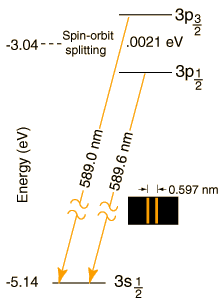 |
The well known bright doublet which is responsible for the bright yellow light from a sodium lamp may be used to demonstrate several of the influences which cause splitting of the emission lines of atomic spectra. The transition which gives rise to the doublet is from the 3p to the 3s level, levels which would be the same in the hydrogen atom. The fact that the 3s (orbital quantum number = 0) is lower than the 3p (l=1) is a good example of the dependence of atomic energy levels on angular momentum. The 3s electron penetrates the 1s shell more and is less effectively shielded than the 3p electron, so the 3s level is lower (more tightly bound). The fact that there is a doublet shows the smaller dependence of the atomic energy levels on the total angular momentum . The 3p level is split into states with total angular momentum j=3/2 and j=1/2 by the magnetic energy of the electron spin in the presence of the internal magnetic field caused by the orbital motion. This effect is called the spin-orbit effect. In the presence of an additional externally applied magnetic field, these levels are further split by the magnetic interaction, showing dependence of the energies on the z-component of the total angular momentum. This splitting gives the Zeeman effect for sodium.
众所周知的明亮双线,它负责钠灯发出的明亮黄色光,可用于演示几种导致原子光谱发射线分裂的影响。产生双线的跃迁是从3p到3s能级,这些能级在氢原子中会是相同的。3s(轨道量子数=0)比3p(l=1)低,这是原子能级对角动量依赖性的良好例子。3s电子更深入地穿透1s壳层,因此比3p电子更不被有效屏蔽,所以3s能级更低(更紧密地结合)。双线的存在表明原子能级对总角动量的依赖性较小。在内部磁场(由轨道运动引起)的作用下,3p能级被电子自旋的磁能分裂成总角动量j=3/2和j=1/2的态。这种效应称为自旋-轨道效应。在存在额外外部施加的磁场时,这些能级进一步被磁相互作用分裂,显示出能量对总角动量z分量的依赖性。这种分裂导致钠的塞曼效应。 |
The magnitude of the spin-orbit interaction has the form μzB = μBSzLz. In the case of the sodium doublet, the difference in energy for the 3p3/2 and 3p1/2 comes from a change of 1 unit in the spin orientation with the orbital part presumed to be the same. The change in energy is of the form
自旋-轨道相互作用的幅度形式为 μ z B = μ B S z L z 。在钠双重态的情况下,3p 3/2 和 3p 1/2 的能量差来自于自旋方向的变化为 1 单位,而轨道部分被假定相同。能量的变化形式为
ΔE = μBgB = 0.0021 eV
ΔE = μ B gB = 0.0021 eV(专名或术语)
where μB is the Bohr magneton and g is the electron spin g-factor with value very close to 2. This gives an estimate of the internal magnetic field needed to produce the observed splitting:
其中 μ_B 是玻尔磁子,g 是电子自旋 g 因子,其值非常接近 2。这给出了产生观察到的分裂所需的内部磁场的估计值:
μBgB = (5.79 x 10⁻⁵ eV/T)2B = 0.0021 eV
μ B gB = (5.79 × 10⁻⁵ eV/T)²B = 0.0021 eV
B = 18 Tesla
B = 18特斯拉
This is a very large magnetic field by laboratory standards. Large magnets with dimensions over a meter, used for NMR and ESR experiments, have magnetic fields on the order of a Tesla.
这在实验室标准下是一个非常大的磁场。用于核磁共振和电子自旋共振实验的大尺寸磁体,其磁场强度通常在特斯拉量级。
| More on sodium spectrum
钠光谱的更多内容 | Sodium Zeeman effect
钠塞曼效应 |
Other spectra
References
Thornton & Rex
Sec 9.2
Serway, Moses, Moyer
Sec 8.3
索引 其他光谱 参考文献 Thornton & Rex 第9章第2节 Serway, Moses, Moyer 第8章第3节
| HyperPhysics***** Quantum Physics
HyperPhysics ***** 量子物理 | R Nave |
返回
