When would you be better off not wearing your seatbelt?什么时候你不系安全带反而更好?
|
Index Work-energy principle Car crash scenario 索引 功-能原理 汽车碰撞场景 | ||
|
Go Back
返回 |
Seatbelt and Airbag for Safety安全带和安全气囊
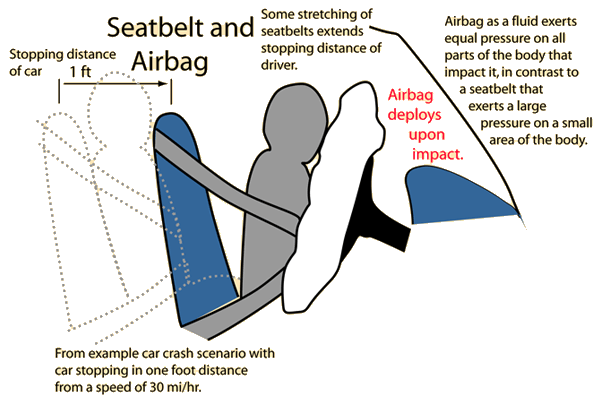
While the driver with an airbag may experience the same average impact force as the driver with a good seatbelt, the airbag exerts an equal pressure on all points in contact with it according to Pascal's principle. The same force is distributed over a larger area, reducing the maximum pressure on the body. 尽管装有气囊的驾驶员可能体验到与装有良好安全带的驾驶员相同的平均冲击力,但根据帕斯卡原理,气囊会对接触点的所有区域施加相等的压力。同样的力分布在更大的面积上,从而降低了对身体的最大压力。
The presence of an airbag should not be used as justification for not wearing the seatbelt! The seatbelt keeps the driver from moving out of the position where the airbag is effective in capturing the driver and cushioning the impact. 空气囊的存在不应成为不系安全带的借口!安全带能防止驾驶员移出安全囊有效捕捉驾驶员并缓冲击的区域。
|
Index Work-energy principle Car crash scenario 索引 功-能原理 汽车碰撞场景 | ||
|
Go Back
返回 |
Protection by Seatbelts安全带的保护作用
Data on seatbelt effectiveness was obtained by comparing severe accidents in which at least one person was killed. An effectiveness of 42% for drivers with seatbelts means that a 42% reduction in fatalities would occur if all drivers wore seatbelts. 通过比较至少有一个人死亡的严重事故,获得了关于安全带有效性的数据。安全带对于司机而言的有效性为42%,这意味着如果所有司机都系安全带, fatalities 将减少42%。
|
Index Car crash scenario 索引 碰撞场景 | ||||||||||||||||||||||||||||
|
Go Back
返回 |
Vehicle Mass and Accidents车辆质量与事故
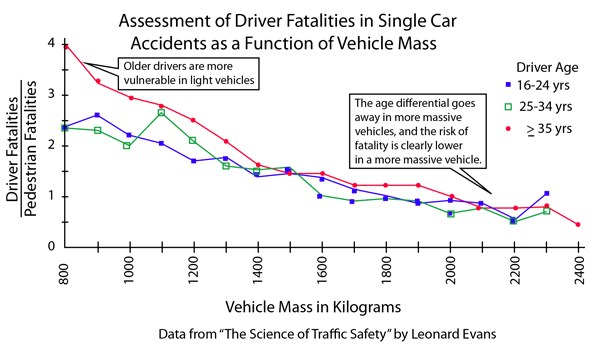
![]() The more massive vehicle in a two-vehicle collision would be presumed to be safer since it would undergo less change in velocity during the collision. Not so evident is the fact that the more massive car is safer in a single-car accident. Leonard Evans collected data from the FARS database for a Fatality vs Mass comparison. His problem in assessing the rate of incidence of fatal accidents was to have a base for comparison since non-fatal single car accidents are not included in the database, nor are the number of cars in a given mass range. He used the number of pedestrian fatalities as a base, a "surrogate" for the number of serious accidents of all types, since it was presumed that the ratio of collisions with pedestrians to other types of collisions, e.g. with trees, would be similar for any mass class. It was also presumed that the pedestrian fatality rate would be more-or-less independent of car mass since even the lightest car is so much more massive than a pedestrian. The self-consistency of the curves for different ages of driver offers some evidence of validity since their accident rates were much different.
在两车碰撞中,质量更大的车辆会被认为更安全,因为它在碰撞过程中速度变化更小。然而,对于单车事故而言,质量更大的车辆更安全这一点并不那么明显。Leonard Evans 从 FARS 数据库中收集了关于死亡人数与质量比较的数据。他在评估致命事故率时的困难在于需要一个比较基准,因为非致命的单车事故不包含在数据库中,而且在特定质量范围内车辆的数量也不包含在内。他使用行人死亡人数作为基准,这是一种“替代指标”,用于代表所有类型的严重事故数量,因为假定任何质量类别中,与行人碰撞的事故比例与其他类型的碰撞(例如与树木碰撞)的比例相似。此外,假定行人死亡率与车辆质量几乎无关,因为即使是最轻的车辆,其质量也远大于行人。不同驾驶员年龄的曲线自洽性提供了一些有效性证据,因为其事故率差异很大。 |
Index Car crash scenario 索引 碰撞场景 | ||
|
Go Back
返回 |
Traffic Accident Data交通事故数据
The U S Department of Transportation keeps data on traffic accidents including the Fatal Accident Reporting System (FARS) with fatalities since 1975 which number over a half million (averaging 45,000 per year in the US). Each year there are about 18 million property damage crashes with 1.7 million injuries. The risk of accidents for young drivers is greater in all categories of accidents, 18 yr olds having 400% more accidents than 40 yr olds.
Analysis of such data permits reasonable estimation of factors which influence safety such as vehicle mass and the use of seatbelts. Some interesting human factors come into play. For example, given a severe crash, the driver of a 900 kg car is about 2.6 times more likely to be killed than the driver of an 1800 kg car. But overall data indicates that 1.7 times as many drivers of 900 kg cars are killed, compared to 1800 kg cars, indicating that drivers of light cars are more cautious and less likely to have such accidents. In seatbelt statistics, it must be factored in that persons who choose not to use seatbelts are more likely to have accidents out of a higher general bent toward risk taking. Source: Leonard Evans, "The Science of Traffic Safety", The Physics Teacher 26, October 1988, Page 431. 美国交通部保存着有关交通事故的数据,包括自1975年以来的致命事故报告系统(FARS),其中死亡人数超过半百万(每年平均45000人)。每年有约1800万起财产损失事故,造成170万人受伤。年轻司机在所有事故类别中事故风险都更高,18岁司机的事故数量比40岁司机多400%。对这类数据的分析可以合理地估计影响安全的因素,如车辆质量和使用安全带。一些有趣的人为因素也起作用。例如,在严重碰撞中,驾驶900千克汽车的司机比驾驶1800千克汽车的司机死亡风险高约2.6倍。但总体数据显示,驾驶900千克汽车的司机死亡人数是驾驶1800千克汽车司机的1.7倍,这表明驾驶轻型汽车的司机更加谨慎,不太容易发生此类事故。在安全带统计数据中,必须考虑到那些不使用安全带的人更倾向于冒险,因此更可能发生事故。来源:Leonard Evans,《交通安全的科学》,《物理教师》26卷,1988年10月,第431页。 |
Index Car crash scenario 索引 碰撞场景 | ||
|
Go Back
返回 |
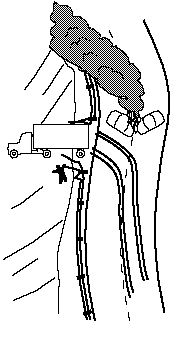
Trucks: more likely to 'win' in car crash卡车:更可能在车祸中‘胜出’
Phil Frame, a spokesman for the National Transportation Safety Board, said that while large trucks are not part of most deadly wrecks, "they are overrepresented in the number of fatal accidents they are involved in." 菲利普·弗莱姆是国家运输安全委员会的发言人,他说尽管大型卡车不是大多数致命事故的组成部分,但“它们在涉及致命事故的数量上被过度代表了。”
In 1997, they accounted for 9 percent nationally of all vehicles in fatal wrecks, but accounted for only 3 percent of all registered vehicles and 7 percent of total vehicle miles traveled, the national transportation statistics show. 1997年,全国致命车祸中的车辆中有9%属于它们,但它们仅占所有注册车辆的3%,占总车辆行驶里程的7%,国家交通统计数据表明。
"The greater mass vehicle almost always wins in a vehicle crash", Frame said. ‘更大质量的车辆在碰撞中几乎总是占上风’,Frame说道。
78 percent of the people who died after collisions with big trucks were occupants of the other vehicle, and 75 percent of the people who were injured were in the other vehicle." 在与大卡车碰撞后死亡的人中,有78%是另一辆车的乘客;受伤的人中,有75%来自另一辆车。
Excerpts from "Facts counter fear about big rigs", by Jennifer Brett, Atlanta Journal. 《关于大型卡车的恐惧事实》摘录,作者:Jennifer Brett,亚特兰大新闻。
Spokesmen for the trucking industry are quick to point out that truck drivers are better trained, and safer drivers than the general public - and that is believable. But just the physics of collisions dictates that the occupant of the less massive vehicle is more at risk when a collision does occur. 卡车行业的发言人往往迅速指出,卡车司机比一般公众更受过训练,而且是更安全的司机——这一点是可信的。但仅仅是碰撞的物理规律就决定了,当发生碰撞时,载有质量较小车辆的乘客处于更大的风险中。
|
Index Car crash scenario 索引 碰撞场景 | ||
|
Go Back
返回 |