Io
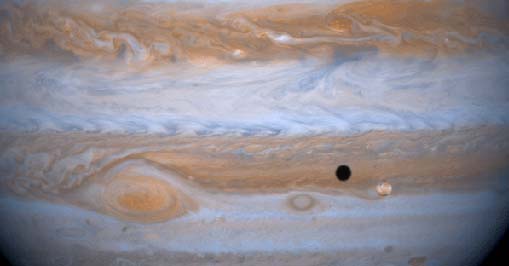
Io is the closest of the four largest moons of Jupiter. These moons are called the "Galilean moons" because they were first observed by Galileo.
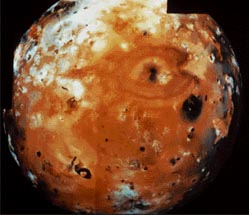 | The first images of Io from the Voyager spacecraft were dramatic indeed, showing a surface with reds, browns and yellows in patterns which reminded one observer of a "giant pizza". Io is the most volcanically active body in the entire solar system. Voyager I photographed eight erupting volcanoes! Four of them were still active when Voyager II arrived 4 months later. Voyager航天器拍摄的木卫一的首批图像确实令人印象深刻,显示出表面有红色、棕色和黄色的图案,使一位观察者想起了“巨型披萨”。木卫一是整个太阳系中最活跃的火山天体。Voyager I拍摄到了八座喷发的火山!当Voyager II四个月后抵达时,其中有四座火山仍处于活跃状态。
The volcanic activity contributes sulfur and other ions to the charged particle field around Jupiter, interacting with its strong magnetic field. These charged particles are swept around the planet and form a donut-shaped region called the Io plasma torus. 火山活动向木星周围的带电粒子场贡献硫和其他离子,与木星强大的磁场相互作用。这些带电粒子围绕行星运动,形成一个称为木卫一等离子体环的环形区域。
These three images areNASA images from Voyager missions 这三张图是来自 Voyager 任务的 NASA 图片 |
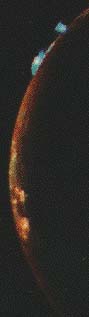 | 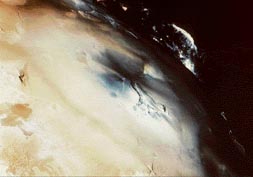 These Voyager images show volcanoes erupting. Some material was observed at heights up to 200 km. Their dramatic heights are significant compared to the radius of the moon as shown in the edge image at left. 这些旅行者号拍摄的图片显示火山正在喷发。有物质被观测到喷发高度可达200公里。与月球半径相比,这些火山的高度相当显著,如左图边缘图像所示。 | The volcanoes of Io eject material at up to 2 km/s, a much higher speed than any volcanic ejection on the Earth.
木卫一的火山喷出物的喷射速度可达2 km/s,这比地球上的任何火山喷发速度都要高得多。 |
Except for the locations of the active volcanoes, the surface of Io is extremely smooth. Apparently the volcanic action is so intense and continuous that flow from the volcanoes smooths out any irregularities and erases impact craters. A thin atmosphere of sulfur dioxide exists on the moon, presumably from the eruptions.
Why is Io so volcanically active? The energy which drives the continuous volcanism must come from the tidal influences of Jupiter on this nearby moon. By the inverse square law for gravity, the force on the near side of the moon is stronger than on the far side. Using the orbital data for Io, the force on the near side of Io is about 1.7% stronger than the force on the far side. But for the Earth's moon, the force on the near side is 1.8% stronger than that on the far side, and it is not volcanically active - why the difference? The answer is that for Earth's moon, the tidal forces long ago brought it into a state of synchronous rotation with the Earth, so that the same side of the moon faces the Earth at all times. Under that condition, the stresses which are caused in the moon by this force differential remain the same, and the forces do no work. For work to be accomplished, there must be motion in the direction of the force. In the case of Io, the rotation is not synchronous, although is is very close. Io has three other large companion moons which exert forces on it, resulting in a slightly elliptical orbit for which the same side does not always face Jupiter. The direction of greatest tidal distortion changes with time, so the forces exerted by Jupiter cause motion to re-establish the "stretching" of the moon in the direction of the forces. These forces therefore do work to achieve that motion - providing energy to drive the volcanic processes. The power from these tidal process which heats Io is estimated at 100 million megawatts!
The modeling of the interior of Io suggests that it has an iron/iron sulfide core and a rocky mantle. With the enormous heating energy of the tidal processes, much of the interior is soft or molten. This energy leads to geyser-like, high-temperature eruptions from the surface.
| Images of Io from Galileo
伽利略拍摄的木卫二影像 |
Jupiter Concepts
Solar System Illustration
Solar System Concepts
References
Chaisson & McMillan,
Ch 11.
| HyperPhysics********** Astrophysics
HyperPhysics ********** 天体物理学 | R Nave |