Stellar Spectral Types恒星光谱类型
Stars can be classified by their surface temperatures as determined from Wien's Displacement Law, but this poses practical difficulties for distant stars. Spectral characteristics offer a way to classify stars which gives information about temperature in a different way - particular absorption lines can be observed only for a certain range of temperatures because only in that range are the involved atomic energy levels populated. The standard classes are: 恒星可以根据其表面温度进行分类,这种分类依据是 Wien 排移定律确定的,但对遥远的恒星来说这在实践中存在困难。光谱特征提供了一种分类恒星的方法,这种方法以不同的方式提供了关于温度的信息——特定的吸收线只能在一定的温度范围内被观测到,因为只有在那个温度范围内,涉及的原子能级才会被激发。标准的分类是:
The commonly used mnemonic for the sequence of these classifications is "Oh Be A Fine Girl, Kiss Me". 这些分类的常用记忆法是口诀‘O h B e A F ine G irl, K iss M e’。
Spectral Class Characteristics光谱分类特征
Data from J. C. Evans, George Mason University 数据来自J. C. Evans,乔治·梅森大学
|
Index Star concepts 索引星概念 | ||||||||||||||||||||||||||||||||||||||||||||||||||||||||
|
Go Back
返回 |
O-Type StarsO型星
Included are blue stars with surface temperatures of 20,000 to 35,000K. The thermal energy is so great at these temperatures that most surface hydrogen is completely ionized so hydrogen (HI) lines are weak. Unionized helium (HeI) is visible but the stronger spectra are of mulitple ionized atoms (HeII, CIII, NIII,OIII,SiV). Note the rise of the spectral curve toward the blue from the blackbody radiation curve. 其中包括表面温度为20,000到35,000K的蓝星。在这些温度下,热能如此巨大,以至于大部分表面氢完全离子化,因此氢(HI)线很弱。未离子化的氦(HeI)是可以看到的,但更强烈的光谱来自多种离子化的原子(HeII、CIII、NIII、OIII、SiV)。注意光谱曲线从黑色体辐射曲线向蓝端上升。
|
Index Star concepts Reference Kaufmann 索引星概念参考Kaufmann | ||||
|
Go Back
返回 |
O-Type StarsO型星
The spectra of O-Type stars shows the presence of hydrogen and helium. At these temperatures most of the hydrogen is ionized, so the hydrogen lines are weak. Both HeI and HeII (singly ionized helium) are seen in the higher temperature examples. O型星的光谱显示氢和氦的存在。在这些温度下,大部分氢离子化,因此氢线较弱。在较高温度的例子中,可以看到HeI和HeII(单电离氦)。
The radiation from O5 stars is so intense that it can ionize hydrogen over a volume of space 1000 light years across. One example is the luminous H II region surrounding star cluster M16. O5型星发出的辐射如此强烈,以至于能在跨度达1000光年的空间中电离氢。一个例子是围绕星团M16的明亮的H II区域。
O-Type stars are very massive and evolve more rapidly than low-mass stars because they develop the necessary central pressures and temperatures for hydrogen fusion sooner. Because of their early development, the O-Type stars are already luminous in the huge hydrogen and helium clouds in which lower mass stars are forming. They light the stellar nurseries with ultraviolet light and cause the clouds to glow in some of the dramatic nebulae associated with the H II regions. O型星非常 massive,比低质量的星体演化得更快,因为它们更早地发展出中心所需的高压和高温以实现氢融合。由于它们的早期发展,O型星已经在巨大的氢和氦云中变得明亮,而这些低质量星体正在形成中。它们用紫外线光照亮星云,并使一些与H II区域相关的壮观星云发光。
|
Index Star concepts Reference Kaufmann 索引星概念参考Kaufmann | ||
|
Go Back
返回 |
B-Type StarsB型星
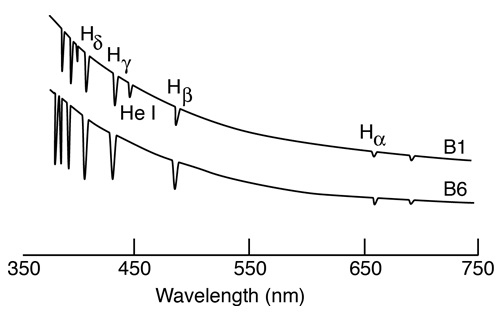
Blue-white stars with surface temperatures of about 15000K. The ionized helium (HeII) lines of the O-type stars have disappeared and neutral helium (HeI) lines are strongest at B2. The neutral hydrogen (HI) lines are getting stronger and singly ionized OII, SiII and Mg II are visible. A significant rise of the blackbody spectrum toward the blue is still evident. 蓝白色恒星,表面温度约为15000K。O型星的离子化氦(HeII)线已消失,而中性氦(HeI)线在B2处最强。中性氢(HI)线逐渐增强,单电离的OII、SiII和MgII线也变得可见。黑体光谱向蓝色方向仍有显著上升。
![]() These are sketches of spectra in Kaufmann. The original data are attributed to G. Jacoby, D. Hunter and C. Christian.
这些是Kaufmann的光谱草图。原始数据归功于G. Jacoby、D. Hunter和C. Christian。 |
Index Star concepts Reference Kaufmann 索引星概念参考Kaufmann | ||
|
Go Back
返回 |