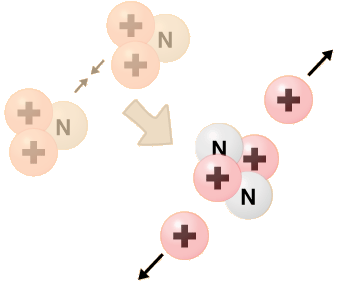
Proton-Proton Fusion质子-质子融合
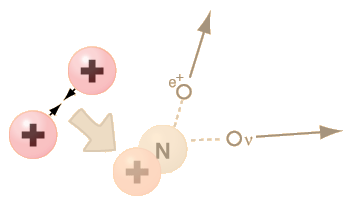
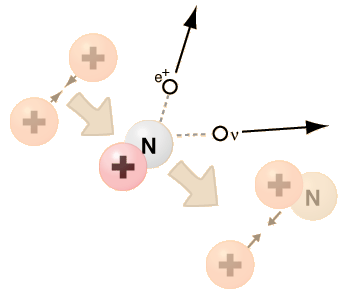
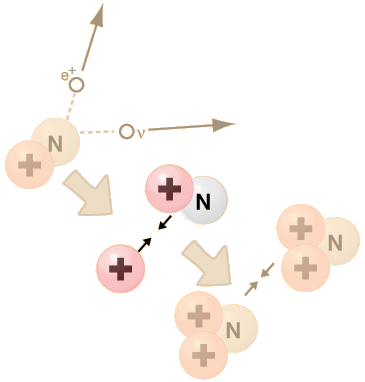
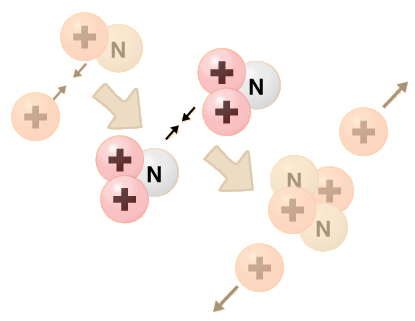
This is the nuclear fusion process which fuels the Sun and other stars which have core temperatures less than 15 million Kelvin. A reaction cycle yields about 25 MeV of energy. 这是核融合过程,它为太阳和其他核心温度低于1500万开尔文的恒星提供能量。一个反应循环会产生约25 MeV的能量。
![]()
|
Index Carroll & Ostlie Ch 10.3 Krane, Intro. Nuclear Physics Ch 14.3 索引 Carroll & Ostlie 第10.3章 Krane, 《介绍性核物理》第14.3章 | ||
|
Go Back
返回 |
Proton-Proton Cycle质子-质子循环
The fusion of hydrogen in lower temperature stars like our Sun involve the following reactions yielding positrons, neutrinos, and gamma rays. 在温度较低的恒星中,如我们的太阳,氢的核融合涉及以下反应,产生正电子、中微子和伽马射线。
which can be followed by either 可以随后由 either
![]() The latter of these reactions is part of what is usually called the proton-proton cycle, which yields about 25 MeV and can be combined to the form 后者反应是通常称为质子-质子循环的一部分,该循环产生约25 MeV,并可以表示为形式
![]()
|
Index Carroll & Ostlie Ch 10.3 Krane, Intro. Nuclear Physics Ch 14.3 索引 Carroll & Ostlie 第10.3章 Krane, 《介绍性核物理》第14.3章 | |||
|
Go Back
返回 |
Step 1. Proton Fusion第一步:质子融合
With the development of quantum mechanics, it was realized that on this scale the protons must be considered to have wave properties and that there was the possibility of tunneling through the coulomb barrier. 随着量子力学的发展,人们认识到在这一尺度上,质子必须被视为具有波动性,并且存在穿透库仑势垒的可能。
|
Index Carroll & Ostlie Ch 10.3 Krane, Intro. Nuclear Physics Ch 14.3 索引 Carroll & Ostlie 第10.3章 Krane, 《介绍性核物理》第14.3章 | ||||
|
Go Back
返回 |
Eddington and his fusion critics爱丁顿与他的融合批评者
Arthur Eddington thought that nuclear processes must be involved to account for the radiant energy of the sun, but was criticized because the temperature was seen to be not hot enough when considered by classical physics alone. His tongue-in-cheek reply to his critics: "I am aware that many critics consider the stars are not hot enough. The critics lay themselves open to an obvious retort; we tell them to go and find a hotter place." 阿瑟·爱丁顿认为,要解释太阳的辐射能,必须涉及核过程,但因为仅凭经典物理考虑,温度被认为不够高而遭到批评。他对批评者的俏皮回应是:“我明白许多批评者认为恒星不够热。批评者自己已经暴露在明显的反驳之下;让他们去寻找一个更热的地方。”
|
Index Carroll & Ostlie Ch 10.3 Krane, Intro. Nuclear Physics Ch 14.3 索引 Carroll & Ostlie 第10.3章 Krane, 《介绍性核物理》第14.3章 | ||
|
Go Back
返回 |
Step 2. Deuterium formation第2步:氘的形成
|
Index Carroll & Ostlie Ch 10.3 Krane, Intro. Nuclear Physics Ch 14.3 索引 Carroll & Ostlie 第10.3章 Krane, 《介绍性核物理》第14.3章 | ||||||
|
Go Back
返回 |
Step 3. Deuterium-proton fusion步骤3. 氘-质子聚变
|
Index Carroll & Ostlie Ch 10.3 Krane, Intro. Nuclear Physics Ch 14.3 索引 Carroll & Ostlie 第10.3章 Krane, 《介绍性核物理》第14.3章 | |||
|
Go Back
返回 |
Step 4. Helium-3 fusion步骤4:氦-3聚变
|
Index Carroll & Ostlie Ch 10.3 Krane, Intro. Nuclear Physics Ch 14.3 索引 Carroll & Ostlie 第10.3章 Krane, 《介绍性核物理》第14.3章 | |||
|
Go Back
返回 |
Step 5. Alpha particle formation步骤5:α粒子形成
|
Index Carroll & Ostlie Ch 10.3 Krane, Intro. Nuclear Physics Ch 14.3 索引 Carroll & Ostlie 第10.3章 Krane, 《介绍性核物理》第14.3章 | |||
|
Go Back
返回 |