Star Temperatures恒星温度
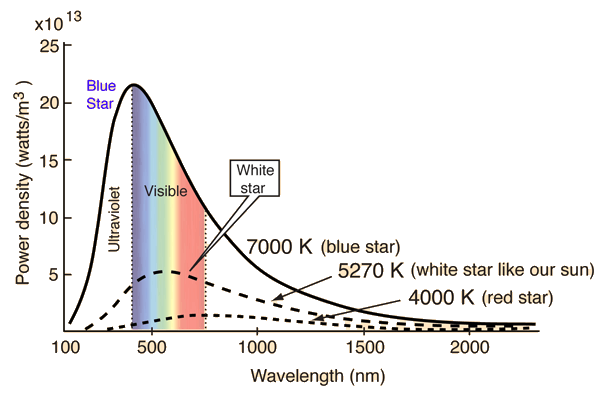
Stars approximate blackbody radiators and their visible color depends upon the temperature of the radiator. The curves show blue, white, and red stars. The white star is adjusted to 5270K so that the peak of its blackbody curve is at the peak wavelength of the sun, 550 nm. From the wavelength at the peak, the temperature can be deduced from the Wien displacement law.
![]() The change in the visual color of stars of different temperatures can be traced out on a chromaticity diagram. 不同温度的恒星的视觉颜色变化可以在色度图上表示出来。
Star classification恒星分类 恒星近似于黑体辐射体,其可见颜色取决于辐射体的温度。曲线显示蓝星、白星和红星。白星被调整到5270K,使得其黑体曲线的峰值位于太阳的峰值波长550 nm处。从峰值波长可以利用 Wien 移动定律推导出温度。 |
Index Blackbody radiation concepts 索引 黑体辐射概念 | ||
|
Go Back
返回 |
Wien's Displacement LawWien's Displacement Law(专名或术语)
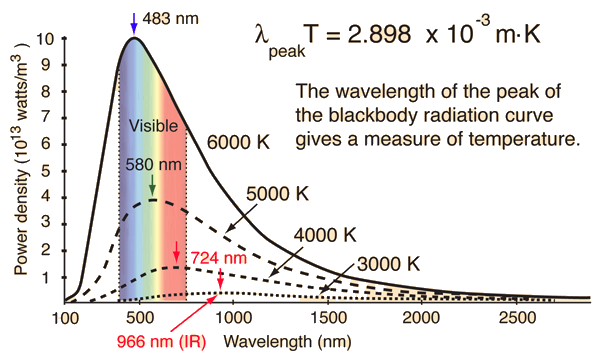
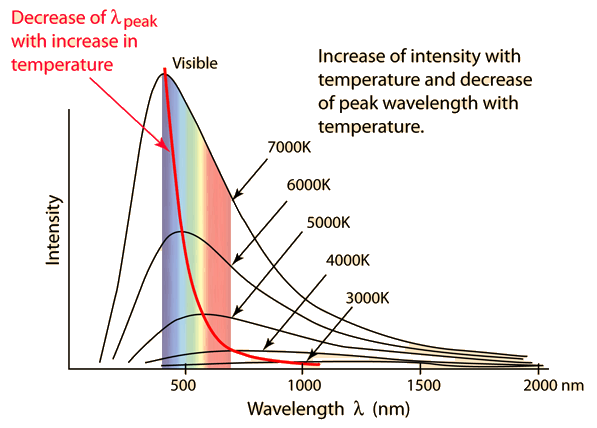
When the temperature of a blackbody radiator increases, the overall radiated energy increases and the peak of the radiation curve moves to shorter wavelengths. When the maximum is evaluated from the Planck radiation formula, the product of the peak wavelength and the temperature is found to be a constant. ![]()
This relationship is called Wien's displacement law and is useful for determining the temperatures of hot radiant objects such as stars, and indeed for a determination of the temperature of any radiant object whose temperature is far above that of its surroundings. 这种关系称为 Wien 定律,对于确定高温辐射物体的温度(如恒星)很有用,事实上也用于确定任何温度远高于其周围环境温度的辐射物体的温度。
It should be noted that the peak of the radiation curve in the Wien relationship is the peak only because the intensity is plotted as a function of wavelength. If frequency or some other variable is used on the horizontal axis, the peak will be at a different wavelength. 应注意的是,在 Wien 关系中辐射曲线的峰值仅是由于将强度作为波长的函数来绘制。如果横轴使用频率或其他变量,峰值将出现在不同的波长。
Development of relationship关系发展 Intensity as a function of temperature and wavelength强度作为温度和波长的函数 当黑体辐射体的温度升高时,总的辐射能量增加,辐射曲线的峰值向更短的波长移动。当从普朗克辐射公式中求出最大值时,峰值波长与温度的乘积被发现是一个常数。 |
Index Blackbody radiation concepts 索引 黑体辐射概念 | ||||
|
Go Back
返回 |
Wien's Displacement LawWien's Displacement Law(专名或术语)
For a blackbody radiator, the temperature can be found from the wavelength at which the radiation curve peaks.
对于黑体辐射体,其温度可通过辐射曲线峰值处的波长确定。λ_peak = x10^ m = nm = 微米。 中文译文中的待填/计算数值依次对应:1:wb 2:wp 3:wnm 4:wm。实际数值以上方原输入框为准。 |
Index Blackbody radiation concepts 索引 黑体辐射概念 | ||||||||||||||||||||||||||
|
Go Back
返回 |
Radiation Curves辐射曲线
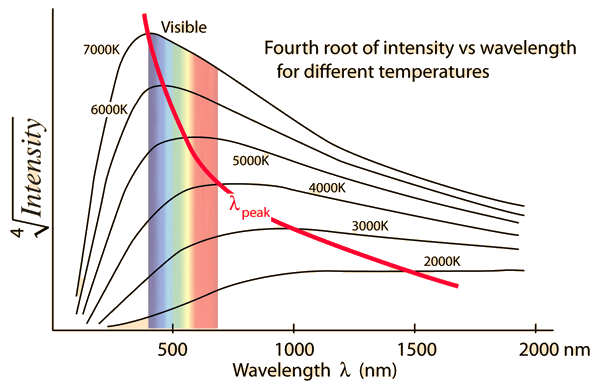
![]() The wavelength of the peak of the blackbody radiation curve decreases in a linear fashion as the temperature is increased (Wien's displacement law). This linear variation is not evident in this kind of plot since the intensity increases with the fourth power of the temperature (Stefan- Boltzmann law). The nature of the peak wavelength change is made more evident by plotting the fourth root of the intensity. 黑体辐射曲线的波长在温度升高时以线性方式减小( Wien's displacement law )。这种线性变化在这种类型的图表中并不明显,因为强度与温度的四次方成正比( Stefan- Boltzmann law )。通过绘制强度的四次方根,可以更清楚地看出峰值波长的变化。 |
Index Blackbody radiation concepts 索引 黑体辐射概念 | ||
|
Go Back
返回 |
Radiation Curves辐射曲线
![]() The wavelength of the peak of the blackbody radiation curve decreases with increasing temperature according to Wien's displacement law. The fourth root of the intensity shows the variation of the wavelength more clearly than the plot of the full radiated intensity. 根据维恩位移定律,黑体辐射曲线的峰值波长随温度升高而减小。光强的四次方根能更清晰地显示波长的变化,比绘制完整的辐射光强曲线更明显。 |
Index Blackbody radiation concepts 索引 黑体辐射概念 | ||
|
Go Back
返回 |