Entropy as Time's Arrow
One of the ideas involved in the concept of entropy is that nature tends from order to disorder in isolated systems. This tells us that the right hand box of molecules happened before the left.

|
Using Newton's laws to describe the motion of the molecules would not tell you which came first. For an isolated system, entropy always increases or remains the same, so if you compare states of different entropy, the one with the greater entropy will be later in time.
用牛顿运动定律来描述分子的运动无法告诉你哪一个先发生。对于孤立系统,熵总是增加或保持不变,因此如果比较不同熵的状态,熵较大的状态将在时间上更晚。
熵的概念中涉及的一个想法是,自然界倾向于使孤立系统从有序变为无序。这告诉我们,分子的右边盒子发生在左边盒子之前。
|
Caveats and Objections
There are some subtleties in the nature of entropy and other thermodynamic quantities, subtleties that we try to put into word pictures and sketches which sometimes oversimplify. In teaching thermodynamics, I have always tried to keep in mind the words of one of the great physics teachers of the mid-20th century, Mark Zemansky:
is as easy as a song:
You think you make it simpler
when you make it slightly wrong."
The diagrams above have generated a lively discussion, partly because of the use of order vs disorder in the conceptual introduction of entropy. It is typical for physicists to use this kind of introduction because it quickly introduces the concept of multiplicity in a visual, physical way with analogies in our common experience. Chemists, on the other hand, often protest this approach because in chemical applications order vs disorder doesn't communicate the needed ideas on the molecular level and can indeed be misleading. The very fact of differences of opinion on the use of order and disorder can itself be instructive.
The top diagram depicts time's arrow as pointing from order to disorder, but one must admit that the apparent tendency to move from order to disorder is not the most fundamental way to look at the top diagram. At ordinary temperatures, the internal energy of a gas would give the molecules high velocities, and it is evident that this orderly arrangement would be very rare because there are only a few ways to do it. If it occurred, it would be for a brief instant and then the molecules would move to some other configuration. The diagram at left depicts a more random or disordered configuration, but the key point is that there is a vast number of ways that such configurations could be achieved. So multiplicity is the key concept - molecular ensembles will spontaneously tend to evolve from configurations of lower multiplicity to configurations of greater multiplicity.
The bottom diagram is again a picture with which common experience immediately identifies - there are more ways to create a jumbled pile of bricks than a neatly stacked arrangement. Again, the idea of multiplicity is the key point. Objections to this kind of introduction to entropy come from the fact that the useful applications of entropy are thermodynamic ones and involve nature on the atomic and molecular scale. The ordered bricks vs the jumbled pile may be a useful introductory visualization, but if these two piles of bricks were at the same temperature, then the numerical value of the entropy would be almost identical for the two stacks. If the contributions to entropy involves the multiplicity of the ways that the vast number of molecules in the two stacks of bricks can be arranged, then the fact that the macroscopic orientations of the bricks is different is a negligible contribution to the total entropy. Entropy is a crucial microscopic concept for describing the thermodynamics of systems of molecules, and the assignment of entropy to macroscopic objects like bricks is of no apparent practical value except as an introductory visualization.
Entropy concepts
| HyperPhysics***** Thermodynamics
HyperPhysics ***** 热力学 | R Nave |
Entropy and Disorder熵与无序
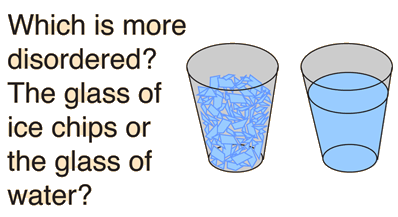
If you assert that nature tends to take things from order to disorder and give an example or two, then you will get almost universal recognition and assent. It is a part of our common experience. Spend hours cleaning your desk, your basement, your attic, and it seems to spontaneously revert back to disorder and chaos before your eyes. So if you say that entropy is a measure of disorder, and that nature tends toward maximum entropy for any isolated system, then you do have some insight into the ideas of the second law of thermodynamics. 如果你断言自然界倾向于从有序变为无序,并举出一两个例子,你将获得几乎普遍的认可和赞同。这是我们共同经验的一部分。花几个小时整理你的书桌、阁楼和储藏室,似乎事物会自发地恢复到无序和混乱的状态。因此,如果你说熵是无序程度的度量,并且自然界倾向于使任何孤立系统达到最大熵,那么你确实对热力学第二定律的概念有所理解。
Some care must be taken about how you define "disorder" if you are going to use it to understand entropy. A more precise way to characterize entropy is to say that it is a measure of the "multiplicity" associated with the state of the objects. If a given state can be accomplished in many more ways, then it is more probable than one which can be accomplished in only a few ways. When "throwing dice", throwing a seven is more probable than a two because you can produce seven in six different ways and there is only one way to produce a two. So seven has a higher multiplicity than a two, and this gives some insight why systems in nature like the molecules of a gas would spontaneously tend toward states of higher multiplicity or higher "entropy". 如果你打算用“混乱”来理解熵,就必须小心地定义这个词。更精确地说,熵是与物体状态相关的“多重性”的度量。如果某个状态可以通过更多的方式实现,那么它比那些只能通过少数方式实现的状态更可能。当“掷骰子”时,掷出7比掷出2更可能,因为可以有六种方式得到7,而只有一种方式得到2。因此,7的多重性比2高,这提供了一些见解,说明自然界中的分子倾向于自发地趋向于更高多重性或更高“熵”的状态。
| Index Entropy concepts 索引 熵概念 | |||
|
Go Back
返回 |