Hydrogen Fuel Cell
氢燃料电池
Hydrogen and oxygen can be combined in a fuel cell to produce electrical energy. A fuel cell uses a chemical reaction to provide an external voltage, as does a battery, but differs from a battery in that the fuel is continually supplied in the form of hydrogen and oxygen gas. It can produce electrical energy at a higher efficiency than just burning the hydrogen to produce heat to drive a generator because it is not subject to the thermal bottleneck from the second law of thermodynamics. It's only product is water, so it is pollution-free. All these features have led to periodic great excitement about its potential, but we are still in the process of developing that potential as a pollution-free, efficient energy source (see Kartha and Grimes).
氢气和氧气可以在燃料电池中结合产生电能。燃料电池通过化学反应提供外部电压,就像电池一样,但与电池不同的是,燃料以氢气和氧气气体的形式持续供应。它比仅仅燃烧氢气产生热量来驱动发电机更高效,因为它不受热力学第二定律的热瓶颈限制。它的唯一产物是水,因此它是无污染的。所有这些特性都导致了人们对它潜力的周期性关注,但我们仍处于将这种潜力发展为无污染、高效的能源过程之中(见Kartha和Grimes)。
Note that when the descriptor "efficient energy source" is used here, it just refers to the relative efficiency with which the energy is applied to a task, not that it is the ultimate source of that energy. The fuel cell does not generate energy, but just transforms the energy contained in the hydrogen and oxygen fuel to a useful electrical energy output. The overall practicality of fuel cells depends upon the efficiency of the process of producing the hydrogen and oxygen fuels which power the cells. Getting the hydrogen and oxygen fuels from other, more primary, sources of energy has proved to be the limitation on the application of fuel cells. If solar or wind energy could be efficiently used to electrolyze water, the practicality of fuel cells would be enhanced.
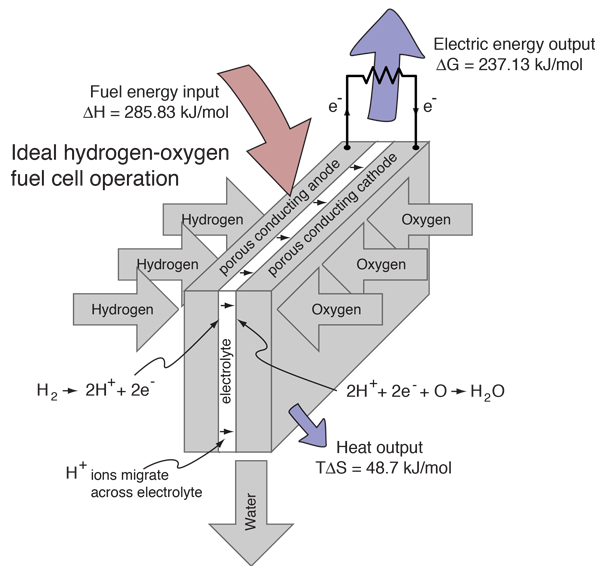
Combining a mole of hydrogen gas and a half-mole of oxygen gas from their normal diatomic forms produces a mole of water. A detailed analysis of the process makes use of the thermodynamic potentials. This process is presumed to be at 298K and one atmosphere pressure, and the relevant values are taken from a table of thermodynamic properties.
将一摩尔氢气和半摩尔氧气从其常态双原子形式结合,生成一摩尔水。对这一过程的详细分析需要用到热力学势。假设该过程在298K和一个大气压下进行,相关数值均取自热力学性质表。
| Quantity
量 | H2 | 0.5 O2 | H2O | Change
变化 |
| Enthalpy
焓 | 0 | 0 | -285.83 kJ
-285.83 kJ(专名或术语) | ΔH = -285.83 kJ
ΔH = -285.83 kJ(专名或术语) |
| Entropy
熵 | 130.68 J/K | 0.5 x 205.14 J/K | 69.91 J/K | TΔS = -48.7 kJ
TΔS = -48.7 kJ(专名或术语) |
Energy is provided by the combining of the atoms and from the decrease of the volume of the gases. Both of those are included in the change in enthalpy included in the table above. At temperature 298K and one atmosphere pressure, the system work is
能由原子的结合以及气体体积的减少提供。这两种情况都包含在上表中所列的焓变变化中。在298K和一个大气压下,系统的功是
W = PΔV = (101.3 x 10³ Pa)(1.5 moles)(-22.4 x 10⁻³ m3/mol)(298K/273K) = -3715 J
Since the enthalpy H= U+PV, the change in internal energy U is then
由于焓 H= U+PV,因此内能 U 的变化为
ΔU = ΔH - PΔV = -285.83 kJ - 3.72 kJ = -282.1 kJ
The entropy of the gases decreases by 48.7 kJ in the process of combination since the number of water molecules is less than the number of hydrogen and oxygen molecules combining. Since the total entropy will not decrease in the reaction, the excess entropy in the amount TΔS must be expelled to the environment as heat at temperature T. The amount of energy per mole of hydrogen which can be provided as electrical energy is the change in the Gibbs free energy:
气体的熵在结合过程中减少了48.7 kJ,因为水分子的数量少于结合的氢气和氧气分子的数量。由于反应的总熵不会减少,超出的熵TΔS必须以温度为T的热量排放到环境中。每摩尔氢气可以提供的电能是吉布斯自由能的变化:
ΔG = ΔH - TΔS = -285.83 kJ + 48.7 kJ = -237.1 kJ
For this ideal case, the fuel energy is converted to electrical energy at an efficiency of 237.1/285.8 x100% = 83%! This is far greater than the ideal efficiency of a generating facility which burned the hydrogen and used the heat to power a generator! Although real fuel cells do not approach that ideal efficiency, they are still much more efficient than any electric power plant which burns a fuel.
在这一理想情况下,燃料的能量以83%的效率转换为电能!这远高于发电设施的理想效率,该设施燃烧氢气并利用热量驱动发电机!尽管实际的燃料电池无法达到这一理想效率,但它们仍然比任何燃烧燃料的电力电站更加高效。
Comparison of electrolysis and the fuel cell process
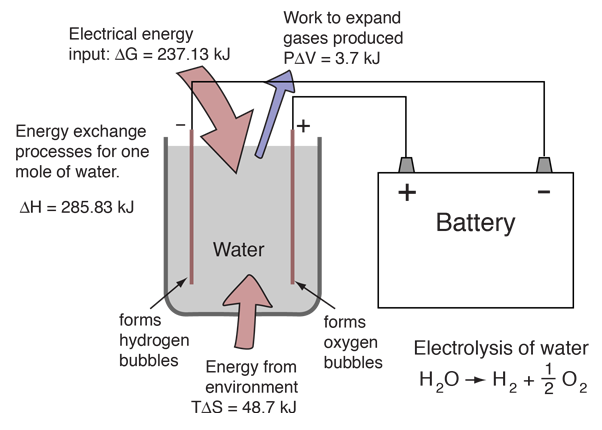
In comparing the fuel cell process to its reverse reaction, electrolysis of water, it is useful treat the enthalpy change as the overall energy change. The Gibbs free energy is that which you actually have to supply if you want to drive a reaction, or the amount that you can actually get out if the reaction is working for you. So in the electrolysis/fuel cell pair where the enthalpy change is 285.8 kJ, you have to put in 237 kJ of energy to drive electrolysis and the heat from the environment will contribute TΔS=48.7 kJ to help you. Going the other way in the fuel cell, you can get out the 237 kJ as electric energy, but have to dump TΔS = 48.7 kJ to the environment.
将燃料电池过程与其逆反应(水电解)进行比较时,将焓变视为总能量变化是有用的。吉布斯自由能是你如果想驱动反应必须提供的能量,或者当反应为你工作时你能实际获得的能量。因此,在电解/燃料电池配对中,当焓变为285.8 kJ时,你必须投入237 kJ的能量来驱动电解,而环境的热量会贡献TΔS=48.7 kJ来帮助你。在燃料电池方向,你可以将237 kJ作为电能输出,但必须将TΔS=48.7 kJ排放到环境中。
需要注意的是,当使用‘高效能源源’这一描述时,它仅仅指的是能量被应用于任务的相对效率,而不是它本身是该能量的最终来源。燃料电池并不产生能量,而是将氢气和氧气燃料中所含的能量转化为有用的电能输出。燃料电池的总体实用性取决于产生氢气和氧气燃料的效率。从其他更基础的能源获取氢气和氧气燃料,已成为限制燃料电池应用的瓶颈。如果太阳能或风能能够高效地用于电解水,燃料电池的实用性将得到提升。W = PΔV = (101.3 x 10 3 Pa)(1.5 moles)(-22.4 x 10 -3 m 3 /mol)(298K/273K) = -3715 J ΔU = ΔH - PΔV = -285.83 kJ - 3.72 kJ = -282.1 kJ ΔG = ΔH - TΔS = -285.83 kJ + 48.7 kJ = -237.1 kJ 电解与燃料电池过程的比较 |