Rods and Cones杆和锥
The retina contains two types of photoreceptors, rods and cones. The rods are more numerous, some 120 million, and are more sensitive than the cones. However, they are not sensitive to color. The 6 to 7 million cones provide the eye's color sensitivity and they are much more concentrated in the central yellow spot known as the macula. In the center of that region is the " fovea centralis ", a 0.3 mm diameter rod-free area with very thin, densely packed cones. 视网膜包含两种光感受器,即杆细胞和锥细胞。杆细胞更多,约有1200万,比锥细胞更敏感。然而,它们对颜色不敏感。约有600万到700万的锥细胞提供了眼睛的颜色敏感性,它们在中央黄斑区域更为集中。在该区域的中心是被称为“中央窝”的区域,其直径为0.3毫米,没有杆细胞,而充满非常密集的锥细胞。
The experimental evidence suggests that among the cones there are three different types of color reception. Response curves for the three types of cones have been determined. Since the perception of color depends on the firing of these three types of nerve cells, it follows that visible color can be mapped in terms of three numbers called tristimulus values. Color perception has been successfully modeled in terms of tristimulus values and mapped on the CIE chromaticity diagram. 实验证据表明,视锥细胞中存在三种不同的颜色感受类型。已确定了这三种视锥细胞的响应曲线。由于颜色感知依赖于这三种神经细胞的放电,因此可以将可见颜色用三个称为三刺激值的数字来表示。颜色感知已成功地基于三刺激值进行建模,并在CIE色度图上进行了映射。
|
Index Vision concepts Color vision concepts Reference Williamson & Cummins Ch 6,10 索引 视觉概念 色觉概念 参考 Williamson & Cummins 第6、10章 | |||
|
Go Back
返回 |
Rod and Cone Density on Retina视网膜上的视杆和视锥密度
Cones are concentrated in the fovea centralis. Rods are absent there but dense elsewhere. 锥细胞集中在中央窝,而杆细胞则 absent 在此区域,但在其他区域密集。
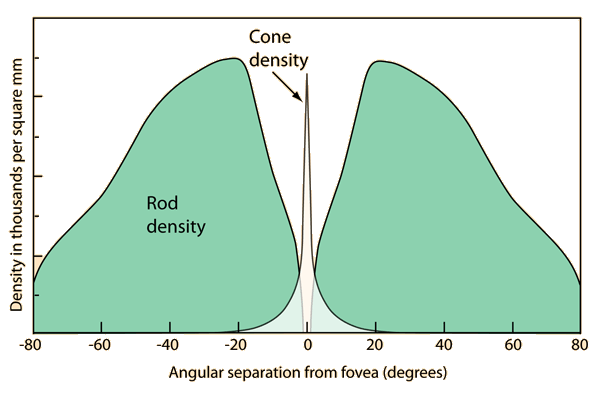
![]() Measured density curves for the rods and cones on the retina show an enormous density of cones in the fovea centralis. To them is attributed both color vision and the highest visual acuity. Visual examination of small detail involves focusing light from that detail onto the fovea centralis. On the other hand, the rods are absent from the fovea. At a few degrees away from it their density rises to a high value and spreads over a large area of the retina. These rods are responsible for night vision, our most sensitive motion detection, and our peripheral vision. 视网膜上视杆细胞和视锥细胞的密度测量曲线显示,视网膜中央窝区域视锥细胞密度极高。这些细胞负责颜色视觉和最高视觉敏锐度。要观察小细节,需要将该细节的光线聚焦到中央窝。另一方面,视杆细胞在中央窝区域不存在。在中央窝几度以外的区域,视杆细胞密度升高到较高值,并广泛分布于视网膜的广阔区域。这些视杆细胞负责夜视,我们的最敏感运动检测,以及我们的周边视觉。
The above illustration does make it appear that there are no cones outside the fovea centralis, but that is not true. The blue cones in particular do extend out beyond the fovea.
上述示意图似乎表明视网膜中央窝外没有锥细胞,但这并不正确。特别是蓝色锥细胞确实延伸到了中央窝之外。 Reference: 参考文献: Anatomical distribution of rods and cones 视网膜中视杆和视锥细胞的分布 Physiological principles for effective use of color 有效使用颜色的生理原理 杆和锥 |
Index Vision concepts References Williamson & Cummins 索引视觉概念 参考文献 Williamson & Cummins | ||
|
Go Back
返回 |
Cone Details圆锥详情
Current understanding is that the 6 to 7 million cones can be divided into "red" cones (64%), "green" cones (32%), and "blue" cones (2%) based on measured response curves. They provide the eye's color sensitivity. The green and red cones are concentrated in the fovea centralis . The "blue" cones have the highest sensitivity and are mostly found outside the fovea, leading to some distinctions in the eye's blue perception. 目前认为,约600万到700万种视锥细胞可以根据测量的响应曲线分为“红色”视锥细胞(64%)、“绿色”视锥细胞(32%)和“蓝色”视锥细胞(2%)。这些视锥细胞提供了眼睛的色觉灵敏度。红色和绿色视锥细胞集中在视盘中央区域。蓝色视锥细胞具有最高的灵敏度,主要分布在视盘以外的区域,导致了眼睛对蓝色的感知存在一些差异。
The cones are less sensitive to light than the rods, as shown a typical day-night comparison. The daylight vision (cone vision) adapts much more rapidly to changing light levels, adjusting to a change like coming indoors out of sunlight in a few seconds. Like all neurons, the cones fire to produce an electrical impulse on the nerve fiber and then must reset to fire again. The light adaption is thought to occur by adjusting this reset time. 视锥细胞对光的敏感性比视杆细胞低,如典型日间与夜间对比所示。日光视觉(视锥细胞视觉)适应变化的光强要快得多,例如从阳光中走进室内,几秒钟内就能适应变化。像所有神经元一样,视锥细胞在神经纤维上产生电信号后,必须重置才能再次放电。光适应被认为是由调整这个重置时间来实现的。
The cones are responsible for all high resolution vision. The eye moves continually to keep the light from the object of interest falling on the fovea centralis where the bulk of the cones reside. 锥细胞负责所有高分辨率视觉。眼睛不断移动,以使感兴趣的物体的光线落在中央窝,而该区域大部分都是锥细胞所在之处。
|
Index Vision concepts Reference Williamson & Cummins Ch 6,10 索引 视觉概念 参考 Williamson & Cummins 第6、10章 | ||
|
Go Back
返回 |
"Blue" Cone Distinctions蓝色锥体区别
The "blue" cones are identified by the peak of their light response curve at about 445 nm. They are unique among the cones in that they constitute only about 2% of the total number and are found outside the fovea centralis where the green and red cones are concentrated. Although they are much more light sensitive than the green and red cones, it is not enough to overcome their disadvantage in numbers. However, the blue sensitivity of our final visual perception is comparable to that of red and green, suggesting that there is a somewhat selective "blue amplifier" somewhere in the visual processing in the brain. 蓝色锥体的响应曲线在约445纳米处达到峰值,因此被识别出来。它们与其他锥体不同,因为它们仅占总数的约2%,且位于视网膜中央窝以外的区域,而绿色和红色锥体则集中在中央窝。尽管蓝色锥体比绿色和红色锥体更敏感,但这种敏感度不足以弥补数量上的劣势。然而,我们的最终视觉感知中的蓝色敏感度与红色和绿色相当,这表明大脑中的视觉处理中可能存在某种选择性的‘蓝色放大’机制。
The visual perception of intensely blue objects is less distinct than the perception of objects of red and green. This reduced acuity is attributed to two effects. First, the blue cones are outside the fovea, where the close-packed cones give the greatest resolution. All of our most distinct vision comes from focusing the light on the fovea. Second, the refractive index for blue light is enough different from red and green that when they are in focus, the blue is slightly out of focus (chromatic aberration). For an "off the wall" example of this defocusing effect on blue light, try viewing a hologram with a mercury vapor lamp. You will get three images with the dominant green, orange and blue lines of mercury, but the blue image looks less focused than the other two. intensely blue objects 的视觉感知比 red 和 green 对象的感知更不清晰。这种降低的清晰度归因于两个效应。首先,蓝锥体位于视网膜黄斑以外,而黄斑处密集排列的锥体提供了最高的分辨率。我们最清晰的视觉都来自将光线聚焦在黄斑上。其次,蓝光的折射率与红光和绿光足够不同,当它们聚焦时,蓝光略微处于模糊状态(色差)。对于蓝光这种模糊效应的一个“出格”例子,尝试用汞蒸气灯观看一个全息图。你将看到三个图像,主要由汞的绿色、橙色和蓝色谱线构成,但蓝色图像看起来比其他两个更不清晰。
|
Index Vision concepts Reference Williamson & Cummins Ch 6,10 索引 视觉概念 参考 Williamson & Cummins 第6、10章 | ||
|
Go Back
返回 |
Rod Details罗德详情
The rods are the most numerous of the photoreceptors, some 120 million, and are the more sensitive than the cones. However, they are not sensitive to color. They are responsible for our dark-adapted, or scotopic, vision. The rods are incredibly efficient photoreceptors. More than one thousand times as sensitive as the cones, they can reportedly be triggered by individual photons under optimal conditions. The optimum dark-adapted vision is obtained only after a considerable period of darkness, say 30 minutes or longer, because the rod adaption process is much slower than that of the cones. 杆细胞是光感受器中数量最多的类型,约有1.2亿个,它们比视锥细胞更敏感。然而,它们不敏感于颜色。它们负责我们暗适应,或视杆型的视觉。杆细胞是极其高效的光感受器。它们的敏感度比视锥细胞高一千多倍,在最佳条件下,据说可以被单个光子触发。只有在较长时间的黑暗适应后,才能获得最佳的暗适应视觉,例如30分钟或更长,因为杆细胞的适应过程比视锥细胞慢得多。
The rod sensitivity is shifted toward shorter wavelengths compared to daylight vision, accounting for the growing apparent brightness of green leaves in twilight. 与日光视觉相比,杆细胞的灵敏度偏向于较短的波长,这解释了黄昏时绿色叶子显得更加明亮的现象。
While the visual acuity or visual resolution is much better with the cones, the rods are better motion sensors. Since the rods predominate in the peripheral vision, that peripheral vision is more light sensitive, enabling you to see dimmer objects in your peripheral vision. If you see a dim star in your peripheral vision, it may disappear when you look at it directly since you are then moving the image onto the cone-rich fovea region which is less light sensitive. You can detect motion better with your peripheral vision, since it is primarily rod vision. 尽管视锥细胞在视觉敏锐度或视觉分辨率方面表现更好,但视杆细胞作为更好的运动传感器。由于视杆细胞在周边视觉中占主导地位,因此周边视觉更敏感于光线,使你能够在周边视觉中看到更暗的物体。如果你在周边视觉中看到一颗暗星,当你直接注视它时,它可能会消失,因为此时你将图像投射到了视杆细胞较少的视网膜中央窝区域,该区域对光线的敏感度较低。由于周边视觉主要依赖视杆细胞,因此你通过周边视觉能更好地感知运动。
The rods employ a sensitive photopigment called rhodopsin. 这些杆使用一种敏感的光色素称为视紫红质。
|
Index Vision concepts Reference Williamson & Cummins Ch 6,10 索引 视觉概念 参考 Williamson & Cummins 第6、10章 | ||
|
Go Back
返回 |
Rods Do Not See Red!杆子看不到红色!
The light response of the rods peaks sharply in the blue; they respond very little to red light. This leads to some interesting phenomena: 视杆细胞对蓝光的响应非常尖锐;它们对红光的响应非常有限。这导致了一些有趣的现象:
Red rose at twilight: In bright light, the color-sensitive cones are predominant and we see a brilliant red rose with somewhat more subdued green leaves. But at twilight, the less-sensitive cones begin to shut down for the night, and most of the vision comes from the rods. The rods pick up the green from the leaves much more strongly than the red from the petals, so the green leaves become brighter than the red petals! 暮色中的红玫瑰:在明亮的光线下,对颜色敏感的视锥细胞占主导地位,我们看到一朵鲜艳的红玫瑰,其略显暗淡的绿色叶子也显得清晰。但到了暮色,对颜色不那么敏感的视锥细胞开始关闭,大部分视觉来自视杆细胞。视杆细胞对叶子的绿色捕捉比对花瓣的红色要强得多,因此绿色的叶子比红色的花瓣更明亮!
The ship captain has red instrument lights. Since the rods do not respond to red, the captain can gain full dark-adapted vision with the rods with which to watch for icebergs and other obstacles outside. It would be undesirable to examine anything with white light even for a moment, because the attainment of optimum night-vision may take up to a half-hour. Red lights do not spoil it. 船长有红色的仪器灯。由于这些灯对红色不敏感,船长可以利用视杆细胞获得完全的暗适应视觉,以便在外面观察冰山和其他障碍物。即使是一瞬间使用白光来观察任何东西也是不希望的,因为达到最佳夜视能力可能需要长达半小时。红色灯光不会破坏这种效果。
These phenomena arise from the nature of the rod-dominated dark-adapted vision, called scotopic vision. 这些现象源于杆状细胞主导的暗适应视觉,称为视觉暗适应。
|
Index Vision concepts Reference Williamson & Cummins Ch 6,10 索引 视觉概念 参考 Williamson & Cummins 第6、10章 | ||
|
Go Back
返回 |