Traveling Wave Demonstrations
A slinky is a good tool for the demonstration of wave phenomena. Here it is used to show a pulse of a longitudinal wave. 弹力绳是演示波现象的良好工具。这里它被用来展示纵波的脉冲。 | 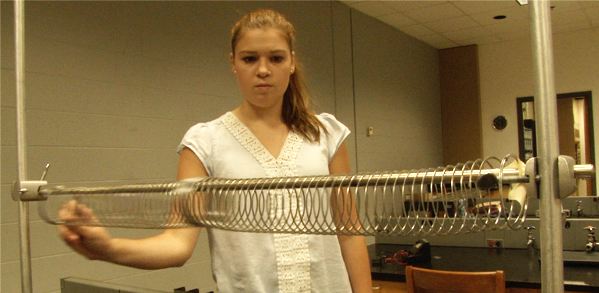 |
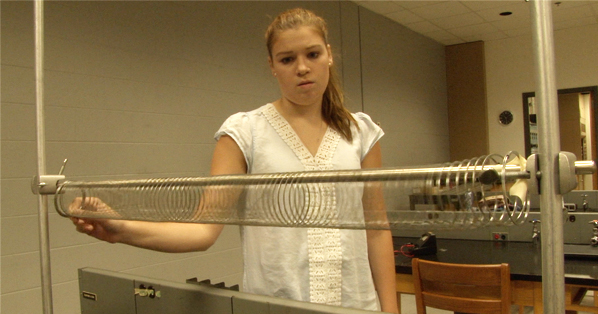 | The slinky with one end fixed can be used to show longitudinal standing waves analogous to those of a closed air column, demonstrating odd harmonics. 固定一端的弹簧可以用来展示类似于封闭空气柱的纵向驻波,展示奇数倍谐波。 |
With both ends free to move, the slinky can be used to show standing wave modes analogous to an open air column, like a flute. The fundamental mode has a node in the center, which can be seen clearly with the slinky. 当两端都可以移动时,弹簧可以用来展示类似于开放空气柱的驻波模式,就像笛子一样。基频模式在中心有一个节点,可以用弹簧清晰地观察到。 | 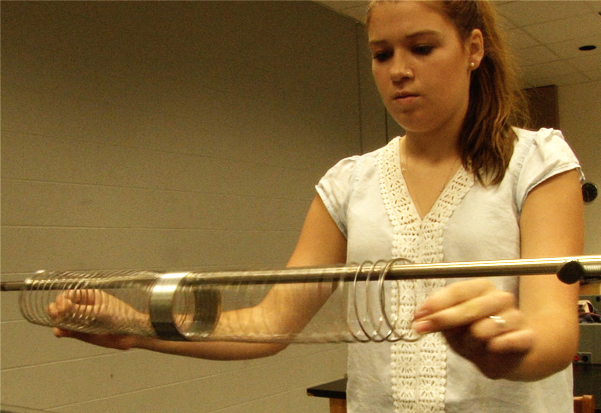 |
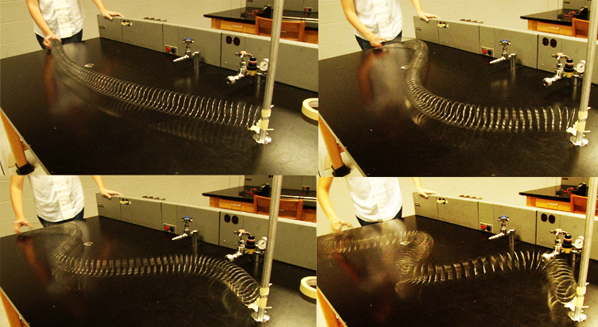 | If placed on a table with one end fixed, the slinky can also be used to demonstrate transverse waves and transverse standing waves, which can occur in all harmonics. The first four standing wave modes are shown. 如果将弹簧放在桌子上,一端固定,弹簧也可以用来演示横波和横驻波,这些驻波可以在所有谐波中出现。前四个驻波模式如图所示。 |
Another useful visualization with the slinky is the fact that a traveling wave will reverse in phase upon encountering a fixed end. An incoming right pulse will reflect as a left pulse (see another example). There are analogies with light and other waves upon encountering reflecting interfaces. 用弹簧的另一个有用可视化是,当波遇到固定端时,它会反转相位。一个向右的脉冲会反射为一个向左的脉冲(见另一个例子)。与光和其他波遇到反射界面时有类似的情况。 | 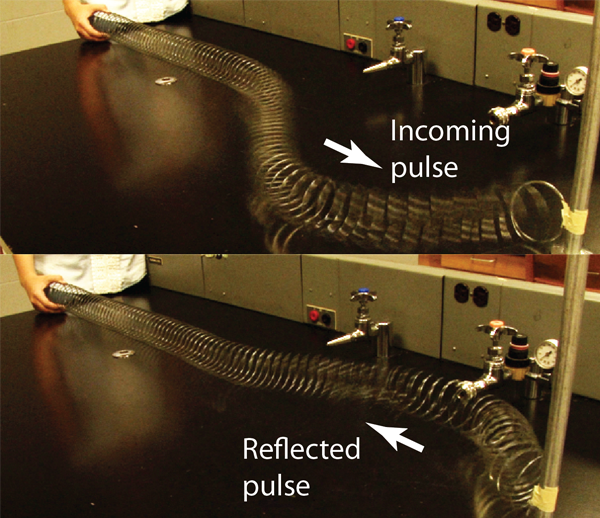 |
Wave concepts
| HyperPhysics***** Traveling Waves
HyperPhysics ***** 波的传播 | J Nave, R Nave
J Nave, R Nave(专名或术语) |