Phase Change Upon Reflection
反射时的相变
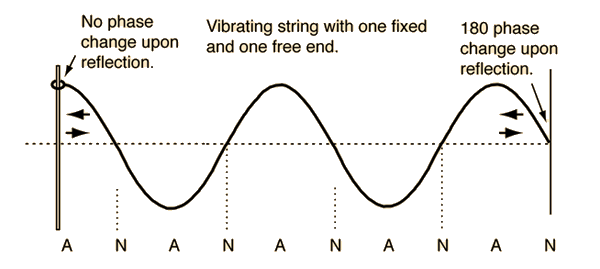
The phase of the reflected sound waves from hard surfaces and the reflection of string waves from their ends determines whether the interference of the reflected and incident waves will be constructive or destructive. For string waves at the ends of strings there is a reversal of phase and it plays an important role in producing resonance
in strings. Since the
reflected wave
and the incident
wave add to each
other while moving
in opposite
directions, the
appearance of propagation
is lost and the resulting
vibration is called a
standing wave.
反射声波从硬表面的相位以及弦波在弦端的反射相位决定了反射波与入射波干涉是建设性还是破坏性。对于弦波来说,在弦的端点处存在相位反转,这一点在产生弦的共振中起着重要作用。由于反射波和入射波在相反方向传播时相互叠加,传播现象消失,所形成的振动被称为驻波。
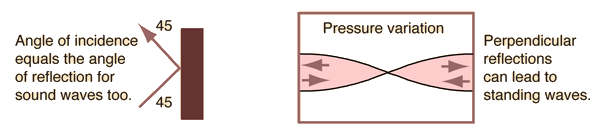
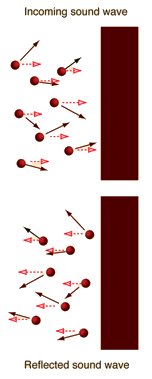
When sound waves in air (pressure waves) encounter a hard surface, there is no phase change upon reflection. That is, when the high pressure part of a sound wave hits the wall, it will be reflected as a high pressure, not a reversed phase which would be a low pressure. Keep in mind that when we talk about the pressure associated with a sound wave, a positive or "high" pressure is one that is above the ambient atmospheric pressure and a negative or "low" pressure is just one that is below atmospheric pressure. A wall is described as having a higher "acoustic impedance" than the air, and when a wave encounters a medium of higher acoustic impedance there is no phase change upon reflection.
当空气中的声波(压力波)遇到硬表面时,反射时不发生相位变化。也就是说,当声波的高压部分撞击墙壁时,它会被反射为高压,而不是反相的低压。请注意,当我们谈论声波相关的压力时,正的或‘高压’是指高于环境大气压的压强,而负的或‘低压’则只是指低于大气压的压强。墙壁的‘声阻抗’高于空气,当波遇到声阻抗更高的介质时,反射时不发生相位变化。
On the other hand, if a sound wave in a solid strikes an air boundary, the pressure wave which reflects back into the solid from the air boundary will experience a phase reversal - a high-pressure part reflecting as a low-pressure region. That is, reflections off a lower impedance medium will be reversed in phase.
另一方面,如果固体中的声波遇到空气边界,从空气边界反射回固体的声波将经历相位反转——高压部分反射为低压区域。也就是说,反射到低阻抗介质时,相位会反转。
Besides manifesting itself in the "pressure zone" in air near a hard surface, the nature of the reflections contribute to standing waves in rooms and in the air columns which make up musical instruments.
除了在靠近硬表面的空气中表现为“压力区”外,反射的性质还导致了房间和构成乐器的空气柱中的驻波。
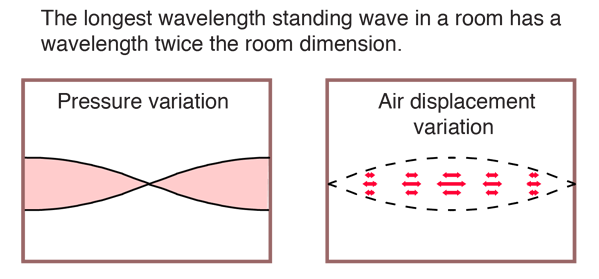
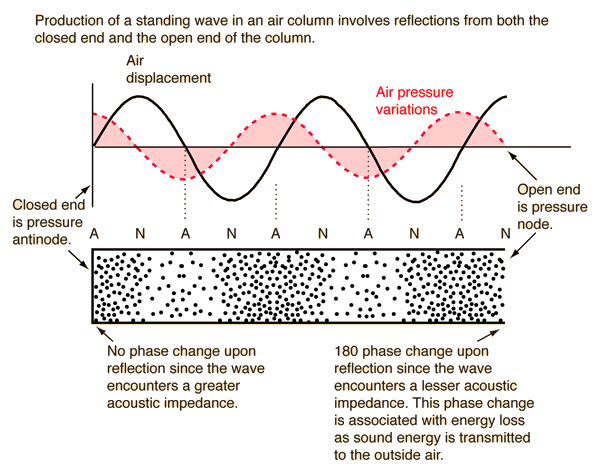
The conditions which lead to a phase change on one end but not the other can also be envisioned with a string if one presumes that the loose end of a string is constrained to move only transverse to the string. The loose end would represent an interface with a smaller effective impedance and would produce no phase change for the transverse wave. In many ways, the string and the air column are just the inverse of each other.
导致一端发生相位变化而另一端不发生相位变化的条件,也可以通过一根弦来想象。如果假设弦的自由端只能沿弦的方向横向移动,则自由端将代表一个有效阻抗较小的界面,并且对于横向波不会产生相位变化。在很多方面,弦和空气柱只是彼此的逆。
|