Bilingual edition: English is preserved and Chinese follows each unit. Terminology uses the confirmed v20260916 glossary; automated semantic review remains traceable.
中英双语版:英文原文完整保留,中文紧随对应单元;术语采用 v20260916 确认表,自动语义审校结果可追溯。

Dark Energy

暗能量

One of the observational foundations for the big bang model of cosmology was the observed expansion of the universe. Measurement of the expansion rate is a critical part of the study, and it has been found that the expansion rate is very nearly "flat". That is, the universe is very close to the critical density, above which it would slow down and collapse inward toward a future "big crunch". A big conceptual problem has been that we haven't been able to observe more than a fraction of that density in the form of ordinary matter. The WMAP projection of the ordinary baryonic matter is only 4.4% of critical density, and only 27% even when the projected "dark matter" is included. So we are left having to account for the remaining 73% of the effective density, and the name chosen is "dark energy".

宇宙膨胀的观测事实是大爆炸宇宙模型的一个基础依据。测量膨胀速率是研究的重要部分,发现膨胀速率几乎“平坦”。也就是说,宇宙非常接近临界密度,超过这一密度,宇宙将逐渐减速并最终向未来的“大挤压”坍缩。一个重要的概念问题在于,我们无法观测到普通物质所占的密度的大部分。WMAP对普通重子物质的测量仅占临界密度的4.4%,即使包括“暗物质”后,也仅占27%。因此,我们不得不解释剩余的73%的有效密度,这一部分被命名为“暗能量”。

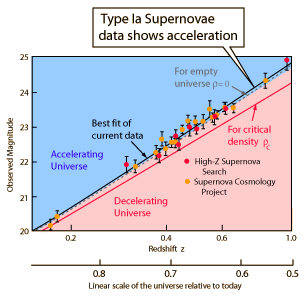
One of the great challenges of astronomy and astrophysics is distance measurement over the vast distances of the universe. Since the 1990s it has become apparent that type Ia supernovae offer a unique opportunity for the consistent measurement of distance out to perhaps 1000 Mpc. Measurement at these great distances provided the first data to suggest that the expansion rate of the universe is actually accelerating. That acceleration implies an energy density that acts in opposition to gravity which would cause the expansion to accelerate. This is an energy density which we have not directly detected observationally - hence "dark energy".

天体物理学的一大挑战是测量宇宙中巨大的距离。自20世纪90年代以来,人们逐渐认识到Ia型超新星提供了一个独特的机会,可以一致地测量出至可能1000 Mpc范围内的距离。在这些巨大距离上的测量提供了最初的数据,表明宇宙的膨胀率实际上在加速。这种加速意味着一种能量密度,它与重力作用相反,会导致膨胀加速。这种能量密度我们尚未直接观测到——因此称为暗能量。

If we take the WMAP value for critical density at
ρc,0 = 9.47 x 10⁻²⁷ kg/m3
and presume that dark energy makes up about 73% of that, then the effective density of the dark energy would amount to just over 4 hydrogen atoms (m = 1.67 x 10⁻²⁷ kg) in a cubic meter of space. If we take 5.9 x 10⁹ km as a mean radius of Pluto and calculate the volume of a sphere of that radius, then the dark energy in that sphere would be equivalent to just under 6 x 10¹² kg distributed throughout a space representing the solar system. The density of the asteroid Ida has been measured to be about 2.7 g/cm3. So all the dark energy in the solar system would amount to about 2.2 x 10⁹ m3 of the material of Ida, or a sphere of about 800 m radius. Ida has a tiny satellite or moon named Dactyl of dimensions 1.2 x 1.4 x 1.6km, so the mass of that tiniest of satellites is comparable to the dark energy in the entire solar system. Yet extended uniformly throughout the entire universe, this dark energy becomes the dominant influence on the expansion of the universe in this era.

如果我们采用WMAP给出的临界密度ρc,0 = 9.47 × 10⁻²⁷ kg/m³,并假设暗能量约占其73%,那么暗能量的有效密度将相当于每立方米空间中超过4个氢原子(m = 1.67 × 10⁻²⁷ kg)。如果取5.9 × 10⁹ km作为冥王星的平均半径,并计算该半径的球体体积,那么该球体内暗能量相当于分布在太阳系空间中的约6 × 10¹² kg。小行星伊达的密度已测得约为2.7 g/cm³。因此,太阳系内所有暗能量相当于约2.2 × 10⁹ m³的伊达物质,或一个半径约800米的球体。伊达有一个微小的卫星或月亮,名为达克利,其尺寸为1.2 × 1.4 × 1.6 km,因此该最小的卫星质量与整个太阳系内的暗能量相当。然而,如果在整个宇宙中均匀分布,这种暗能量将成为当前时代宇宙膨胀的主导因素。
Measurement of the redshift of distant type Ia supernovae is one of the types of evidence for and accelerated expansion of the universe and hence for dark energy.
测量遥远的Ia型超新星的红移是支持宇宙加速膨胀的证据之一,从而也是暗能量的证据。
The density parameter Ω
密度参数 Ω
Index

Reference
Carroll & Ostlie
Ch 29

Conselice
索引参考Carroll & Ostlie第29章Conselice
 
HyperPhysics***** Astrophysics
HyperPhysics ***** 天体物理学
R Nave
Go Back
返回