Energy in Radiation in the Early Universe早期宇宙中的辐射能量
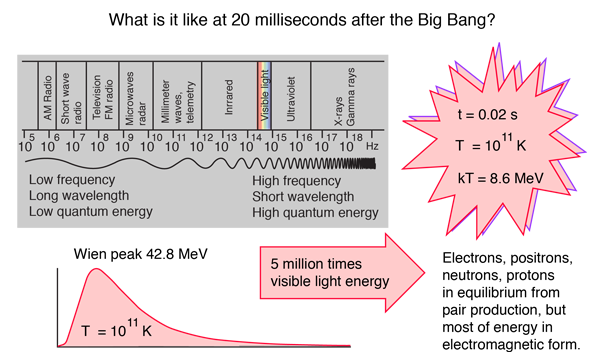
![]() Electromagnetic radiation and the flux of neutrinos were the dominant form of energy in the early universe, becoming more dominant as one models earlier times in the big bang. It is reminiscent of the Biblical phrase "Let there be light". But of course this is not visible light but far beyond gamma rays since the average photon energy increases as one models earlier times and photon energies become high enough to accomplish pair production of all known particles. For example at a temperature of 1011 K, modeled at a time of about 20 milliseconds into Weinberg's model of the big bang, the thermal energy kT = 8.6 MeV. At this temperature, the peak energy given by the Wien displacement law is 42.8 MeV. The radiation energy was sufficient not only for electron-positron pair production, but also to maintain essentially equal populations of protons and neutrons. So in that era, radiation was truly dominant. 在宇宙早期,电磁辐射和中微子通量是主要的能量形式,随着对大爆炸早期时间的建模,这种形式的能量变得更为主导。这让人联想到《圣经》中的短语“要有光”。但当然,这并不是可见光,而是远超伽马射线,因为随着对更早时期的时间建模,平均光子能量增加,光子能量变得足够高,能够实现所有已知粒子的对产生。例如,在温度为10¹¹ K时,对应于韦恩模型中大爆炸约20毫秒时,热能kT = 8.6 MeV。在这一温度下,根据维恩位移定律给出的峰值能量为42.8 MeV。此时,辐射能量不仅足以产生电子-正电子对,还能维持质子和中子的几乎相等数量。因此,在那个时代,辐射确实是主导的能量形式。
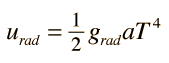
The radiation energy density in astronomy texts is usually put in the form ![]() ![]() For consistency with other particle quantities that are expressed in terms of the number of degrees of freedom, this is sometimes written in the form ![]() 为与以自由度数目表达的其他粒子量一致,这种形式有时也写成:光子的‘g因子’为g_rad = 2,这是与光子相关的有效自由度数目:其极化可以与运动方向平行或反平行。这种记法便于将其与中微子能量密度结合,以描述相对论粒子对宇宙能量密度的贡献。
To assess the role of radiation in the expansion of the early universe, one must take a step beyond the simple Newtonian expansion model and include the radiation pressure. When the radiation pressure is included, the effective density represented by the radiation as a function of the scale factor R is 要评估辐射在早期宇宙膨胀中的作用,必须超越简单的牛顿膨胀模型,纳入辐射压。当纳入辐射压时,辐射所表示的有效密度作为尺度因子R的函数为
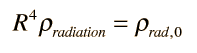
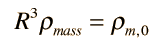
![]() The dependence on the fourth power of R distinguishes the radiation energy density from the mass density, which depends upon the third power of R, ![]() 对R的四次方的依赖性使辐射能量密度区别于质量密度,后者依赖于R的三次方,这意味着质量与辐射能量密度的平衡随宇宙的膨胀而变化,从而从辐射主导时期过渡到质量主导时期。
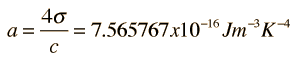
天文学文献中通常将辐射能量密度表示为一种形式,其中a被称为辐射常数,并具有值 |
Index Reference Carroll & Ostlie Ch 29 索引参考Carroll & Ostlie第29章 | ||
|
Go Back
返回 |
Neutrinos in the Early Universe早期宇宙中的中微子
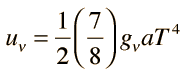
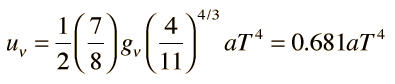
Neutrinos joined Electromagnetic radiation as the dominant form of energy in the early universe, becoming more dominant as one models earlier times in the big bang. To assess the energy density in neutrinos, it would be helpful to place it in a form similar to the energy density in radiation, ![]() Applying all the statistical factors gives a neutrino energy density expression ![]() 应用所有统计因子后,得到一个中微子能量密度表达式,其中g ν = 6,对应3种中微子及其反粒子,而7/8的倍数则源于它们是费米子而非玻色子。每种6种粒子仅有一个自旋态。
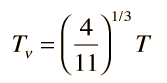
Another difference for the neutrinos is the fact that their effective temperature at the present time is different from the 2.725K of the cosmic microwave background. Analysis of the neutrino temperature leads to the prediction that the neutrino temperature is
![]() 中微子的另一个差异在于,它们当前的有效温度与宇宙微波背景辐射的2.725K不同。分析中微子温度得出的预测表明,中微子温度为1.9 K。当用电磁辐射温度来表述时,中微子的能量表达式则变为。尽管由于中微子探测的困难,我们尚未能够检测到宇宙中微子背景,但我们确信它存在,其能量密度的预测约为宇宙微波背景辐射的68%。
中微子与电磁辐射一同成为早期宇宙中占主导地位的能量形式,随着对大爆炸早期时间的建模,中微子的主导地位愈加明显。为了评估中微子的能量密度,将其与辐射的能量密度形式相类似会有所帮助,但这需要一些分析。一方面,中微子是费米子,而光子是玻色子,因此中微子遵循费米-狄拉克统计,而光子则服从玻色-爱因斯坦统计。此外,还有三种中微子,即电子中微子、缪子中微子和tau中微子,每种中微子都对应一种反中微子。人们或许会预期有两种自旋态,但中微子的一个奇特之处是它们的“手性”——它们都是“左旋”的,并且局限于一种自旋态。 |
Index Reference Carroll & Ostlie Ch 29 索引参考Carroll & Ostlie第29章 | |||||
|
Go Back
返回 |
Relativistic Particle Density ΩRel相对论粒子密度 Ω Rel
Neutrinos joined Electromagnetic radiation as the dominant form of energy in the early universe, becoming more dominant as one models earlier times in the big bang. In characterizing the effective density of the present universe, the mass of the neutrinos is generally neglected, and they are combined with photons as the effective density of the relativistic particles. 中微子与电磁辐射一起成为早期宇宙中占主导地位的能量形式,并且随着对大爆炸早期时期的建模,其主导地位进一步增强。在描述当前宇宙的有效密度时,中微子的质量通常被忽略,它们与光子一起作为相对论粒子的有效密度。
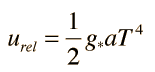
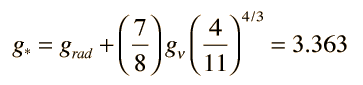
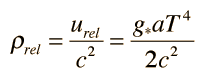
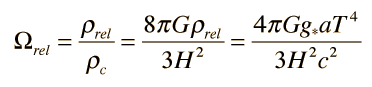
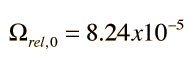
The combination of the radiation energy density ![]() ![]() ![]() ![]() ![]() ![]() ![]()
辐射能量密度与中微子能量密度的结合给出了相对论粒子的总能量,可以写成其中。我们现在可以为相对论粒子的总有效密度给出一个值,并通过除以临界密度来获得相对论粒子的密度参数Ω rel。这表明,在当前宇宙时代,相对论粒子中的能量密度远小于由WMAP得到的物质密度0.27。 |
Index Reference Carroll & Ostlie Ch 29 索引参考Carroll & Ostlie第29章 | ||
|
Go Back
返回 |