The Cori Cycle
The Cori cycle refers to the process of transporting lactate from cells that are undergoing anaerobic metabolism to the liver where it is used to provide glucose back to the cells. It is an example of one of the critical roles of the liver in assuring an adequate supply of glucose in the body. It is named after Carl Ferdinand Cori and Gerty Cori who received the 1947 Nobel Prize for their discovery of the pathway for the catalytic conversion of glycogen. The illustration below is patterned after Matthews, et al.
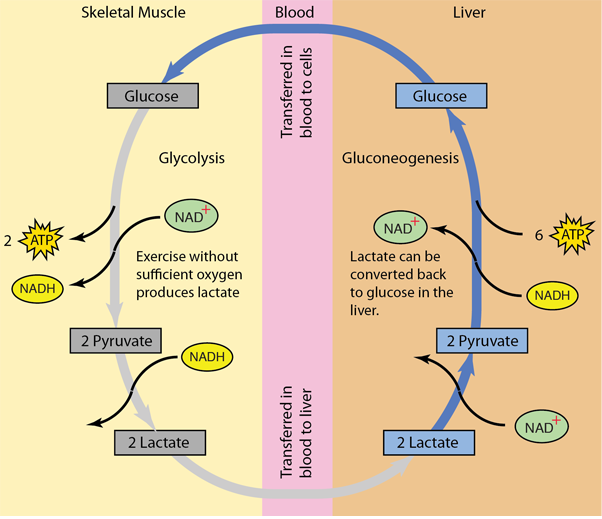
When exercising, the skeletal muscles require glucose for energy. If the cells have sufficient oxygen, the process of glycolysis will produce pyruvate and proceed through the TCA cycle and the electron transport process to produce the needed energy currency in the form of ATP. If the oxygen supply is insufficient, the pyruvate can continue through the process of fermentation, producing lactate and ethyl alcohol plus NAD+ to replenish the necessary supply of NAD+ for continuing glycolysis. During intense exertion, glycogen stores in the muscle stores are mobilized and used to produce pyruvate, and if the oxygen supply is low, this contributes further to the production of lactate in the cells.
The lactate cannot be used by the cell and is transported out of the cell into the bloodstream, and a portion of it reaches the liver where it can undergo gluconeogenesis to produce glucose to transport back to the cells.
Note that the process of producing glucose in the liver requires 6 ATPs, whereas the return through glycolysis to lactate produces only 2 ATPs, so it is an inefficient process for producing useful energy in the cell. The process does highlight the liver's role of providing energy backup for cellular processes when needed, even though it is costly in energy.
Reference
Audesirk & Audesirk
Ch 29
Thibodeau & Patton
Ch2,4, 25, 27
Matthews, van Holde, & Ahern
Ch 16
| HyperPhysics***** Biology
HyperPhysics ***** 生物学 | R Nave |