Bilingual edition: English is preserved and Chinese follows each unit. Terminology uses the confirmed v20260916 glossary; automated semantic review remains traceable.
中英双语版:英文原文完整保留,中文紧随对应单元;术语采用 v20260916 确认表,自动语义审校结果可追溯。

Loudness

响度

Loudness is not simply sound intensity!

响度并不是简单的声强!

Sound loudness is a subjective term describing the strength of the ear's perception of a sound. It is intimately related to sound intensity but can by no means be considered identical to intensity. The sound intensity must be factored by the ear's sensitivity to the particular frequencies contained in the sound. This is the kind of information contained in equal loudness curves for the human ear. It must also be considered that the ear's response to increasing sound intensity is a "power of ten" or logarithmic relationship. This is one of the motivations for using the decibel scale to measure sound intensity. A general "rule of thumb" for loudness is that the power must be increased by about a factor of ten to sound twice as loud. To more realistically assess sound loudness, the ear's sensitivity curves are factored in to produce a phon scale for loudness. The factor of ten rule of thumb can then be used to produce the sone scale of loudness. In practical sound level measurement, filter contours such as the A, B, and C contours are used to make the measuring instrument more nearly approximate the ear.
声音的响度是一个描述人耳对声音感知强度的主观术语。它与声音的强度密切相关,但绝不能等同于强度。声音的强度必须考虑人耳对其中所含特定频率的灵敏度。这种信息包含在人类耳朵的等响曲线中。还必须考虑到人耳对增加的声音强度的反应是一种“十的幂”或对数关系。这正是使用分贝尺度来测量声音强度的一个动机。对于响度的一个一般“经验法则”是,要使声音听起来大两倍,功率必须增加约十倍。为了更真实地评估声音的响度,将人耳的灵敏度曲线纳入考虑,从而产生一个响度的phon尺度。然后可以使用十倍法则来产生响度的sone尺度。在实际的声音强度测量中,如A、B和C轮廓的滤波器被用来使测量仪器更接近模拟人耳。

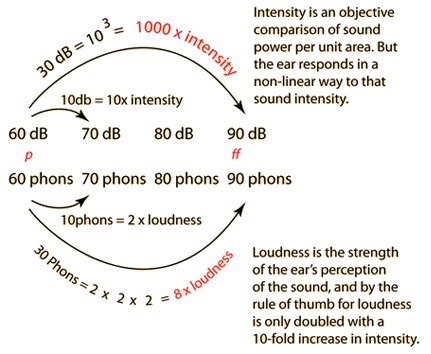
Since "loudness" is a subjective measurement of perception, one must be careful about how much accuracy you attribute to it. But though ff is much louder than p in dynamic level, it is not 1000x louder, so one must attempt to develop a scale of loudness that comes closer to mapping your ear's perception. The "rule of thumb" for loudness is one way to attempt that.

由于‘响度’是主观的感知测量,因此必须谨慎地确定你对其准确性的归因。尽管ff在动态电平上比p大很多,但它并不比p大1000倍,因此必须尝试开发一个更接近映射你耳朵感知的响度刻度。‘经验法则’就是尝试做到这一点的一种方式。
Index

Loudness concepts

Hearing concepts
索引 响度概念 听觉概念
 
HyperPhysics***** Sound
HyperPhysics ***** 声音
R Nave
Go Back
返回


"Rule of Thumb" for Loudness

响度的粗略规则

A widely used "rule of thumb" for the loudness of a particular sound is that the sound must be increased in intensity by a factor of ten for the sound to be perceived as twice as loud. A common way of stating it is that it takes 10 violins to sound twice as loud as one violin. Another way to state the rule is to say that the loudness doubles for every 10 phon increase in the sound loudness level. Although this rule is widely used, it must be emphasized that it is an approximate general statement based upon a great deal of investigation of average human hearing but it is not to be taken as a hard and fast rule.

一个广泛使用的“经验法则”是,要使某种声音被感知为两倍响度,其强度必须增加十倍。一种常见的表述方式是,十把小提琴的声音相当于一把小提琴的两倍响度。另一种表述方式是,每增加10 phon,声音的响度就会翻倍。尽管这个规则被广泛使用,但必须强调,它是一个基于大量对平均人类听觉研究的近似通用陈述,但它不应被视为一条绝对不变的规则。

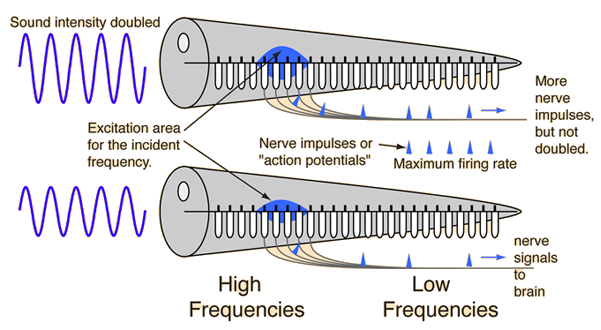
Why is it that doubling the sound intensity to the ear does not produce a dramatic increase in loudness? We cannot give answers with complete confidence, but it appears that there are saturation effects. Nerve cells have maximum rates at which they can fire, and it appears that doubling the sound energy to the sensitive inner ear does not double the strength of the nerve signal to the brain. This is just a model, but it seems to correlate with the general observations which suggest that something like ten times the intensity is required to double the signal from the inner ear.

为什么将声音的强度加倍到耳朵中并不会产生显著的响度增加?我们无法给出完全确定的答案,但似乎存在饱和效应。神经元有其最大放电速率,似乎将声音的能量加倍到敏感的内耳也不会使神经信号到大脑的强度加倍。这只是一个模型,但它似乎与一般观察结果相吻合,这些结果表明,大约需要十倍的强度才能使内耳的信号加倍。

One difficulty with this "rule of thumb" for loudness is that it is applicable only to adding loudness for identical sounds. If a second sound is widely enough separated in frequency to be outside the critical band of the first, then this rule does not apply at all.

这种‘经验法则’在响度叠加方面存在一个困难,即它仅适用于相同频率的声音。如果第二个声音的频率与第一个声音相差很大,位于其临界带之外,那么这一规则根本不适用。

While not a precise rule even for the increase of the same sound, the rule has considerable utility along with the just noticeable difference in sound intensity when judging the significance of changes in sound level.

尽管即使对于相同声音的增加,这也不是一个精确的规则,但该规则在判断声音强度变化的显著性时,与可察觉差异相结合,具有相当的实用性。
Adding loudness at different frequencies
不同频率下的响度叠加
Index

Loudness concepts

Hearing concepts
索引 响度概念 听觉概念
 
HyperPhysics***** Sound
HyperPhysics ***** 声音
R Nave
Go Back
返回


Adding Loudness

添加响度

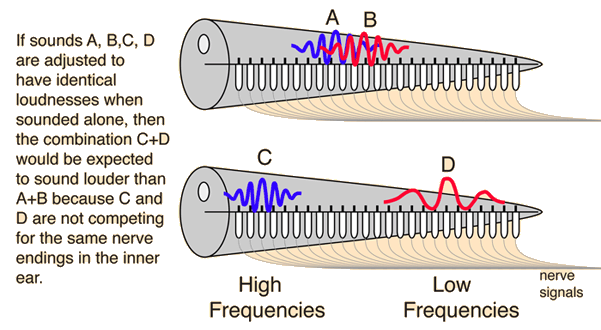
When one sound is produced and another sound is added, the increase in loudness perceived depends upon its frequency relative to the first sound. Insight into this process can be obtained from the place theory of pitch perception. If the second sound is widely separated in pitch from the first, then they do not compete for the same nerve endings on the basilar membrane of the inner ear. Adding a second sound of equal loudness yields a total sound about twice as loud. But if the two sounds are close together in frequency, within a critical band, then the saturation effects in the organ of Corti are such that the perceived combined loudness is only slightly greater than either sound alone. This is the condition which leads to the commonly used rule of thumb for loudness addition.

当一种声音产生并另一种声音叠加时,感知到的响度增加取决于其频率相对于第一种声音的位置。通过听觉皮层理论可以理解这一过程。如果第二种声音的音调与第一种声音相差很大,那么它们不会竞争内耳基底膜上的同一组神经末梢。添加一个与原声同样响度的第二种声音,会使总响度大约增加一倍。但如果两种声音的频率接近,处于一个临界带上,那么柯蒂器的饱和效应使得感知到的总响度仅略高于单独的声音。这种条件导致了用于响度叠加的常用经验法则。
Index

Loudness concepts

Hearing concepts
索引 响度概念 听觉概念
 
HyperPhysics***** Sound
HyperPhysics ***** 声音
R Nave
Go Back
返回


Critical Band

临界带

When two sounds of equal loudness when sounded separately are close together in pitch, their combined loudness when sounded together will be only slightly louder than one of them alone. They may be said to be in the same critical band where they are competing for the same nerve endings on the basilar membrane of the inner ear. According the the place theory of pitch perception, sounds of a given frequency will excite the nerve cells of the organ of Corti only at a specific place. The available receptors show saturation effects which lead to the general rule of thumb for loudness by limiting the increase in neural response.

当两个单独发声时响度相等的声音在音调上接近时,它们同时发声时的总响度仅比单独一个稍大。它们可以被认为在同一临界带上,它们在内耳基底膜上的神经末梢上竞争。根据位置理论,特定频率的声音只会激发耳蜗器官中的神经细胞在特定位置。可用的受体显示出饱和效应,这导致了响度的一般经验规则,即通过限制神经响应的增加来限制响度的增加。

If the two sounds are widely separated in pitch, the perceived loudness of the combined tones will be considerably greater because they do not overlap on the basilar membrane and compete for the same hair cells. The phenomenon of the critical band has been widely investigated.

如果两个声音在音调上相差很大,合并后的声音的感知响度将显著增大,因为它们在基底膜上不重叠,不会竞争同一根毛细胞。临界带现象已被广泛研究。

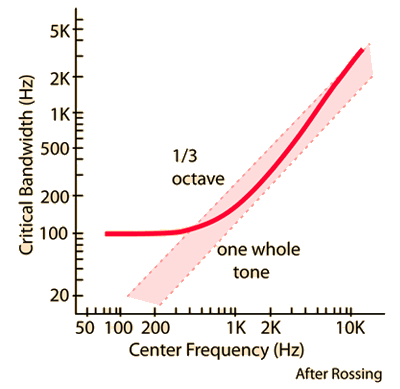
Backus reports that this critical band is about 90 Hz wide for sounds below 200 Hz and increases to about 900 Hz for frequencies around 5000 Hertz. It is suggested that this corresponds to a roughly constant length on the basilar membrane of length about 1.2 mm and involving some 1300 hair cells. If the tones are far apart in frequency (not within a critical band), the combined sound may be perceived as twice as loud as one alone.

Backus指出,对于低于200 Hz的声音,这个临界带宽约为90 Hz,当频率接近5000赫兹时,这个带宽增加到约900 Hz。建议这对应于基底膜上约1.2毫米的长度,涉及约1300根毛细胞。如果频率相差很大(不在同一个临界带内),则复合声音可能被感知为单独一个声音的两倍响度。
Illustration of critical band
临界带示意图
Index

Hearing concepts

References
Rossing, Science of Sound

Backus

Zwicker, et al.
索引听力概念参考 Rossing, Science of Sound Backus Zwicker, et al.
 
HyperPhysics***** Sound
HyperPhysics ***** 声音
R Nave
Go Back
返回


Critical Band Measurement

临界带测量

For low frequencies the critical band is about 90 Hz wide. For higher frequencies, it is between a whole tone and 1/3 octave wide.

在低频时,临界带宽约为90赫兹。在高频时,它介于一个全音和1/3倍频程之间。
Center
Freq (Hz)
中心频率 (Hz)
Critical
bandwidth (Hz)
临界带宽 (Hz)
100
90
200
90
500
110
1000
150
2000
280
5000
700
10000
1200
Rossing 2nd Ed p74
Rossing 第二版第74页
Index

Hearing concepts

Reference
Rossing, Science of Sound
索引听力概念参考Rossing,声音科学
 
HyperPhysics***** Sound
HyperPhysics ***** 声音
R Nave
Go Back
返回