Bilingual edition: English is preserved and Chinese follows each unit. Terminology uses the confirmed v20260916 glossary; automated semantic review remains traceable.
中英双语版:英文原文完整保留,中文紧随对应单元;术语采用 v20260916 确认表,自动语义审校结果可追溯。

Fast Breeder Reactors

快中子堆

Under appropriate operating conditions, the neutrons given off by fission reactions can "breed" more fuel from otherwise non-fissionable isotopes. The most common breeding reaction is that of plutonium-239 from non-fissionable uranium-238. The term "fast breeder" refers to the types of configurations which can actually produce more fissionable fuel than they use, such as the LMFBR. This scenario is possible because the non-fissionable uranium-238 is 140 times more abundant than the fissionable U-235 and can be efficiently converted into Pu-239 by the neutrons from a fission chain reaction.
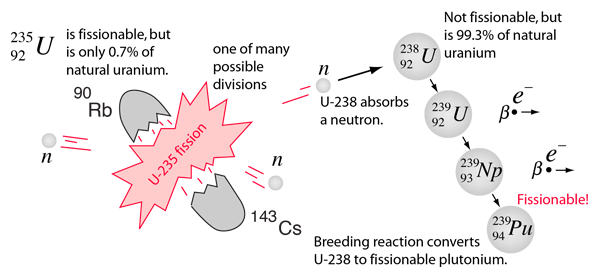
在适当的运行条件下,裂变反应释放的中子可以‘培育’出原本无法裂变的同位素的燃料。最常见的培育反应是将非裂变的铀-238转化为 plutonium-239。‘快堆’这一术语指的是能够实际产生比其消耗的裂变燃料更多的燃料的配置,例如液态金属钠冷却堆(LMFBR)。这种情形之所以可能,是因为非裂变的铀-238比裂变的U-235丰富140倍,并且可以通过裂变链式反应释放的中子高效地转化为Pu-239。

France has made the largest implementation of breeder reactors with its large Super-Phenix reactor and an intermediate scale reactor (BN-600) on the Caspian Sea for electric power and desalinization.

法国在电功率和海水淡化方面,实现了最大的快堆应用,其大型超菲尼克斯反应堆和位于里海的中等规模反应堆(BN-600)均为此作出了贡献。
Index
索引
 
HyperPhysics***** Nuclear
HyperPhysics ***** 核物理
R Nave
Go Back
返回


Breeding Plutonium-239

培育钚-239

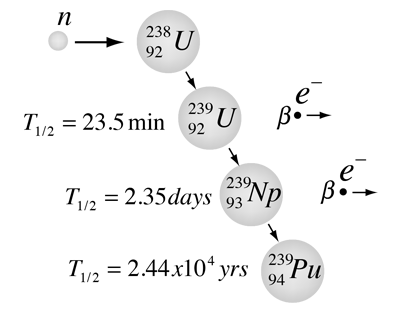
Fissionable plutonium-239 can be produced from non-fissionable uranium-238 by the reaction illustrated.

图中所示的反应可以将非裂变的铀-238转化为裂变的钚-239。

The bombardment of uranium-238 with neutrons triggers two successive beta decays with the production of plutonium. The amount of plutonium produced depends on the breeding ratio.

用中子轰击铀-238会引发两次连续的β衰变,产生钚。产生的钚量取决于增殖比。
Index

Fission concepts
索引 裂变概念
 
HyperPhysics***** Nuclear
HyperPhysics ***** 核物理
R Nave
Go Back
返回


Plutonium Breeding Ratio

钚增殖比

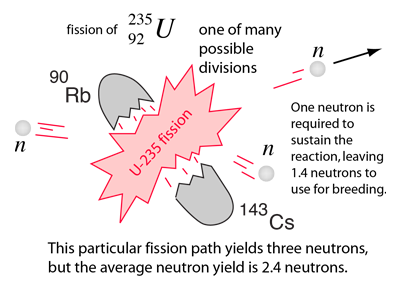
In the breeding of plutonium fuel in breeder reactors, an important concept is the breeding ratio, the amount of fissile plutonium-239 produced compared to the amount of fissionable fuel (like U-235) used to produced it. In the liquid-metal, fast-breeder reactor (LMFBR), the target breeding ratio is 1.4 but the results achieved have been about 1.2 . This is based on 2.4 neutrons produced per U-235 fission, with one neutron used to sustain the reaction.

在增殖反应堆中生产钚燃料时,一个重要概念是增殖比,即产生的可裂变钚-239量与用来产生它的可裂变燃料(如铀-235)量的比值。在液态金属快堆(LMFBR)中,目标增殖比为1.4,但实际结果约为1.2。这基于每次铀-235裂变产生2.4个中子,其中1个中子用于维持反应。

The time required for a breeder reactor to produce enough material to fuel a second reactor is called its doubling time, and present design plans target about ten years as a doubling time. A reactor could use the heat of the reaction to produce energy for 10 years, and at the end of that time have enough fuel to fuel another reactor for 10 years.

增殖反应堆产生足够材料以燃料另一个反应堆所需的时间称为其倍增时间,当前设计计划将倍增时间定为大约十年。一个反应堆可以利用反应产生的热量为10年提供能量,并在10年后拥有足够燃料为另一个反应堆提供10年的能量。
Index

Fission concepts
索引 裂变概念
 
HyperPhysics***** Nuclear
HyperPhysics ***** 核物理
R Nave
Go Back
返回


Liquid-Metal, Fast-Breeder Reactor

液态金属快中子增殖反应堆

The plutonium-239 breeder reactor is commonly called a fast breeder reactor, and the cooling and heat transfer is done by a liquid metal. The metals which can accomplish this are sodium and lithium, with sodium being the most abundant and most commonly used. The construction of the fast breeder requires a higher enrichment of U-235 than a light-water reactor, typically 15 to 30%. The reactor fuel is surrounded by a "blanket" of non-fissionable U-238. No moderator is used in the breeder reactor since fast neutrons are more efficient in transmuting U-238 to Pu-239. At this concentration of U-235, the cross-section for fission with fast neutrons is sufficient to sustain the chain-reaction. Using water as coolant would slow down the neutrons, but the use of liquid sodium avoids that moderation and provides a very efficient heat transfer medium.

钚-239增殖反应堆通常称为快增殖反应堆,其冷却和传热由液态金属完成。能够完成这一功能的金属有钠和锂,其中钠最为丰富且最常用。建造快增殖反应堆需要比轻水堆更高的铀-235富集度,通常为15%至30%。反应堆燃料周围设有由非裂变的铀-238组成的‘包层’。快增殖反应堆中不使用慢化剂,因为快中子更有效于将铀-238转化为钚-239。在这样的铀-235浓度下,快中子引发裂变的截面足够维持链式反应。若使用水作为冷却剂会减慢中子,但使用液态钠则避免了这种慢化作用,提供了非常高效的传热介质。

Illustration
示例
Cool with liquid sodium? Isn't that stuff dangerous?
液钠真的不危险吗?
Index

Fission concepts
索引 裂变概念
 
HyperPhysics***** Nuclear
HyperPhysics ***** 核物理
R Nave
Go Back
返回


Liquid Sodium Coolant

液钠冷却剂

Liquid sodium is used as the coolant and heat-transfer medium in the LMFBR reactor. That immediately raised the question of safety since sodium metal is an extremely reactive chemical and burns on contact with air or water (sometimes explosively on contact with water). It is true that the liquid sodium must be protected from contact with air or water at all times, kept in a sealed system. However, it has been found that the safety issues are not significantly greater than those with high-pressure water and steam in the light-water reactors.

液钠被用作快中子堆(LMFBR)反应堆中的冷却剂和传热介质。这立即引发了安全性的担忧,因为钠金属是一种高度反应性的化学物质,接触空气或水时会燃烧(有时甚至会爆炸)。确实,液钠必须始终避免与空气或水接触,保持在密封系统中。然而,发现其安全性问题并不比轻水反应堆中的高压水和蒸汽显著更高。

Sodium is a solid at room temperature but liquifies at 98°C. It has a wide working temperature since it does not boil until 892°C. That brackets the range of operating temperatures for the reactor so that it does not need to be pressurized as does a water-steam coolant system. It has a large specific heat so that it is an efficient heat-transfer fluid.

钠在常温下是固体,但98°C时会液化。它有较宽的工作温度范围,因为其沸点高达892°C。这涵盖了反应堆的运行温度范围,因此不需要像水-蒸汽冷却系统那样被加压。它具有较大的比热容,因此是一种高效的传热流体。

In practice, those reactors which have used liquid metal coolants have been fast-neutron reactors. The liquid metal coolant has a major advantage there because water as a coolant also moderates or slows down the neutrons. Such fast-neutron reactors require a higher degree of enrichment of the uranium fuel than do the water moderated reactors.

实际上,使用液态金属冷却剂的反应堆大多是快中子反应堆。液态金属冷却剂在此处具有重大优势,因为水作为冷却剂也会使中子减速或慢化。这类快中子反应堆需要比水慢化反应堆更高的铀燃料富集度。
Properties of liquid sodium
液态钠的性质

References:
Wiki:Liquid-metal cooled reactors

参考文献:Wiki: 液态金属冷却反应堆
Index

Fission concepts
索引 裂变概念
 
HyperPhysics***** Nuclear
HyperPhysics ***** 核物理
R Nave
Go Back
返回


The Super-Phenix

超现象

The Super-Phenix was the first large-scale breeder reactor. It was put into service in France in 1984. It ceased operation as a commercial power plant in 1997.

超级菲尼克斯是第一个大型增殖反应堆。它于1984年在法国投入运行。作为商业发电厂,它于1997年停止运行。

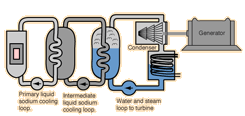
The reactor core consists of thousands of stainless steel tubes containing a mixture of uranium and plutonium oxides, about 15-20% fissionable plutonium-239. Surrounding the core is a region called the breeder blanket consisting of tubes filled only with uranium oxide. The entire assembly is about 3x5 meters and is supported in a reactor vessel in molten sodium. The energy from the nuclear fission heats the sodium to about 500°C and it transfers that energy to a second sodium loop which in turn heats water to produce steam for electricity production.

反应堆核心由数千个不锈钢管组成,这些管中包含铀和钚的氧化物混合物,其中约15-20%是可裂变的钚-239。核心周围是一个称为增殖层的区域,该区域由仅填充铀氧化物的管组成。整个装置大约为3x5米,并支撑在熔融的钠中。核裂变产生的能量将钠加热至约500°C,并将该能量传递给第二个钠循环,后者加热水产生蒸汽以用于发电。

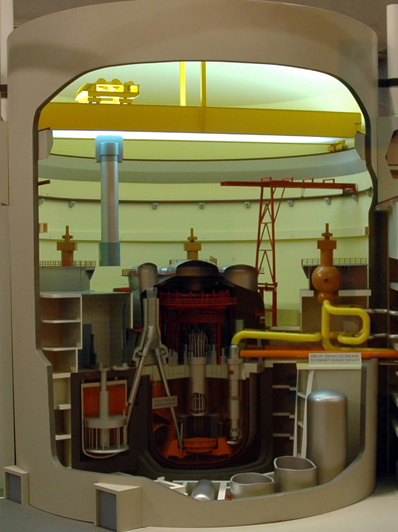
This is a photo of a model of the containment vessel of the Super-Phenix. It is displayed at the National Museum of Nuclear Science and Technology in Albuquerque, NM.

这是一张超级菲涅斯反应堆 containment 容器的模型照片。该照片在新墨西哥州阿尔伯克基的国家核科学与技术博物馆展出。

Such a reactor can produce about 20% more fuel than it consumes by the breeding reaction. Enough excess fuel is produced over about 20 years to fuel another such reactor. Optimum breeding allows about 75% of the energy of the natural uranium to be used compared to 1% in the standard light water reactor .

此类反应堆通过增殖反应可以产生约20%更多的燃料,比其消耗的燃料多。大约在20年后,产生的过剩燃料足以为另一个这样的反应堆提供燃料。最优的增殖反应使自然铀的能量利用率约为75%,而常规轻水反应堆仅为1%。
Wiki: Super-Phenix
超-菲尼克斯
Index

Fission concepts
索引 裂变概念
 
HyperPhysics***** Nuclear
HyperPhysics ***** 核物理
R Nave
Go Back
返回