索引
| HyperPhysics***** Nuclear
HyperPhysics ***** 核物理 | R Nave |
返回
|
|
Index
索引 | ||
|
Go Back
返回 |
Beta Radioactivityβ衰变
|
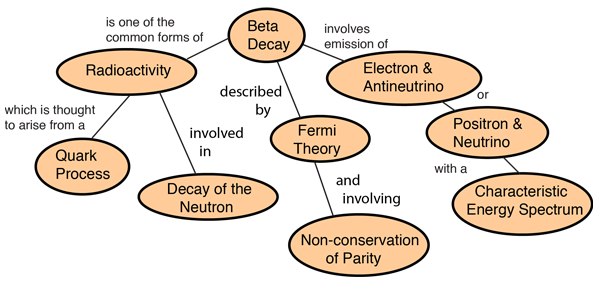
Index Beta decay concepts β衰变概念索引 | ||||||||||
|
Go Back
返回 |
How Does the Beta Electron Escape All Those Protons?β粒子是如何逃过所有那些质子的?
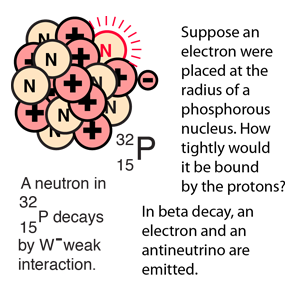
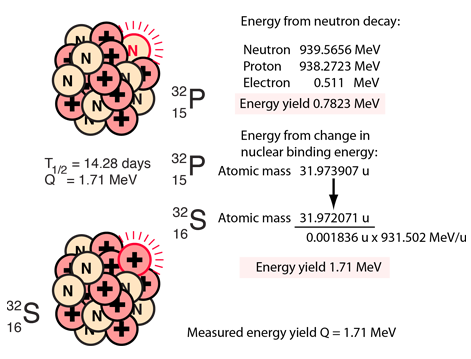
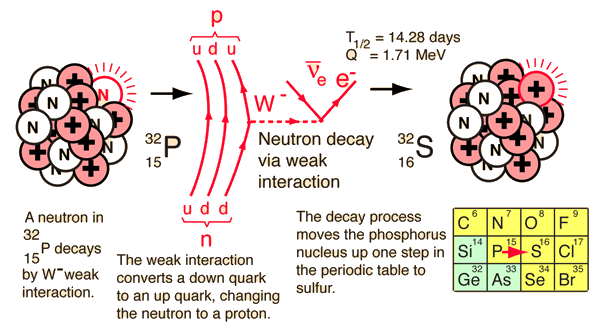
For a mass number A = 32 for 32P , the nuclear size model yields r = 3.8 x 10⁻¹⁵ m. 对于原子序数 A = 32 的 32P,核尺寸模型得出 r = 3.8 x 10 -15 m。 For 32P with 15 protons, the nuclear charge Q = 2.40 x 10⁻¹⁸ coulombs. 对于有15个质子的32P,核电荷Q = 2.40 x 10 -18库仑。 Using the radius and charge, the electric potential energy of the electron would be KQe/r = -9.09 x 10⁻¹⁵ J = -5.68 MeV! It is hard to conceive of an electron escaping that! 利用半径和电荷,电子的电势能为 KQe/r = -9.09 x 10 -15 J = -5.68 MeV!很难想象电子能逃脱这样的束缚! Considering that placing an electron at the radius is not plausible, look at the entire beta decay process from the point of view of the nuclear binding energies involved. The process of beta decay must be examined from the point of view of the binding energy difference between the parent and daughter nucleus, and the energy yield is then distributed to the products of the decay.
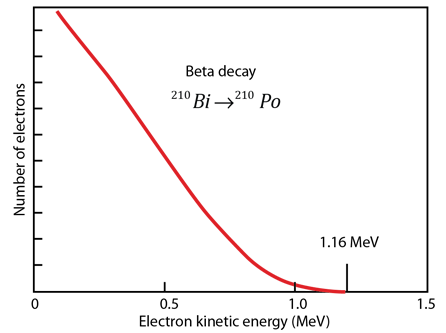
考虑到将电子放在半径处是不合理的,从核结合能的角度来看整个β衰变过程。β衰变过程必须从母核与子核之间的结合能差异的角度进行考察,并将能量产出分配给衰变产物。 The electron from the beta decay of 32P can approach the full decay energy of 1.71 MeV, but it has an average value of about 0.7 MeV. β衰变的32P的电子可以接近完整的衰变能量1.71 MeV,但其平均值约为0.7 MeV。 For another numerical example, consider the example of the beta decay of bismuth 210Bi cited by Krane. 对于另一个数值示例,考虑克兰引用的铋-210 的 β 衰变示例。 For the beta decay 210Bi -> 210Po
对于β衰变 210Bi → 210Po |
Index Beta decay concepts Krane, Ch 9 β衰变概念 索引 Krane , Ch 9 | ||||||||||||||
|
Go Back
返回 |
Electron and Antineutrino电子和反中微子
Early studies of beta decay revealed a continuous energy spectrum up to a maximum, unlike the predictable energy of alpha particles. Another anomaly was the fact that the nuclear recoil was not in the the direction opposite the momentum of the electron. The emission of another particle was a probable explanation of this behavior, but searches found no evidence of either mass or charge. The interesting history has Wolfgang Pauli in 1930 proposing an as yet unobserved particle to explain the continuous distribution of energy of the emitted electrons. Then Enrico Fermi called this particle a neutrino and developed a theory of beta decay in which the neutrino carried away the missing energy and momentum. With no charge and almost no mass, it was hard to detect, and not until 1956 was experimental detection of the neutrino achieved. For symmetry reasons, the particle emitted along with the electron from nuclei is called an antineutrino. The emission of a positron is accompanied by a neutrino. 早期对β衰变的研究揭示出发射的电子具有连续的能量分布,最高可达一个最大值,这与α粒子可预测的能量不同。另一个异常现象是核 recoil 不是与电子动量相反的方向。发射另一个粒子被认为是解释这种行为的可能解释,但搜索并未发现该粒子的质量或电荷的证据。有趣的历史中,沃尔夫冈·泡利于1930年提出一个尚未观测到的粒子来解释发射电子的连续能量分布。随后恩里科·费米将此粒子称为中微子,并发展出一个β衰变理论,在该理论中,中微子携带走了缺失的能量和动量。由于中微子几乎无电荷且质量极小,很难探测,直到1956年才实现中微子的实验探测。出于对称性的考虑,从核中发射出的粒子与电子一起被称作反中微子。正电子的发射伴随着中微子的发射。
|
Index Beta decay concepts β衰变概念索引 | ||
|
Go Back
返回 |
Positron and Neutrino正电子和中微子
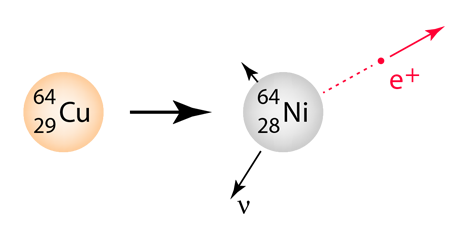
The emission of a positron or an electron is referred to as beta decay. The positron is accompanied by a neutrino, an almost massless and chargeless particle. Positrons are emitted with the same kind of energy spectrum as electrons in negative beta decay because of the emission of the neutrino. 发射正电子或电子称为β衰变。正电子伴随中微子一起发射,中微子是一种几乎没有质量和电荷的粒子。由于中微子的发射,正电子的能谱与负β衰变中的电子的能谱相同。
 |
Index Beta decay concepts β衰变概念索引 | ||
|
Go Back
返回 |
Beta Energy Spectrum贝塔能谱
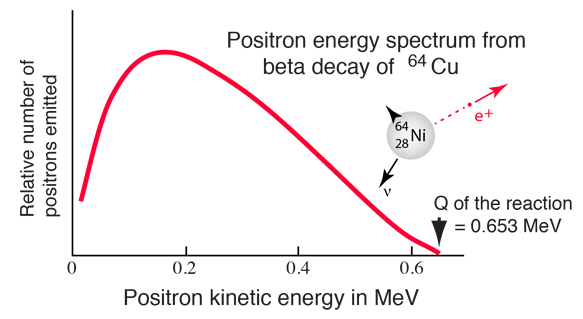
In the process of beta decay, either an electron or a positron is emitted. Because either a neutrino or an antineutrino is emitted as well, there is a spectrum of energies for the electron or positron, depending upon what fraction of the reaction energy Q is carried by the massive particle. The shape of this energy curve can be predicted from the Fermi theory of beta decay. 在β衰变过程中,会发出一个电子或正电子。由于同时也会发出一个中微子或反中微子,因此电子或正电子的能量谱会因反应能量Q中由质量粒子携带的那部分能量的比例而有所不同。这种能量曲线的形状可以从费米的β衰变理论中预测出来。
|
Index Beta decay concepts Reference Halliday, Resnick, Walker Sec. 47.5 索引 β 衰变概念 参考文献:Halliday、Resnick、Walker,第 47.5 节 | ||
|
Go Back
返回 |