Bilingual edition: English is preserved and Chinese follows each unit. Terminology uses the confirmed v20260916 glossary; automated semantic review remains traceable.
中英双语版:英文原文完整保留,中文紧随对应单元;术语采用 v20260916 确认表,自动语义审校结果可追溯。

Nuclear Fusion

核融合

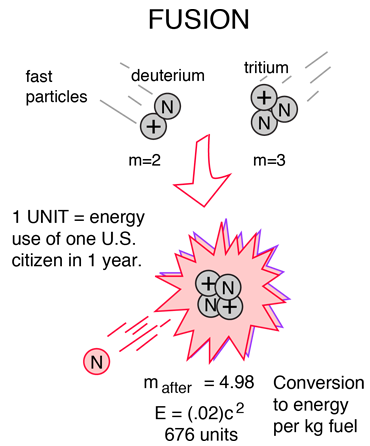
If light nuclei are forced together, they will fuse with a yield of energy because the mass of the combination will be less than the sum of the masses of the individual nuclei. If the combined nuclear mass is less than that of iron at the peak of the binding energy curve, then the nuclear particles will be more tightly bound than they were in the lighter nuclei, and that decrease in mass comes off in the form of energy according to the Einstein relationship. For elements heavier than iron, fission will yield energy.

如果将轻核强行结合在一起,它们会发生聚变并释放能量,因为结合后的总质量会小于各单个核子的质量之和。如果结合后的核质量小于铁在结合能曲线顶点处的质量,则核粒子的结合会比在较轻的核中更紧密,这种质量的减少会以能量的形式释放出来,根据爱因斯坦的关系。对于比铁更重的元素,裂变也会释放能量。

For potential nuclear energy sources for the Earth, the deuterium-tritium fusion reaction contained by some kind of magnetic confinement seems the most likely path. However, for the fueling of the stars, other fusion reactions will dominate.

对于地球的潜在核能来源,某种磁约束装置中包含的氘-氚聚变反应似乎是最可能的路径。然而,对于恒星的燃料,其他聚变反应将占主导地位。


Fusion reactors
核融合反应堆
Conditions for fusion
核融合的条件
Index

Fusion concepts
索引与融合概念
 
HyperPhysics***** Nuclear
HyperPhysics ***** 核物理
R Nave
Go Back
返回


Deuterium-Tritium Fusion

氘-氚融合

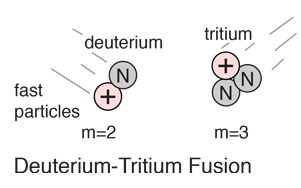
The most promising of the hydrogen fusion reactions which make up the deuterium cycle is the fusion of deuterium and tritium. The reaction yields 17.6 MeV of energy but to achieve fusion one must penetrate the coulomb barrier with the aid of tunneling, requiring very high temperatures . 80% of that energy yield is in the energy of the neutron, which is not as easily utilized as if it were carried by a charged particle. The deuterium fuel is abundant, but tritium must be either bred from lithium or gotten in the operation of the deuterium cycle.

在氘核循环中,最有可能的氢融合反应是氘核与氚核的融合。该反应产生17.6 MeV的能量,但要实现融合,必须借助隧道效应穿透库仑壁垒,这需要极高的温度。其中80%的能量以中子的形式释放,而中子的能量不如带电粒子容易利用。氘燃料很丰富,但氚必须通过锂生产或在氘循环运行中获得。
Compare with fission
与裂变相比
Conditions for fusion
核融合的条件
Index

Fusion concepts
索引与融合概念
 
HyperPhysics***** Nuclear
HyperPhysics ***** 核物理
R Nave
Go Back
返回


Hydrogen Fusion Reactions

氢核融合反应

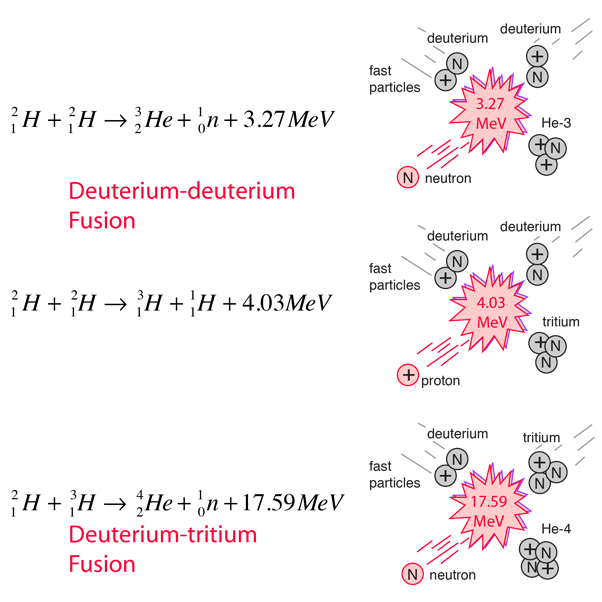
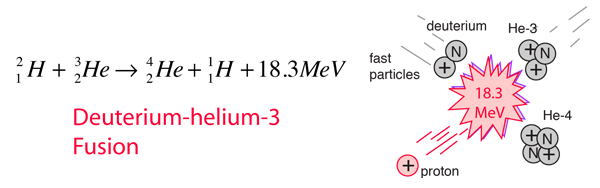
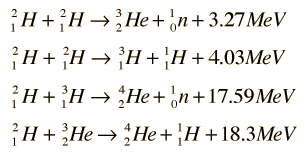
Even though a lot of energy is required to overcome the Coulomb barrier and initiate hydrogen fusion, the energy yields are enough to encourage continued research. Hydrogen fusion on the earth could make use of the reactions:

尽管克服库仑势垒并引发氢聚变需要大量能量,但产生的能量足以鼓励持续的研究。在地球上,氢聚变可以利用以下反应:

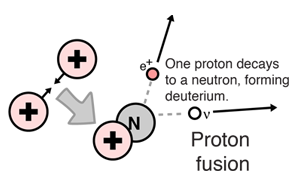
These reactions are more promising than the proton-proton fusion of the stars for potential energy sources. Of these the deuterium-tritium fusion appears to be the most promising and has been the subject of most experiments. In a deuterium-deuterium reactor, another reaction could also occur, creating a deuterium cycle:

这些反应比恒星中的质子-质子融合更具有潜力作为能源。其中,氘-氚融合似乎最为有希望,已成为大多数实验的研究对象。在氘-氘反应堆中,另一种反应也可能发生,形成氘循环:
Index

Fusion concepts
索引与融合概念
 
HyperPhysics***** Nuclear
HyperPhysics ***** 核物理
R Nave
Go Back
返回


Deuterium Cycle of Fusion

聚变的氘循环

The four fusion reactions which can occur with deuterium can be considered to form a deuterium cycle. The four reactions:

与氘发生反应的四种核融合反应可以被视为形成一个氘循环。这四种反应:

can be combined as

可以合并为

or, omitting those constituents whose concentrations do not change:

或者,省略那些浓度不发生变化的组分:
Index

Fusion concepts
索引与融合概念
 
HyperPhysics***** Nuclear
HyperPhysics ***** 核物理
R Nave
Go Back
返回


Tritium Breeding

氚增殖

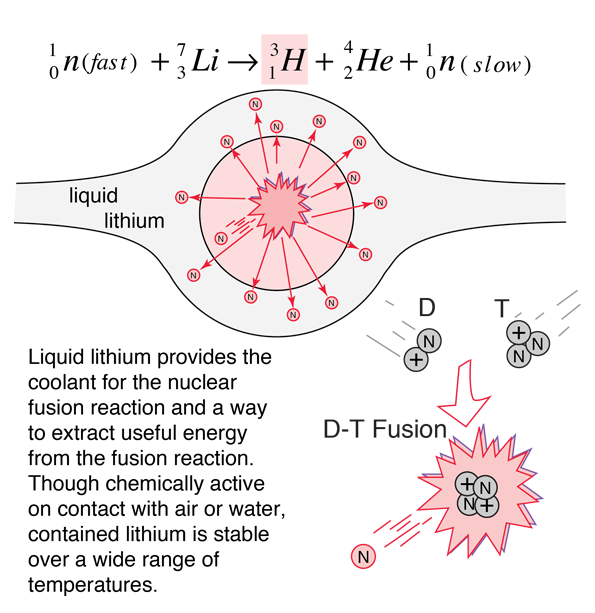
Deuterium-Tritium fusion is the most promising of the hydrogen fusion reactions, but no tritium occurs in nature since it has a 10 year half-life. The most promising source of tritium seems to be the breeding of tritium from lithium-6 by neutron bombardment with the reaction

氘-氚核融合是氢核融合反应中最有希望的反应,但自然界中不存在氚,因为它的半衰期为10年。氚最可能的来源是通过中子轰击锂-6来生产氚,反应为

which can be achieved by slow neutrons. This would occur if lithium were used as the coolant and heat transfer medium around the reaction chamber of a fusion reactor. Lithium-6 makes up 7.4% of natural lithium. While this constitutes a sizable supply, it is the limiting resource for the D-T process since the supply of deuterium fuel is virtually unlimited. With fast neutrons, tritium can be bred from the more abundant Li-7:

这可以通过慢中子实现。如果锂用作反应堆反应室周围的冷却剂和传热介质,这种情况就会发生。锂-6在天然锂中占7.4%。虽然这构成了相当大的供应量,但它是D-T过程的限制资源,因为氘的燃料供应几乎是无限的。使用快中子时,可以从更丰富的Li-7中生产出氚:

The conceptual sketch below is grossly oversimplified since the engineering for handling liquid lithium is quite complex.

下面的示意图过于简化,因为处理液态锂的工程相当复杂。
Index

Fusion concepts
索引与融合概念
 
HyperPhysics***** Nuclear
HyperPhysics ***** 核物理
R Nave
Go Back
返回


Deuterium Source

氘源

Since the most practical nuclear fusion reaction for power generation seems to be the deuterium-tritium reaction, the sources of these fuels are important. The deuterium part of the fuel does not pose a great problem because about 1 part in 5000 of the hydrogen in seawater is deuterium. This amounts to over 1015 tons of deuterium. Viewed as a potential fuel for a fusion reactor, a gallon of seawater could produce as much energy as 300 gallons of gasoline. The tritium part of the fuel is more problematic - there is no sizable natural source since tritium is radioactive with a halflife of about 10 years. It would have to be obtained by breeding the tritium from lithium.

由于核融合反应最实用的用于发电的反应似乎是氘-氚反应,这些燃料的来源就显得很重要。燃料中的氘部分并不构成大问题,因为海水中的氢约有1/5000是氘,这相当于超过10¹⁵吨的氘。作为核融合反应的潜在燃料,一加仑海水可以产生相当于300加仑汽油的能量。而燃料中的氚部分则更为棘手——由于氚是放射性的,半衰期约为10年,目前没有显著的天然来源。它必须通过锂的嬗变来获得。
Index

Fusion concepts
索引与融合概念
 
HyperPhysics***** Nuclear
HyperPhysics ***** 核物理
R Nave
Go Back
返回


Fusion Energy Release

核融合能量释放

A large amount of energy is released by nuclear fusion reactions. It seems that for power generation, the deuterium-tritium reaction is the most practical, but it provides most of the energy to the released neutron. That is problematic because it is harder to extract the energy from neutrons compared to charged particles. The deuterium-deuterium fusion divides its output energy between neutrons and protons. The proton fraction interacts by the electromagnetic force with the medium and converts its kinetic energy to thermal energy very quickly.

It is practical to examine the kinetic energies of the products of nuclear fusion in the center of mass frame of reference. This amounts to neglecting the kinetic energies of the reacting particles before the fusion, which is justified by the fact that those energies are usually in the 1-10 keV range, and the fusion yield is in the MeV range. In the CM frame the energies of constituents a and b in terms of the fusion energy release Q are:

在质心参考系中考察核融合反应产物的动能是合理的。这相当于忽略反应粒子在融合前的动能,这是合理的,因为这些动能通常在1-10 keV范围内,而融合释放的能量在MeV范围内。在CM参考系中,构成物a和b的动能用融合能量释放Q来表示为:

核融合反应释放出大量的能量。对于发电来说,氘-氚反应是最实用的,但它大部分能量都传递给了释放出的中子。这存在问题,因为相比于带电粒子,从中子中提取能量更困难。氘-氘融合反应将输出能量分为中子和质子之间。质子通过电磁力与介质相互作用,很快将动能转化为热能。

The magnitudes of the momenta in that frame are equal:

在那个参考系中,动量的大小相等:

Combining these two equations gives:

将这两个方程结合起来得到:

This allows us to determine the relative magnitudes of the energies of the two fusion products:

For D-D fusion, the smaller particle carries 75% of the energy.

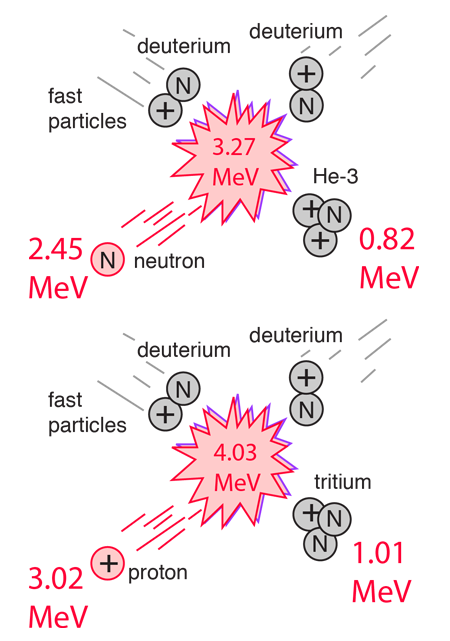
With m(He3) = 2.8084 GeV/c2, m(H3) = 2.8089 GeV/c2,m(n) = 0.9396GeV/c2, and m(p) = 0.9383GeV/c2, the product energies for deuterium-deuterium fusion are shown. With a total yield of 3.27 GeV for the neutron reaction, the neutron carries 74.93% of the yield. For the proton reaction with yield 4.03 MeV, the proton carries 74.96%.

当³He的质量为2.8084 GeV/c²,³H的质量为2.8089 GeV/c²,中子的质量为0.9396 GeV/c²,质子的质量为0.9383 GeV/c²时,氘-氘融合的产物能量如图所示。对于中子反应总产额为3.27 GeV,中子携带了74.93%的产额。对于产额为4.03 MeV的质子反应,质子携带了74.96%的产额。
在D-D聚变中,较小的粒子携带75%的能量。
For D-T fusion, the smaller particle carries 80% of the energy.

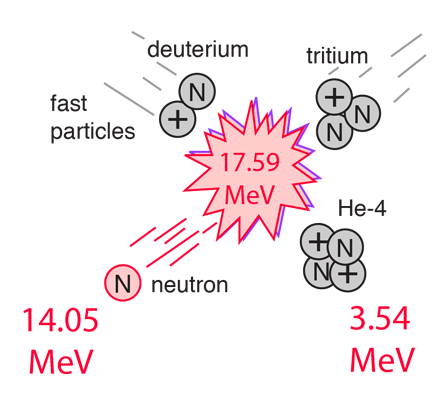
With m(He4) = 3.7274 GeV/c2 and m(n) = 0.9396 GeV/c2, the product energies for deuterium-tritium fusion are shown. With a total yield of 17.59 MeV for this reaction, the neutron carries 79.87% of the yield.

当氦-4的质量为3.7274 GeV/c²,中子的质量为0.9396 GeV/c²时,氘-氚聚变的产物能量如图所示。该反应总产额为17.59 MeV,其中中子携带了79.87%的产额。
在D-T聚变中,较小的粒子携带80%的能量。
这使我们能够确定两个核融合产物的能量相对大小:
Index

Fusion concepts

References:
Krane,
Sec 14.2
索引 熔化概念 参考文献:Krane,第14章第2节
 
HyperPhysics***** Nuclear
HyperPhysics ***** 核物理
R Nave
Go Back
返回