Bilingual edition: English is preserved and Chinese follows each unit. Terminology uses the confirmed v20260916 glossary; automated semantic review remains traceable.
中英双语版:英文原文完整保留,中文紧随对应单元;术语采用 v20260916 确认表,自动语义审校结果可追溯。

Coulomb Barrier for Fusion

核融合的库仑障碍

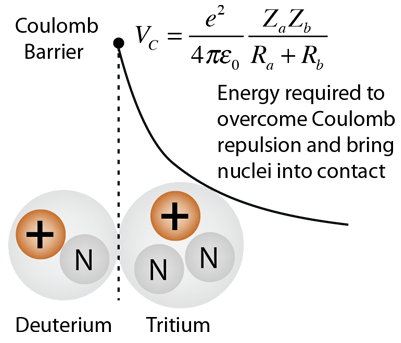
In order to accomplish nuclear fusion, the particles involved must first overcome the electric repulsion to get close enough for the attractive nuclear strong force to take over to fuse the particles. This requires extremely high temperatures, if temperature alone is considered in the process. In the case of the proton cycle in stars, this barrier is penetrated by tunneling, allowing the process to proceed at lower temperatures than that which would be required at pressures attainable in the laboratory.

为了实现核融合,参与的粒子必须首先克服电斥力,接近到足以让吸引力强的核力接管,从而融合粒子。这需要极高的温度,如果仅考虑温度因素的话。在恒星的质子循环中,这一障碍通过隧穿效应被克服,使过程能够在实验室可达到的压力下所需的更低温度下进行。

Considering the barrier to be the electric potential energy of two point charges (e.g., protons), the energy required to reach a separation r is given by

考虑电势能(例如质子之间的电势能)作为势垒,达到分离距离r所需能量由下式给出
where k = Coulomb's constant and e is the proton charge.
其中,k 是库仑常数,e 是质子的电荷。

Given the radius r at which the nuclear attractive force becomes dominant, the temperature necessary to raise the average thermal energy to that point can be calculated.

给定核吸引力主导的半径r,可以计算将平均热能提升到该点所需的温度。
Calculation
计算
Index

Fusion concepts
索引与融合概念
 
HyperPhysics***** Nuclear
HyperPhysics ***** 核物理
R Nave
Go Back
返回


Calculation of Coulomb Barrier

库仑势垒的计算

The height of the Coulomb barrier can be calculated if the nuclear separation and the charges of the particles are known.

如果已知核间距和粒子的电荷,就可以计算出库仑势垒的高度。

The nuclear radii can be calculated from the mass numbers A and atomic numbers Z. Note that this models a nucleus as a sphere of constant charge density.

核子半径可以从质量数A和原子序数Z计算得出。请注意,这种模型将核视为具有恒定电荷密度的球体。
For Aa = and Za = , Ra = x10^ m = fermi.

For Ab = and Zb = , Rb = x10^ m = fermi.

对于 A b = 和 Z b = ,R b = ×10^ m = 佛米。
中文译文中的待填/计算数值依次对应:1:ab 2:zb 3:rbb 4:rbp 5:rbf。实际数值以上方原输入框为准。

The height of the Coulomb Barrier is

VC = x 10^J = x 10^eV = keV = MeV.

The temperature required to provide this energy as an average thermal energy for each particle would be

将这种能量作为每个质点的平均热能所需温度为
库仑屏障的高度是 V_C = x 10^ J = x 10^ eV = keV = MeV。
中文译文中的待填/计算数值依次对应:1:vjb 2:vjp 3:vevb 4:vevp 5:vkev 6:vmev。实际数值以上方原输入框为准。

Kinetic temperature T = x 10^ K

动能温度 T = x 10^ K
中文译文中的待填/计算数值依次对应:1:tb 2:tp。实际数值以上方原输入框为准。

Of course for head-on collisions between particles only half of that energy would be required of each particle, so you could cut that temperature in half. The above temperature is calculated as a reference value.

Discussion of Coulomb barrier
库仑势垒讨论
Why is this temperature too high?
为什么这个温度太高?
当然,对于质点之间的正面对撞,仅需每个质点提供一半的能量,因此你可以将温度减半。上述温度是作为参考值计算的。
对于 A a = 和 Z a = ,R a = ×10^ m = 佛米。
中文译文中的待填/计算数值依次对应:1:a 2:z 3:rb 4:rp 5:rf。实际数值以上方原输入框为准。
Index

Fusion concepts

References:
Krane,
Sec 14.2
索引 熔化概念 参考文献:Krane,第14章第2节
 
HyperPhysics***** Nuclear
HyperPhysics ***** 核物理
R Nave
Go Back
返回


Critical Ignition Temperature for Fusion

核融合的临界点燃温度

The fusion temperature obtained by setting the average thermal energy equal to the coulomb barrier gives too high a temperature because fusion can be initiated by those particles which are out on the high-energy tail of the Maxwellian distribution of particle energies. The critical ignition temperature is lowered further by the fact that some particles which have energies below the coulomb barrier can tunnel through the barrier.

将平均热能设为库仑势垒时得到的熔化温度过高,因为那些处于麦克斯韦分布高能尾部的粒子足以引发熔化。此外,一些能量低于库仑势垒的粒子能够通过隧道效应穿透势垒,从而进一步降低临界点燃温度。

The presumed height of the coulomb barrier is based upon the distance at which the nuclear strong force could overcome the coulomb repulsion. The required temperature may be overestimated if the classical radii of the nuclei are used for this distance, since the range of the strong interaction is significantly greater than a classical proton radius.

库仑势垒的假定高度是基于强相互作用在能克服库仑排斥作用时的距离。如果使用核的经典半径来确定这个距离,可能会高估所需的温度,因为强相互作用的范围显著大于经典质子半径。

When trying to model the probability of nuclear fusion, the typical approach is to model it as a "cross-section" for the reaction to occur. This approach is perhaps more apparent in evaluating particle scattering like Rutherford scattering, but the language is often used for nuclear fusion as well. For the purposes here, cross-section can be taken to mean the probability for nuclear fusion to occur. Modeling this cross-section involves taking into account the probability for tunneling through the coulomb barrier. This probability is higher for higher energy particles, but because of the Maxwellian distribution, there are fewer of these high energy particles. Also, the effective energy of collision between the particles for fusion depends on their relative velocities, so the model calculation for nuclear fusion yield involves averaging over all relative velocities. The results of such modeling are presented as a plot of fusion cross-section as a function of average particle energy.
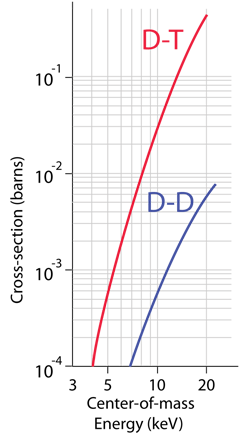
With all these considerations, the energy requirements for the nuclear fusion of deuterium- tritium and for deuterium-deuterium are dramatically lower than the coulomb barrier, but they are nevertheless very difficult to attain in a controlled manner.

考虑到所有这些因素,氘-氚核融合和氘-氘核融合的能量需求显著低于库仑壁垒,但要以受控方式实现仍非常困难。

The references suggest that the currently attainable particle energies in thermonuclear reactors is in the range 1 - 10 keV. If you just substitute those energies into the thermal energy relationship, then 1keV corresponds to a temperature of 0.77 x 10⁷K and 10 keV corresponds to 0.77 x 10⁸K.

参考文献表明,目前在热核反应堆中可达到的粒子能量范围是1 - 10 keV。如果你只是将这些能量代入热能关系中,那么1 keV对应的是0.77 x 10 7 K的温度,10 keV对应的是0.77 x 10 8 K的温度。

The TFTR reached a temperature of 5.1 x 10⁸ K, well above the critical ignition temperature for D-T fusion.

TFTR达到5.1 x 10 8 K的温度,远高于D-T融合的临界点燃温度。
在尝试建模核融合的概率时,通常的做法是将其建模为“截面”,即反应发生的概率。这种方法可能在评估粒子散射(如卢瑟福散射)时更为明显,但语言通常也用于核融合。在此处的用途中,截面可以理解为核融合发生概率。建模这种截面需要考虑粒子穿透库仑势垒的概率。这种概率对于高能粒子更高,但由于麦克斯韦分布,高能粒子数量较少。此外,粒子间用于融合的有效碰撞能量取决于它们的相对速度,因此核融合产额的模型计算需要对所有相对速度进行平均。此类建模的结果以融合截面作为平均粒子能量函数的图示形式呈现。

References:

参考文献:

Kaye & Laby

Kaye & Laby(专名或术语)

Crossfire Fusion

Temperature comments
温度评论
交叉火核融合
Index

Fusion concepts

References:
Krane,
Sec 14.2
索引 熔化概念 参考文献:Krane,第14章第2节
 
HyperPhysics***** Nuclear
HyperPhysics ***** 核物理
R Nave
Go Back
返回


Temperatures for Fusion

核融合温度

The temperatures required to overcome the coulomb barrier for fusion to occur are so high as to require extraordinary means for their achievement. Such thermally initiated reactions are commonly called thermonuclear fusion. With particle energies in the range of 1-10keV, the temperatures are in the range 107-108K.

In the sun, the proton-proton cycle of fusion is presumed to proceed at a much lower temperature because of the extremely high density and high population of particles.

在太阳中,由于极高的密度和粒子的高人口,核融合过程被假定在远较低的温度下进行。
要克服库仑势垒以实现核融合所需的温度如此之高,以至于需要非凡的手段来实现它们。这类由热引发的反应通常被称为热核融合。当粒子能量在1-10 keV范围内时,温度在10⁷-10⁸ K范围内。
Interior of the sun, proton cycle: 1.5 x 10⁷ K
太阳内部,质子循环:1.5 x 10⁷ K

The most feasible near-term options for thermonuclear fission appear to be deuterium-tritium, deuterium-deuterium, and deuterium-helium 3.

近期最可行的热核裂变选项似乎包括氘-氚、氘-氘和氘-氦3。

To obtain an approximate temperature for any location on the diagram, use the corresponding energy in the relationship for thermal energy.

要获得图上任一位置的近似温度,可使用热能关系中的相应能量。

References:

参考文献:

Kaye & Laby

Kaye & Laby(专名或术语)

Crossfire Fusion

Index

Fusion concepts

References:
Krane,
Sec 14.2
索引 熔化概念 参考文献:Krane,第14章第2节
 
HyperPhysics***** Nuclear
HyperPhysics ***** 核物理
R Nave
Go Back
返回


交叉火核融合