Step 1. Proton Fusion
|
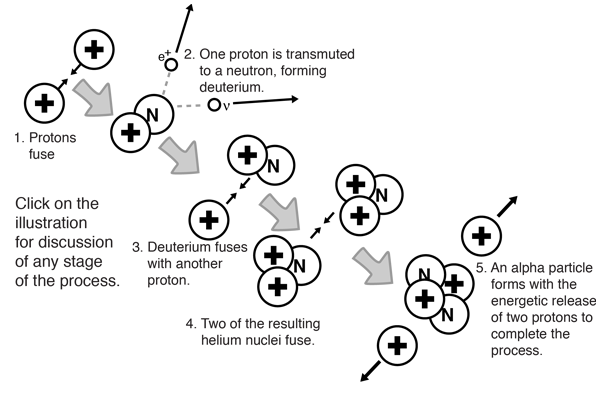
| The fusing of two protons which is the first step of the proton-proton cycle created great problems for early theorists because they recognized that the interior temperature of the sun (some 14 million Kelvins) would not provide nearly enough energy to overcome the coulomb barrier of electric repulsion between two protons.
|
With the development of quantum mechanics, it was realized that on this scale the protons must be considered to have wave properties and that there was the possibility of tunneling through the coulomb barrier.
Index
Carroll & Ostlie
Ch 10.3
Krane, Intro. Nuclear Physics
Ch 14.3 |
| |
Go Back |
Eddington and his fusion critics
Arthur Eddington thought that nuclear processes must be involved to account for the radiant energy of the sun, but was criticized because the temperature was seen to be not hot enough when considered by classical physics alone. His tongue-in-cheek reply to his critics: "I am aware that many critics consider the stars are not hot enough. The critics lay themselves open to an obvious retort; we tell them to go and find a hotter place."
|
Index
Carroll & Ostlie
Ch 10.3
Krane, Intro. Nuclear Physics
Ch 14.3 |
| |
Go Back |
Step 2. Deuterium formation
|
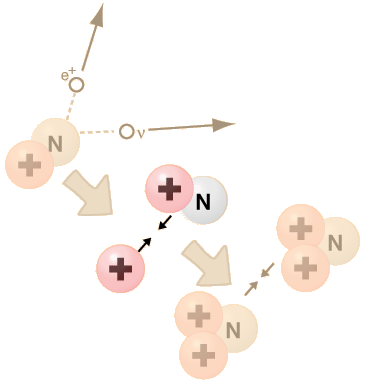
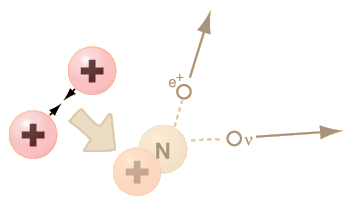
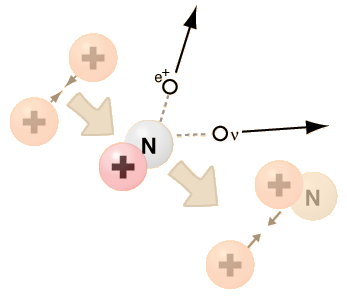 | The second step of the proton-proton cycle . This step involves the weak interaction because it involves the transmutation of one of the protons to a neutron in order to form deuterium. This process requires energy and produces a positron and an electron neutrino.
|
 |
In the proton-proton fusion process, deuterium is produced by the weak interaction in a quark transformation which converts one of the protons to a neutron. The neutrinos quickly escape the sun, requiring only about 2 seconds to exit the sun compared to perhaps a million years for a photon to traverse from the center to the surface of the sun. The neutrino flux can be calculated, but earlier measurements of the neutrino flux measured only about a third of the expected number. This is called the solar neutrino problem. It is now presumed to be solved with the evidence for neutrino oscillation at the Sudbury Neutrino Observatory and at the Super Kamiokande neutrino detector. |
Index
Carroll & Ostlie
Ch 10.3
Krane, Intro. Nuclear Physics
Ch 14.3 |
| |
Go Back |
Index
Carroll & Ostlie
Ch 10.3
Krane, Intro. Nuclear Physics
Ch 14.3 |
| |
Go Back |
Index
Carroll & Ostlie
Ch 10.3
Krane, Intro. Nuclear Physics
Ch 14.3 |
| |
Go Back |
Step 5. Alpha particle formation
|
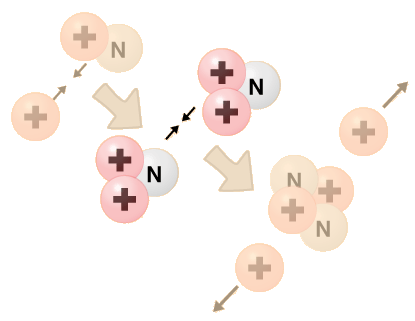
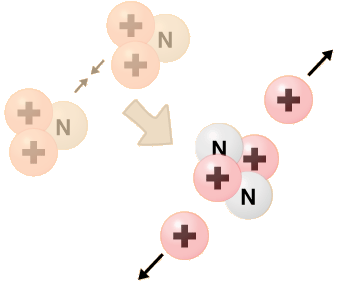
The fifth step of the proton-proton cycle . Alpha particles are the end product of the proton-proton fusion cycle. They are formed by the fusion of two helium-3 nuclei. |
|
Index
Carroll & Ostlie
Ch 10.3
Krane, Intro. Nuclear Physics
Ch 14.3 |
| |
Go Back |