Aurora at Earth's South Pole
地球南磁极处的极光
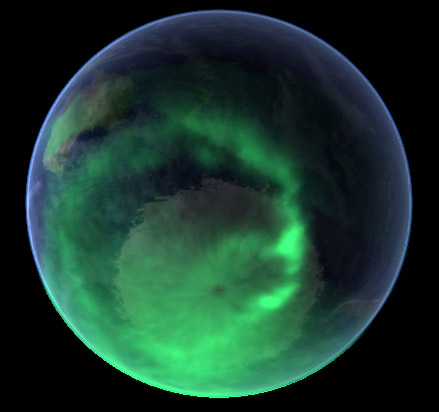 NASA image taken by Polar satellite, November 2004 The Sun produced at least five major "halo" coronal mass ejections (CMEs) over the period of Nov. 4-8, 2004, an unusually fast pace for solar activity.The Polar spacecraft saw the aurora australis (southern lights) expanding and brightening on Nov. 8. A "halo" CME occurs when a CME produces an expanding circle of particles all around the Sun. When observers see this they know the CME is heading directly towards or away from Earth. In this case, all were headed in our direction, bringing the auroral light show with them. The source of storms was a group of sunspots called Active Region 696. The area also produced powerful solar explosions called flares.
Credit: NASA/UC Berkeley
2004年11月4日至8日,太阳至少发生了五次主要的“halo”日冕物质抛射(CMEs),这在太阳活动期间是非常快的节奏。极地航天器在11月8日观察到极光(南极光)在扩展和变亮。“halo”CME发生于当CME产生围绕太阳的粒子扩展圆圈时。当观测者看到这种情况时,他们知道CME正直接朝向或远离地球。在此情况下,所有CME都是朝我们方向来的,带来了极光表演。风暴的源头是一组称为活跃区域696的太阳黑子。该区域还产生了强烈的太阳爆炸,称为耀斑。Credit: NASA/UC Berkeley
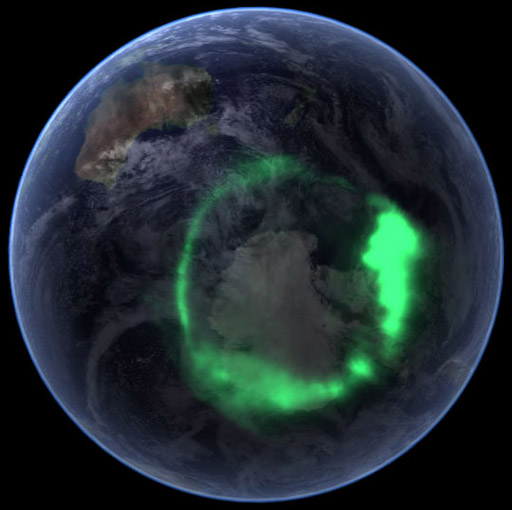
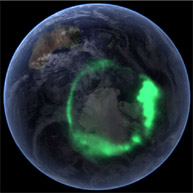
From space, the aurora is a crown of light that circles each of Earth's poles. The IMAGE satellite captured this view of the aurora australis (southern lights) on September 11, 2005, four days after a record-setting solar flare sent plasma-an ionized gas of protons and electrons-flying towards the Earth. The ring of light that the solar storm generated over Antarctica glows green in the ultraviolet part of the spectrum, shown in this image. The IMAGE observations of the aurora are overlaid onto NASA's satellite-based Blue Marble image. From the Earth's surface, the ring would appear as a curtain of light shimmering across the night sky.
从空间看,极光是一顶环绕地球两极的光冠。2005年9月11日,IMAGE卫星捕捉到了极光(南极光)的景象,这发生在一次创纪录的日冕爆发之后,这次爆发将带电粒子(由质子和电子组成的等离子体)送往地球。这次太阳风暴在南极上空产生的光环在紫外光谱中呈现绿色,如图所示。极光的观测结果被叠加在NASA基于卫星的Blue Marble图像上。从地球表面看,这光环会呈现出一道在夜空中闪烁的光幕。
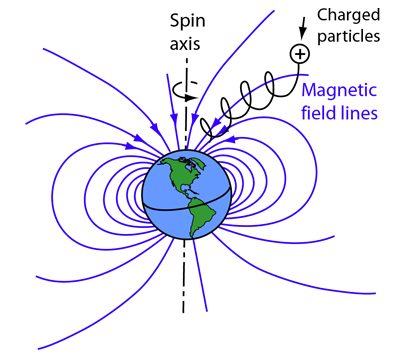
Though scientists knew that the aurora were caused by charged particles from the Sun and their interaction with the Earth's magnetic field, they had no way to measure the interaction until NASA launched the Imager for Magnetopause-to-Aurora Global Exploration (IMAGE) satellite in 2000. The satellite's mission was to collect data that would allow scientists to study the structure and dynamics of the Earth's magnetic field for the first time. Designed to operate for two years, IMAGE sent its last data to Earth in December 2005 after a highly successful five-year mission.
尽管科学家知道极光是由太阳的带电粒子及其与地球磁场的相互作用引起的,但他们直到NASA于2000年发射了“磁极至极光全球探测器”(IMAGE)卫星,才有了测量这种相互作用的方法。该卫星的任务是收集数据,使科学家能够首次研究地球磁场的结构和动态。设计运行两年的IMAGE卫星,在为期五年的高度成功任务后,于2005年12月向地球发送了最后的数据。
Since 2000, IMAGE has provided insight into how the Earth's powerful magnetic field protects the planet from solar winds. Without the shield the magnetic field provides, the upper atmosphere would evaporate into space under the influence of solar winds. IMAGE has shown scientists what sort of changes the magnetic field undertakes as it diverts solar winds from the Earth.
Image and description courtesy NASA
自2000年以来,IMAGE提供了关于地球强大磁场如何保护行星免受太阳风影响的见解。如果没有磁场提供的屏蔽作用,太阳风将使高层大气蒸发到空间中。IMAGE向科学家展示了磁场如何在引导太阳风远离地球时发生的变化。图片和描述 courtesy NASA
NASA于2004年11月由极地卫星拍摄的图片 |