Red Sunset红色日落
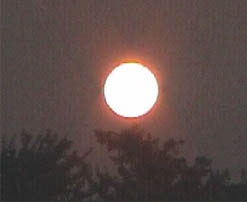
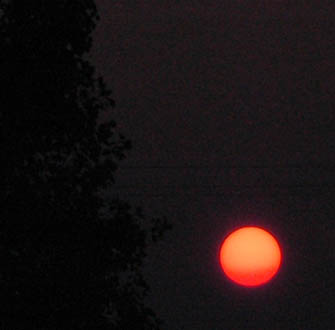
Sunsets are reddened because for sun positions which are very low or just below the horizon, the light passing at grazing incidence upon the earth must pass through a greater thickness of air than when it is overhead. Just before the sun disappears from view, its actual position is about a diameter below the horizon, the light having been bent by atmospheric refraction to reach our eyes. Since short wavelengths are more efficiently scattered by Rayleigh scattering, more of them are scattered out of the beam of sunlight before it reaches you. Aerosols and particulate matter contribute to the scattering of blue out of the beam, so brilliant reds are seen when there are many airborne particles, as after volcanic eruptions. 日落时天空呈现红色,是因为当太阳位置非常低或刚好低于地平线时,光线以近于水平的角度穿过大气层,必须穿过比太阳在头顶时更厚的大气层。就在太阳消失在视野中之前,它的实际位置大约在地平线以下一个直径的位置,光线由于大气折射而弯曲到达我们的眼睛。由于短波长的光更有效地被瑞利散射散射,它们在阳光束中被散射出去更多。气溶胶和颗粒物会将蓝色光散射出去,因此当空气中存在大量悬浮颗粒时,如火山爆发后,会看到鲜艳的红色。

![]() The equivalent phenomenon can be seen at sunrise 可以在日出时观察到等效现象
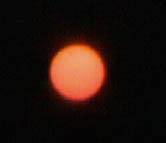
The redness of the sun is about as it appeared to the eye, but the remainder of the sky is much darker than it appeared to the eye, pointing to the remarkable contrast handling ability of human vision. 太阳的红色大致与人眼所见一致,但天空的其余部分却比人眼所见要暗得多,这表明人类视觉具有非凡的对比度处理能力。
|
Index Atmospheric optics concepts 索引:大气光学概念 | ||||||
|
Go Back
返回 |
Green Flash绿色闪光
The famous but seldom seen "green flash" or "emerald flash" which occurs just before the last part of the sun disappears from view at sunset is caused by the same atmospheric refraction and scattering effects which produce the red sunset. 著名的但很少见到的‘绿色闪光’或‘翡翠闪光’,发生在日落时太阳即将消失在视野中的最后阶段,其成因与产生晚霞红色的大气折射和散射效应相同。
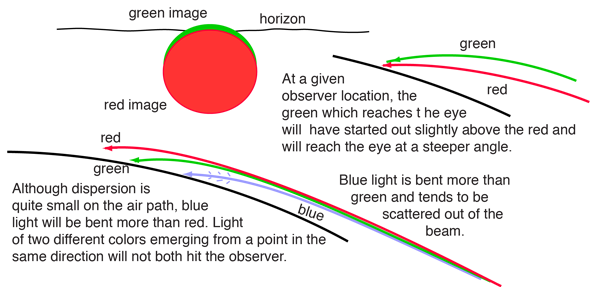
![]() A rich subject for debate over the years, the green flash is rarely seen, but its observers wax eloquent about the brilliant green or emerald color when it is seen. In uniform air, the dispersion is apparently so small that the separation of red and green images is not visible. It takes more unusual layering of the atmosphere to enhance the separation. 多年来,绿色闪光一直是争论的焦点,它很少被观测到,但一旦出现,观测者往往对其明亮的绿色或翡翠色感到赞叹。在均匀的空气中,色散似乎很小,红光和绿光的分离程度不明显。要增强这种分离,需要大气层有更不寻常的结构。
Such a seldom seen and dramatic effect as the green flash tends to collect myth, so some care must be taken to separate fact from myth. I had reported from another reference that the perceived brilliance of the green might be heightened by the low-light enhancement of green vs the red end of the spectrum (see "Rods do not see red!" in color puzzles). Andrew Young contests this, stating that sunsets are so bright and provide so much light even in the green that significant bleaching of the pigment for both red and green may occur, certainly not the conditions for the scotopic or low-light vision. Young maintains an excellent website of resources about green flashes, "An Introduction to Green Flashes". 这种罕见而戏剧性的现象——绿色闪光——往往被赋予神话色彩,因此必须谨慎区分事实与神话。我曾引用另一份资料指出,人们感知到的绿色亮度可能因绿色在光谱中位于红色端的低光增强而增强(参见《视锥细胞不看见红色!》在颜色谜题中)。安德鲁·杨对此提出异议,认为日落时分光线非常明亮,即使在绿色波段也提供了大量光线,因此绿色和红色的色素可能都会显著褪色,这显然不是视锥细胞或低光视觉的条件。杨维护着一个关于绿色闪光的优秀资源网站,《绿色闪光简介》。
The index of refraction for red is 1.000292 and that for blue is 1.000295. Out of a total refraction of about 0.53°, the dispersion is only 0.006° or about 20 arc seconds, compared to a 120 arc sec resolution for the eye. Thus under normal conditions the eye would not see this. 红光的折射率是1.000292,蓝光的折射率是1.000295。在总折射约0.53°的情况下,色散仅为0.006°或约20弧秒,相比之下,人眼的分辨率为120弧秒。因此,在正常条件下,人眼将无法察觉这种差异。
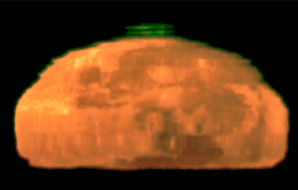
The location of the viewing of this lunar green flash was on the Chile's 8500 ft mountain Cerro Paranal, the home of ESO's Very Large Telescope. The atmospheric conditions are so exceptional there that it is one of the best places to see fleeting events such as the green flash of the setting Sun. The above photo was taken on a clear morning when the setting Moon was crossing the horizon.
这次月球绿色闪光的观测地点位于智利8500英尺高的Cerro Paranal山,这是欧洲南方天文台(ESO)的甚大望远镜(VLT)的所在地。那里的大气条件非常优越,是观测短暂现象如日落时的绿色闪光的最佳地点之一。上述照片是在一个晴朗的早晨拍摄的,当时落山的月亮正掠过地平线。 |
Index Atmospheric optics concepts References Schaaf Greenler Meinel & Meinel Minnaert ![]() Green Flash Green flash pictures by Andrew Young Le rayon vert 索引 大气光学概念 参考文献 Schaaf Greenler Meinel & Meinel Minnaert Green Flash Green Flash 图片 by Andrew Young Le rayon vert | |||||
|
Go Back
返回 |
Green Flash History绿色闪光历史
Jules Verne's 1882 novel "Le Rayon Vert" (The Green Ray) popularized the green flash, described as 儒勒·凡尔纳1882年的小说《绿光》(The Green Ray)使绿光现象广为人知,该现象被描述为
"a green which no artist could ever obtain on his palette, a green of which neither the varied tints of vegetation nor the shades of the most limpid sea could ever produce the like! If there is a green in Paradise, it cannot be but of this shade, which most surely is the true green of Hope" 一种任何画家都无法在自己的颜料中获得的绿色,一种连各种植物的色调或最清澈海水的深浅都无法复制的绿色!如果天堂中存在绿色,那必定就是这种色调,这种绿色无疑就是希望的真正绿色。
|
Index Atmospheric optics concepts 索引:大气光学概念 | ||
|
Go Back
返回 |
Green Flash Details绿色闪光详情
The index of refraction of air for red is 1.000292 and that for blue is 1.000295. Out of a total refraction of about 0.53°, the dispersion is only 0.006° or about 20 arc seconds, compared to a 120 arc sec resolution for the eye. Thus under normal conditions the eye would not see the separation of red and blue images of the sun. 空气的红光折射率为1.000292,蓝光为1.000295。在总折射约0.53°的情况下,色散仅为0.006°或约20弧秒,相比之下,人眼的分辨能力为120弧秒。因此,在正常条件下,人眼不会看到太阳的红光和蓝光图像的分离。
The green or blue would be seen only after the red image is gone, and the passage time for this 20 arc second band is reported by the Meinels to be about 1.4 seconds. 绿色或蓝色图像只有在红色图像消失之后才能被看到,而这一20弧秒带的通过时间据Meinels报告约为1.4秒。
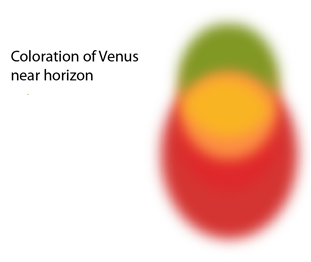
The successive red, green, and then blue images can be seen more distinctly by viewing the planets Venus and Jupiter with a telescope as they pass below the horizon. The ease of viewing the colors in these cases has to do with their smaller angular diameters. 通过望远镜观察金星和木星时,当它们低于地平线时,可以更清晰地看到依次出现的红、绿和蓝的影像。在这些情况下,能够清晰看到颜色的易程度与它们较小的角直径有关。
|
Index Atmospheric optics concepts Reference Greenler Plate 7-9 索引 大气光学概念 参考 Greenler 第7-9页 | |||
|
Go Back
返回 |
Twilight Wedge暮色楔形
The "twilight wedge" is the visible shadow to the earth cast upon the sky by the setting sun. It can be seen as a blue-gray line or wall which rises in the east after a clear sunset. It is often tinged with pink. ‘日落楔’是地球在日落时投射到天空中的可见阴影。它可表现为一条蓝灰色的线或墙,日落后在东方升起。它常常带有粉红色调。
|
Index Atmospheric optics concepts 索引:大气光学概念 | ||
|
Go Back
返回 |