Bilingual edition: English is preserved and Chinese follows each unit. Terminology uses the confirmed v20260916 glossary; automated semantic review remains traceable.
中英双语版:英文原文完整保留,中文紧随对应单元;术语采用 v20260916 确认表,自动语义审校结果可追溯。

History of Rutherford Experiment

卢瑟福实验的历史

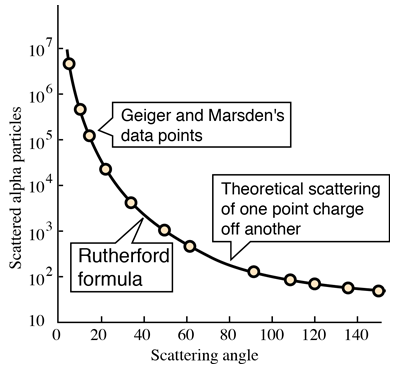
In Ernest Rutherford's laboratory, Hans Geiger and Ernest Marsden (a 20 yr old undergraduate student) carried out experiments to study the scattering of alpha particles by thin metal foils. In 1909 they observed that alpha particles from radioactive decays occasionally scatter at angles greater than 90°, which is physically impossible unless they are scattering off something more massive than themselves. This led Rutherford to deduce that the positive charge in an atom is concentrated into a small compact nucleus. During the period 1911-1913 in a table-top apparatus, they bombarded the foils with high energy alpha particles and observed the number of scattered alpha particles as a function of angle. Based on the Thomson model of the atom, all of the alpha particles should have been found within a small fraction of a degree from the beam, but Geiger and Marsden found a few scattered alphas at angles over 140 degrees from the beam. Rutherford's remark "It was quite the most incredible event that ever happened to me in my life. It was almost as incredible as if you had fired a 15-inch shell at a piece of tissue paper and it came back and hit you." The scattering data was consistent with a small positive nucleus which repelled the incoming positively charged alpha particles. Rutherford worked out a detailed formula for the scattering (Rutherford formula), which matched the Geiger-Marsden data to high precision.

在欧内斯特·卢瑟福的实验室里,汉斯·盖革和欧内斯特·马斯登(一名20岁的本科生)进行了实验,研究α粒子通过薄金属箔的散射现象。1909年,他们观察到来自放射性衰变的α粒子偶尔会以超过90°的角度散射,这在物理上除非它们散射的是比自身更重的物体,否则是不可能的。这促使卢瑟福推断原子中的正电荷集中在极小而紧凑的核中。在1911-1913年间,他们使用桌面装置,将高能α粒子轰击到箔上,并观察散射α粒子的数量随角度的变化。根据汤姆森的原子模型,所有α粒子都应被发现接近入射束的很小角度范围内,但盖革和马斯登发现有少数α粒子散射到入射束的140度以上。卢瑟福评论道:‘这在我一生中是最不可思议的事件。它几乎就像你向一张纸一样薄的组织纸发射一枚15英寸的炮弹,它弹回来击中了你一样不可思议。’散射数据与一个极小的正电荷核相一致,该核排斥了入射的带正电的α粒子。卢瑟福推导出一个详细的散射公式(卢瑟福公式),该公式与盖革-马斯登的数据高度吻合。

The source used in the Rutherford experiments was purifed radium contained in a thin-walled 1-mm diameter glass tube. The source strength was about 0.1 Curie, or about 4 billion nuclear decays per second. The alpha particles were allowed to pass through a small diaphragm and were directed toward a thin foil target. The detector was a small (10-6 m2) zinc sulfide screen mounted a few centimeters away from the target. (Rohlf)

拉瑟福德实验中使用的放射源是装在一根内壁光滑、直径为1毫米的玻璃管中的纯镭。放射源的强度约为0.1居里,或每秒约有40亿次核衰变。α粒子被允许通过一个小孔,并被导向薄箔靶。探测器是一个小的(面积为10⁻⁶平方米)锌硫化物屏,它距离靶约几厘米。(Rohlf)
Index

Rutherford concepts

References
Rohlf
Ch 6

Blatt
Ch 5
索引 瑞利概念 参考文献 罗尔夫 第6章 布莱特 第5章
 
HyperPhysics***** Nuclear
HyperPhysics ***** 核物理
R Nave
Go Back
返回


Rutherford Scattering Questions

卢瑟福散射问题
1. Why was the observation of large angle scattering of alpha particles surprising?
为什么观察到α粒子的大角度散射是令人惊讶的?
2. Under what conditions can you get scattering at angles greater than 90 degrees?
在什么条件下可以得到大于90度的散射角?
3. Besides the mass of the target, what else determines the scattering angle?
除了靶的质量之外,什么还决定了散射角?
4. How can you determine the distance of closest approach to the target?
如何确定粒子接近靶的最近距离?
5. What was the evidence of a new type of force from the observation of the scattering?
观察到的散射现象是什么证据表明了一种新类型的力?
Index

Rutherford concepts

Scattering concepts
索引 瑞利概念 散射概念
 
HyperPhysics***** Nuclear
HyperPhysics ***** 核物理
R Nave
Go Back
返回


Geiger-Marsden Data on Alpha Scattering

盖革-马士登关于α粒子散射的数据

Geiger and Marsden showed that the number of scattered alpha particles as a function of scattering angle was consistent with a small, concentrated positive nucleus. To angles above 140 degrees, the nucleus appeared as a point positive charge, so this data did not measure the nuclear size. When the scattering departed from that predicted from Coulomb's law, it could be inferred that another force was coming into play and you could claim to have "hit" the nucleus. At 140 degrees, they still hadn't hit it.

盖革和马斯登证明,散射角与散射α粒子数的关系与一个小而集中正电荷的核是一致的。对于大于140度的角度,核表现为一个点正电荷,因此这些数据并未测量核的大小。当散射偏离库仑定律预测的范围时,可以推断另一种力起作用,你可以说已经“击中”了核。在140度时,他们仍然没有击中它。
Sketch of experiment
实验示意图

Since they had used the most energetic alpha particles at their disposal, 7.7 MeV, and still hadn't seen the departure from Coulomb scattering which would signal a direct interaction with the nucleus, they had to look for other alternatives to get a measure of nuclear size. This led to a famous remark by Rutherford to his graduate students "There is no money for apparatus -. we shall have to use our heads!"(Keller) The form that "using their heads" took was the study of lighter target nuclei, and finally the use of aluminum target nuclei yielded measurable direct backscatter of alpha particles, at least establishing an upper bound for the nuclear size.

由于他们使用了他们所能获得的最强烈的α粒子,即7.7 MeV,但仍未观察到偏离库仑散射的现象,这种现象将表明与核的直接相互作用,因此他们必须寻找其他方法以测定核的大小。这导致了卢瑟福对他的研究生们做出著名 remarks:‘没有资金购买设备——我们必须动动脑筋!’(Keller) ‘动动脑筋’的体现就是对更轻的目标核进行研究,最终使用铝目标核时,观察到了可测量的α粒子直接背向散射,至少确立了核大小的一个上限。
What can you learn from backscatter from aluminum?
从铝的背散射中你能学到什么?
Index

Rutherford concepts

Scattering concepts
索引 瑞利概念 散射概念
 
HyperPhysics***** Nuclear
HyperPhysics ***** 核物理
R Nave
Go Back
返回


Conditions for large angle scattering

大角度散射的条件

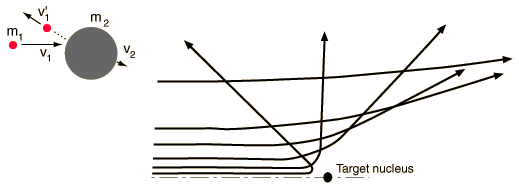
Regardless of the nature of the force in an elastic collision, to get a scattering angle greater than 90 degrees, the target must be more massive than the projectile.

无论弹性碰撞中力的性质如何,要使散射角大于90度,靶体必须比弹体更重。
Index

Rutherford concepts

Scattering concepts

Beiser reference
索引 Rutherford 概念 散射 概念 Beiser 参考
 
HyperPhysics***** Nuclear
HyperPhysics ***** 核物理
R Nave
Go Back
返回


Determining the Impact Parameter

确定影响参数

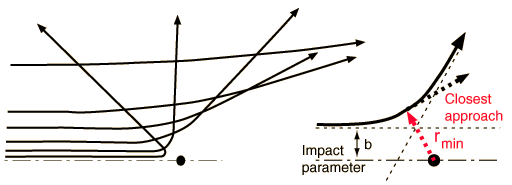
Besides the masses of the target and projectile, the scattering angle depends upon the force and upon the impact parameter. The impact parameter is the perpendicular distance to the closest approach if the projectile were undeflected.

除了目标物和弹丸的质量外,散射角还取决于力和冲击参数。冲击参数是如果弹丸未偏转时的垂直接近距离。
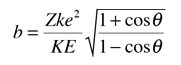
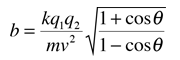
For coulomb scattering of a small projectile off a massive nucleus, the impact parameter is related to the scattering angle by
Show
显示
For the special case of alpha scattering from a nucleus of atomic number Z, the relationship is more convenient in the form to the right.
对于原子序数为Z的核的α粒子散射特殊情况,更方便的形式如右所示。
The constant multiplying Z has the value 1.44 MeV fm in units which are compatible with kinetic energies expressed in MeV. It should be noted that the kinetic energy expression used is non-relativistic, so that the expression must be modified for the extremely high energies obtained in accelerators.
For alpha particle scattering off a nucleus of atomic number Z =, an observed scattering angle of degrees for an alpha particle of kinetic energy MeV corresponds to an impact parameter of

b = x10^ m = fermi.

Determining the closest approach to the nucleus amounts to calculating the minimum distance for the hyperbolic orbit which is produced by the coulomb repulsive force. The expression for the closest approach as a function of the impact parameter b is given by:

Which has a limit for back-scattering which is just determined by setting the initial kinetic energy equal to the final potential energy. This corresponds to stopping the projectile and sending it backward, so at its closest approach, all the energy is in electric potential energy.
哪种情况的反散射有极限,其极限由将初始动能等于最终势能来确定。这对应于使弹体停止并反向发射,因此在最接近时,所有能量都转化为电势能。

The closest approach for the trajectory described above is then

上述轨迹的最近接近点则是
rmin=x10^ m = fermi.
r min = x10^ m = fermi.(专名或术语)
中文译文中的待填/计算数值依次对应:1:rmb 2:rmp 3:rmf。实际数值以上方原输入框为准。

确定粒子接近核的最近距离,相当于计算由库仑斥力产生的双曲线轨道的最小距离。该最近距离作为冲击参数b的函数表达式为:

Rutherford scattering was the first method used to measure the size of nuclei. More precise measurements are made with electron scattering, and it was discovered that the density of nuclei is approximately constant. This has made possible the modeling of nuclear radii from just their mass numbers. As a comparison for the calculated parameters above, if we assume a mass number of twice Z above, an approximate nuclear radius can be calculated.

estimated nuclear radius for A=2Z is r = fermi.

This will always be an underestimate because of the neutron excess of heavy nuclei, but a more accurate value can be obtained by using the nuclear mass in the nuclear radius relationship.

这将始终是一个低估,因为重核中中子过剩,但可以通过使用核质量来获得更准确的值。
卢瑟福散射是测量核尺寸的第一种方法。更精确的测量则使用电子散射,发现核的密度近似是恒定的。这使得仅通过核的质数就能建模核半径成为可能。作为上述计算参数的比较,如果假设质量数是Z的两倍,可以估算出核半径。对于A=2Z的情况,核半径约为r = fermi。
中文译文中的待填/计算数值依次对应:1:nr。实际数值以上方原输入框为准。

The default calculation above will be the calculation of the impact parameter b and the radius of closest approach. However, if you substitute a number for the radius of closest approach, it will calculate the kinetic energy necessary to produce that value, given the angle and other parameters.

上述默认计算将计算碰撞参数b和最近距离。然而,如果你代入一个最近距离的数值,它将计算出产生该值所需的动能,给定角度和其他参数。
Relationship of impact parameter to scattering cross section
冲击参数与散射截面的关系
对于一个轻粒子撞击重核的库仑散射,碰撞参数与散射角之间存在关系。乘以Z的常数在与以MeV表示的动能相容的单位中具有值1.44 MeV fm。应注意的是,所用的动能表达式是非相对论的,因此必须对加速器中获得的极高能量进行修正。对于原子序数为Z的核,一个α粒子以MeV的动能发生散射,散射角为度时,对应的碰撞参数为b = x10^ m = 法尔。
中文译文中的待填/计算数值依次对应:1:z 2:ang 3:ke 4:ib 5:ip 6:fm。实际数值以上方原输入框为准。
Index

Rutherford concepts

Scattering concepts

Beiser reference

Fowles reference
索引 Rutherford 概念 散射概念 Beiser 参考 Fowles 参考
 
HyperPhysics***** Nuclear
HyperPhysics ***** 核物理
R Nave
Go Back
返回