Translation or Protein Synthesis
The information required to build proteins resides on the DNA in the form of sequences of bases, and has the form of triplets of bases called "codons" following the genetic code. Once the genetic information describing how to build a protein is transcribed to RNA, it has to be "translated" into the "language" of the protein. The sequence of bases on the RNA forms a code for the amino acid building blocks of the protein. The word "translation" seems particularly appropriate for this process since the information contained in the DNA is translated from the four-character alphabet of the bases to the twenty-character alphabet of the amino acids.
The construction of the proteins is carried out on the ribosomes of the host cell. There are free floating ribosomes where proteins are built for functions in the cytoplasm. Those proteins which are to be used as part of the cell membrane or transported outside the cell are manufactured on ribosomes which are attached to the endoplasmic reticulum.
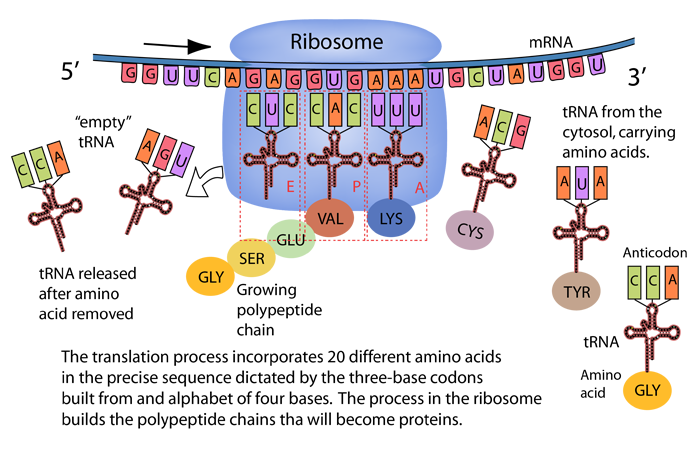
The above is a grossly oversimplified sketch of the translation process as it applies in a prokaryotic cell. See Karp for a more detailed treatment. The essentials that this illustration seeks to convey are that the ribosome uses the detailed sequence of codons on the mRNA and matches those codons to tRNA molecules which carry the corresponding amino acids. The translation process builds a polypeptide with the precise sequence of amino acids specified by the mRNA pattern. In eukaryotic cells, the translation process has many similarities but is of even greater complexity.
The process of translation can be divided into the stages of initiation, elongation, and termination. Initiation involves at least three other proteins called initiation factors to help bind the mRNA to the smaller subunit of the two-unit ribosome. It is bound to the correct location using the initiation codon AUG on the mRNA. The next phase is elongation, or adding other amino acids to the building polypeptide chain. According to Karp, a step of elongation can be accomplished in about 1/20 second, so a small protein of 400 units could be assembled in about 20 seconds! It is suggested that most of this time is used sampling the amino-acid-carrying tRNAs in the cytosol to find the ones for which there is a codon-anticodon match for the next codon along the mRNA pattern.
| Translation of a short segment
短段的平移 |
Biochemical concepts
Chemistry concepts
References
Karp
Sec 11.8
| HyperPhysics*****Chemistry
HyperPhysics ***** 化学 | R Nave |
