D Meson
The D Meson is the lightest particle which contains a charm quark, and therefore is a good example for the study of decay by quark transformation by the weak interaction.
| Particle
质点 | Symbol
符号 | Anti- particle 反粒子 | Makeup
组成 | MeV/c2 静止质量 MeV/c² | S | C | B | Lifetime
寿命 | 衰变模式 |
| 0 | x10-13 | ||||||||
| 0 | x10-13 | ||||||||
| 0 | x10-13 |
An interesting example of a particle interaction which involves the D meson was observed in a bubble chamber at SLAC in 1982 (K. Abe et al., Phys. Rev. Lett. 48,1526 (1982)). Photons at about 20 GeV were produced by Compton scattering of radiation from a YAG laser from energetic electrons from the linear accelerator. The interaction is sketched from the bubble chamber photograph. The presumption is that the photon interacted with a proton, producing the D mesons indicated. The reaction which produced these products would appear to be the following.

The reaction can be analyzed by examining the quark content of the products, and is seen to involve the production of a charm-anticharm quark pair. From the bubble chamber tracks, it can be seen that the neutral D meson decays into two products and the positive D meson decays into three. While the specific products can not be identified with just this photograph, it is interesting to propose possibilities for this process. The decays shown below are one possibility.
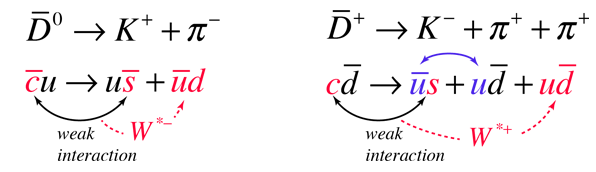
Since the D meson is the lightest meson which contains a charm quark, it must change that charm quark to some other quark in order to decay. Transmutations of quarks occurs by the weak interaction, which changes the charm quark to a strange quark with a W particle. This weak interaction process is indicated in both of the decays above. For the particular decay proposed for the positive D meson, an up-antiup quark pair is also required.
There are many possible decay processes for the D meson because it has a lot of excess mass energy. These all involve the weak interaction to change the charm quark, and the variety of W decays provide many paths for the process.
2011 reports from the Beauty detector of the Large Hadron Collider suggest that D-mesons seem to decay slightly differently from their antiparticles. The LHCb team reported a difference of about 0.8 percent - a significant difference that, if true, could herald the first "new physics" to be found at the LHC.
| Table of mesons
介子表 |
Particle concepts
References
Serway
Ch. 47
Rohlf
Ch. 17,18
| HyperPhysics***** Quantum Physics
HyperPhysics ***** 量子物理 | R Nave |