The Higgs Boson希格斯玻色子
All the known forces in the universe are manifestations of four fundamental forces, the strong, electromagnetic, weak, and gravitational forces. But why four? Why not just one master force? Those who joined the quest for a single unified master force declared that the first step toward unification had been achieved with the discovery of the W and Z particles, the intermediate vector bosons, in 1983. This brought experimental verification of particles whose prediction had already contributed to the Nobel prize awarded to Weinberg, Salam, and Glashow in 1979. Combining the weak and electromagnetic forces into a unified "electroweak" force, these great advances in both theory and experiment provide encouragement for moving on to the next step, the "grand unification" necessary to include the strong interaction. 宇宙中已知的所有力都是四种基本力的体现,即强相互作用、电磁力、弱相互作用和引力。但为什么是四种?为什么不是一种主力?那些寻求单一统一主力量的学者宣称,通过1983年发现W和Z粒子(中间矢量玻色子),人们已经迈出了统一之路的第一步。这为粒子的预测提供了实验验证,而这些预测早已促成了1979年韦因贝格、萨拉姆和格拉肖获得诺贝尔奖。将弱相互作用和电磁力结合为统一的“电弱力”,这些理论和实验的重大进展鼓励人们继续前进,迈向下一步,即“大统一”——这是将强相互作用纳入其中所必需的。
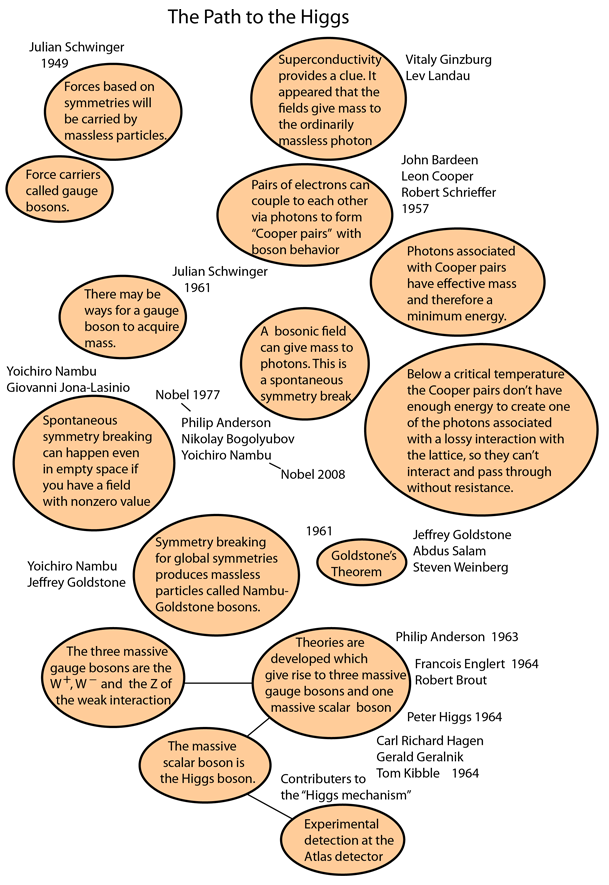
While electroweak unification was hailed as a great step forward, there remained a major conceptual problem. If the weak and electromagnetic forces are part of the same electroweak force, why is it that the exchange particle for the electromagnetic interaction, the photon, is massless while the W and Z have masses more than 80 times that of a proton! The electromagnetic and weak forces certainly do not look the same in the present low temperature universe, so there must have been some kind of spontaneous symmetry breaking as the hot universe cooled enough that particle energies dropped below 100 GeV. The theories attribute the symmetry-breaking to a field called the Higgs field, and it requires a new boson, the Higgs boson, to mediate it. 尽管电弱统一被赞誉为一大进展,但仍存在一个主要的理论问题。如果弱相互作用和电磁相互作用是同一种电弱力的一部分,那么为什么电磁相互作用的交换粒子——光子——是无质量的,而W和Z玻色子的质量却超过质子质量的80倍!在当前低温宇宙中,电磁力和弱力显然看起来并不相同,因此当热宇宙冷却到粒子能量低于100 GeV时,必定发生了某种自发对称破缺。这些理论将对称破缺归因于一个称为希格斯场的场,并需要一个新的玻色子——希格斯玻色子——来实现这一过程。
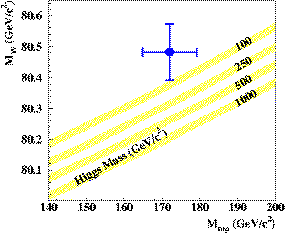
Searching for the Higgs boson was one of the high priority objectives of the Large Hadron Collider at CERN. At the end of 2011, the LHC results appeared to limit the Higgs to between 114 and 145 GeV if it is to fit in the standard model of particle physics. Then in 2012 a peak at 125 GeV was found by both the Atlas and CMS detectors, and by 2013 there was confidence that a Higgs boson had been found.
寻找希格斯玻色子是欧洲核子研究中心大型强子对撞机的高优先级目标之一。2011年底,LHC的结果似乎将希格斯玻色子的质量限制在114至145 GeV之间,如果它要符合粒子物理标准模型。然后在2012年,ATLAS和CMS探测器都发现了125 GeV处的峰值,到2013年,人们确信已发现了希格斯玻色子。 |
Index Fundamental force concepts Higgs Vimeo Higgs Vimeo Atlas bulletin on Higgs Higgs boson Wiki 索引 基本力概念 Higgs Vimeo Higgs Vimeo Atlas 关于Higgs的公告 Higgs玻色子 Wiki | |||||
|
Go Back
返回 |
|
Index Fundamental force concepts Carroll The Particle at the End... 索引基本力概念Carroll《质点的尽头》 | ||
|
Go Back
返回 |
The Atlas Evidence for the Higgs希格斯玻色子的ATLAS证据
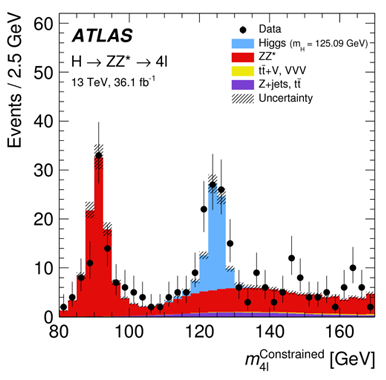
One of the most important goals for the ATLAS detector and CMS detector of the Large Hadron Collider was to search for the Higgs boson. Previous experiments had suggested that the Higgs might have a mass less than 200GeV and might be within the range of the Atlas detector. On July 4, 2012 ATLAS and the CMS detectors at the LHC reported evidence of a particle consistent with the Higgs boson at around 125GeV or 133 times the proton mass. This and subsequent studies are reported in an Atlas bulletin on 4 July 2018. The particle was detected by its decay into two photons and its decay into four leptons. These experiments showed that the properties of the particle and its interactions with other particles were well-matched with the projected properties of the Higgs boson. In March 2013 CERN announced that the new particle was indeed a Higgs boson, and two of the involved theoretical physicists, Peter Higgs and Francois Englert, were awarded the Nobel Prize in Physics for their contributions. An Atlas bulletin of 26 October 2017 described evidence for the Higgs boson in association with two top quarks. 2017年10月26日的ATLAS通报描述了与两个顶夸克相关的希格斯玻色子的证据。
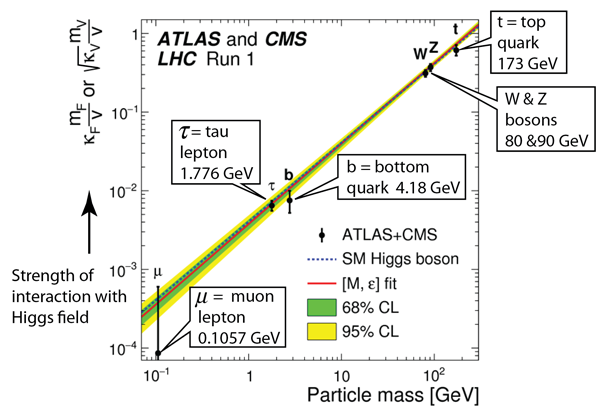
![]() Click on particle for more discussion. ATLAS探测器和CMS探测器的重要目标之一是寻找希格斯玻色子。此前的实验表明,希格斯可能的质量小于200GeV,并且可能在Atlas探测器的探测范围内。2012年7月4日,LHC上的ATLAS和CMS探测器报告了在约125GeV或133倍质子质量处发现的粒子,该粒子与希格斯玻色子一致。这一发现以及后续的研究于2018年7月4日发表在Atlas公报中。该粒子通过其衰变成两个光子和其衰变成四个轻子的方式被探测到。这些实验表明,该粒子的性质及其与其他粒子的相互作用与预期的希格斯玻色子的性质相吻合。2013年3月,CERN宣布新发现的粒子确实是一个希格斯玻色子,并且两位参与理论研究的物理学家彼得·希格斯和弗朗索瓦·恩格勒因他们的贡献获得了诺贝尔物理学奖。点击粒子了解更多讨论。 This is modified from Figure 4 of the Atlas Bulletin. It shows data from Atlas and CMS to depict the proportionality of particle mass to the strength of the interaction with the Higgs field. Continuing studies past the 2013 discoveries have shown the Higgs boson to be consistent with the predicted properties: zero spin, no electric charge, no strong force interaction, even parity. Even the proportions of the decay paths have agreed with those predicted. 这幅图改编自Atlas公报中的图4。它展示了ATLAS和CMS的数据,以说明粒子质量与与希格斯场相互作用强度的比例关系。继续研究2013年的发现结果表明,希格斯玻色子的性质与预测一致:零自旋,无电荷,无强相互作用,偶宇称。甚至衰变路径的比例也与预测一致。 The Atlas and CMS collaboration continues to work on the exploration of the Standard Model of particle physics, and in a 25 October 2019 Bulletin report a Higgs mass of 125.35 +/- 0.15 GeV. ATLAS和CMS合作组继续致力于粒子物理标准模型的探索,并在2019年10月25日的 Bulletin 报告中,报告了希格斯粒子质量为125.35 ± 0.15 GeV。 |
Index Fundamental force concepts Carroll The Particle at the End... Atlas Experiment wiki 索引 基本力概念 Carroll 《质点的尽头...》 Atlas 实验 wiki | ||
|
Go Back
返回 |
The Higgs Field希格斯场
Much attention has been given to the search for and discovery of the Higgs boson, which serves as a confirmation of the Brout-Englert-Higgs (BEH) mechanism by which elementary particles obtain mass. The theory envisions space as filled with the Higgs field, and suggests the elementary particles like leptons and quarks obtain their mass by interaction with the Higgs field. A larger mass for a particle implies that it has a stronger interaction with the Higgs field. The Atlas studies depict a linear relationship of particle mass with the strength of the interaction with the Higgs field. This does not imply that the composite particles (hadrons) obtain all their mass from the Higgs field interaction - the bulk of the mass of a hadron like a proton arises from the strong force interactions. 对希格斯玻色子的搜索和发现给予了大量关注,它作为Brout-Englert-Higgs(BEH)机制的确认,该机制是通过与基本粒子获得质量有关的。该理论设想空间被希格斯场充满,并建议像轻子和夸克这样的基本粒子通过与希格斯场的相互作用获得质量。一个粒子的质量越大,说明它与希格斯场的相互作用越强。Atlas研究显示粒子质量与与希格斯场相互作用强度之间存在线性关系。这并不意味着复合粒子(强子)的所有质量都来自与希格斯场的相互作用——例如质子的大部分质量来自于强相互作用。 There are many kinds of fields, such as electric fields and magnetic fields, and one would suppose that at a great distance from the sources of these fields, their values would approach zero. But Carroll describes the Higgs field as "stuck away from zero". All of space is seen as pervaded by this field which has a non-zero value. Carroll quotes this ground state field value as 246 GeV. This is called the "vacuum expectation value" of the Higgs field. "The Higgs boson - the particle discovered at the LHC - is a vibration in that field around its average value." The Higgs field "fills space, breaks symmetries, gives mass and individuality to the other particles of the Standard Model." 存在许多种类的场,例如电场和磁场,人们或许会认为在这些场源远处,它们的值会接近零。但Carroll描述希格斯场为“远离零”。整个空间都被认为是被这种场充满的,这种场具有非零的值。Carroll引用这种基态场值为246 GeV。这被称为“希格斯场的真空期望值”。“希格斯玻色子——在大型强子对撞机上发现的粒子——是该场围绕其平均值的振动。”“希格斯场‘充满空间,破坏对称性,给标准模型中的其他粒子赋予质量和个性。” The ideas of symmetry and symmetry-breaking in this context are not easily explained. For the weak interaction we have the bosons W+, W-, and Z with the statement that the Higgs boson itself is the fourth member of a boson quartet. It is said that at about 10-12 seconds after the Big Bang, there was a spontaneous symmetry break from a state in which all four were massless and traveling at the speed of light (i.e., symmetric). Interaction with the Higgs field gave them their distinctive masses and character. 在本上下文中,对称性和对称破缺的概念并不容易解释。对于弱相互作用,我们有W⁺、W⁻和Z玻色子,其中陈述说希格斯玻色子本身是玻色子四元组中的第四成员。据说在大爆炸后约10⁻¹²秒时,从一个所有四个粒子都是无质量且以光速(即对称的)的状态中发生了自发对称破缺。与希格斯场的相互作用赋予了它们独特的质量特性。 The Higgs field is critical as a source of the basic structure of matter as we know it. Such matter consists of atoms with tiny nuclei surrounded by a much larger regions of space determined by the electrons of the atoms. Ordinary matter including the elements of the periodic table is made up of just three types of fermions, the electron and the up and down quarks. They are responsible for the great difference in scale between the nucleus and the atom. Quantum mechanically, an electron can be considered to be a wave-packet that obtains its relatively small mass by interacting with the Higgs field. The small mass energy translates to a relatively long characteristic wavelength, so the packet is spread out in space. This gives a relatively large size to the atom as a whole. The up and down quarks which make up protons and neutrons in the nucleus have a relatively much larger mass from a stronger interaction with the Higgs field. The characteristic wavelengths of their quantum mechanical wave packets are much smaller. They make up the nucleus as an entity much smaller than the atom. This approach to the scale of the nucleus and atom should be compared to the discussion of particle confinement and the uncertainty principle. 希格斯场对于我们所知的物质的基本结构是至关重要的。这种物质由原子组成,原子的原子核被电子所确定的较大空间区域包围。普通物质,包括元素周期表中的元素,仅由三种费米子组成,即电子和上夸克和下夸克。它们导致了原子核与原子之间尺度的巨大差异。在量子力学中,电子可以被视为一个波包,其相对较小的质量是通过与希格斯场相互作用获得的。这种小质量的能量转化为相对较长的特征波长,因此波包在空间中扩展。这使得整个原子具有相对较大的尺寸。构成原子核的上夸克和下夸克由于与希格斯场的更强相互作用,具有相对更大的质量。它们的量子力学波包的特征波长要小得多。它们构成了一个比原子小得多的整体原子核。这种对原子核和原子尺度的处理应与粒子束缚和不确定性原理的讨论进行比较。 |
Index Fundamental force concepts Carroll The Particle at the End... Ch 2,8, App 1 Vacuum expectation value, Wiki Atlas Experiment wiki 索引 基本力概念 Carroll 《质点的尽头...》第2、8章,附录1 真空期望值,Wiki Atlas 实验 wiki | ||
|
Go Back
返回 |