Why Higher Energy?
为何高能量?
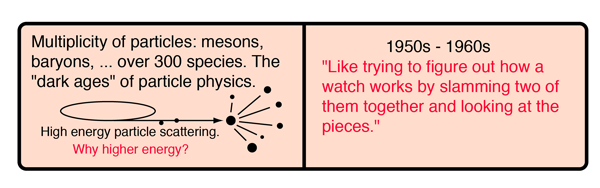
Why the quest for ever-higher energy for the particle accelerators? One answer is to break things apart so that you can look at the pieces. But a deeper reason lies in the essential wave-particle duality and the fact that the attainable resolution of any type of imaging system is on the order of the wavelength of the waves used for the imaging.
为什么粒子加速器要不断追求更高的能量?一个原因是将物体拆开,以便观察其碎片。但更深层次的原因在于基本的波粒二象性,以及任何成像系统的可实现分辨率大致等于所用波的波长。
Light microscopes cannot resolve detail smaller than the wavelength of light. This limitation is related to the Rayleigh criterion for the ultimate resolution of an imaging system. Electron microscopes have higher resolution because the associated wave properties of the electrons have much shorter wavelengths. The de Broglie relationship which allows us to calculate these wavelengths implies that a higher momentum (and thus higher energy) electron has a shorter wavelength.
光镜无法分辨比光的波长更小的细节。这个限制与成像系统的最终分辨率的瑞利标准有关。电子显微镜具有更高的分辨率,因为电子的波性质具有远更短的波长。德布罗意关系使我们能够计算这些波长,这表明动量(因此能量更高)的电子具有更短的波长。
The extremely small nuclear size implies that much higher energy particles will have to be used to resolve details of its structure, and to probe to smaller detail will require higher and higher energy particles with which to do the imaging.
极小的核尺寸意味着要解析其结构细节,必须使用能量极高的粒子。要探测更小的细节,则需要更高能量的粒子来进行成像。
Ultimately, the energy required for the resolution of smaller structural details will be beyond our capacity on the Earth. This has led to a closer cooperation between the search for the very small and the search for the very large, because only in the consideration of cosmology and the high energies involved in formation processes in the universe can we find information about the very small.
最终,解析更小结构细节所需的能量将超出我们在地球上的能力。这导致了对非常小尺度的探索与对非常大尺度的探索之间的紧密合作,因为只有在考虑宇宙学以及宇宙形成过程中涉及的高能情况时,才能获得关于非常小尺度的信息。
|