The Omega-Minus Baryon
| Particle
质点 | Symbol
符号 | Makeup
组成 | Rest mass MeV/c2 静止质量 MeV/c² | Spin
自旋 | B | S | Lifetime
寿命 | 衰变模式 |
欧米伽 | sss(专名或术语) | x10-10 |
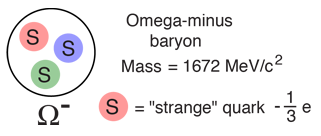 |
The omega-minus, a baryon composed of three strange quarks, is a classic example of the need for the property called "color" in describing particles. Since quarks are fermions with spin 1/2, they must obey the Pauli exclusion principle and cannot exist in identical states. So with three strange quarks, the property which distinguishes them must be capable of at least three distinct values. omega减粒子,由三个奇异夸克组成,是需要在描述粒子时引入称为‘色’的性质的经典例子。由于夸克是自旋为1/2的费米子,它们必须遵守泡利不相容原理,不能处于相同的状态。因此,三个奇异夸克之间的区别属性必须至少有三个不同的值。
|
The discovery of the omega baryon was a great triumph for the quark model of baryons because it was searched for and found only after its existence, mass, and decay modes were predicted by the quark model. It was discovered at Brookhaven in 1964. At left is a sketch of the bubble chamber photograph in which the omega-minus baryon was discovered.
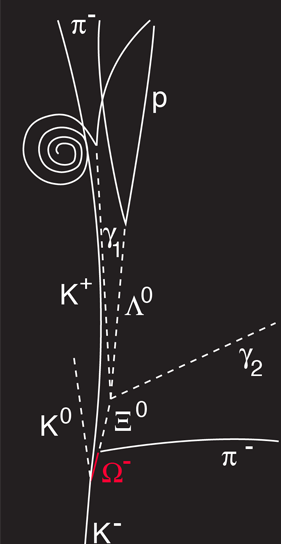 V. E. Barnes et al., Phys. Rev. Lett. 12, 204 (1964) V. E. Barnes 等人,Phys. Rev. Lett. 12, 204 (1964)
|
The omega-minus was produced by a K-p collision which produced the omega-minus and two kaons. omega负粒子是由K粒子与质子的碰撞产生的,该碰撞产生了omega负粒子和两个K介子。
 Considering the particle conservation laws, this interaction conserves strangeness and therefore proceeds by the strong interaction. The decays observed are as follows. 考虑质点守恒定律,这种相互作用 conserve 强相互作用。观察到的衰变如下。
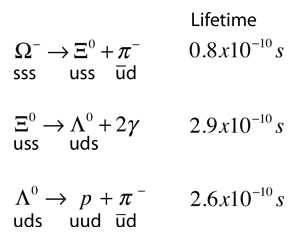 Note that all three of these decays violate strangeness conservation and therefore can proceed only by the weak interaction. This gives them longer lifetimes, on the order of 注意,这三个衰变过程都违反了 strangeness conservation,因此只能通过弱相互作用进行。这使得它们的寿命更长,大约为 10 -10 秒。
|
Examining the decays of the omega-minus above, you see that a quark-antiquark pair can be added on the right, provided the process satisfies conservation of energy. It is expected that the strange quark will be transmuted to an up quark by a quark decay process involving the W- vector boson. This can produce an electron plus and antineutrino, but an alternative W- process involves the production of an up plus an antiup-down (a π- meson). It appears that alternative decay is operating here.
In the decay of the Xi particle above, a lambda baryon and two gamma rays are shown as the products. Actually, the primary decay of the Xi is to a lambda-zero and a pi-zero. It is just that the π0 decays into two gammas with a lifetime of about 10-16 seconds, so the two gamma rays appear to come from the same point as the lambda.
According to the Particle Data Book, the decays of the omega minus branch are as follows:
Λ0K- 67.8%, Ξ0π- 23.6%, and Ξ-π0 8.6%.
| Table of Baryons
重子表 | Baryon Diagram
重子图 |
| Table of quark properties
夸克性质表 | Conservation of Strangeness
strangeness 的守恒 |
Particle concepts
| HyperPhysics***** Quantum Physics
HyperPhysics ***** 量子物理 | R Nave |