Black Hole黑洞
A black hole is an object that meets the conditions that even light cannot escape from it. The idea of a black hole arises from the concepts of Einstein's general relativity, particularly the curvature of space-time by the gravity of a massive object. The fact that light follows this curvature suggests the possibility of a curvature so extreme that light cannot escape the vicinity of the object. The gravity of a massive object interacts with photons to produce a gravitational red shift, representing a decrease in photon energy with increasing radial distance. If the photon frequency and energy are red-shifted to zero, this is another way of saying that the photon cannot escape. The red shift to zero is associated with a radius, the Schwarzschild radius. Using the existence of a Schwarzschild radius to characterize a black hole, it becomes evident that a black hole with larger mass will have a larger Schwarzschild radius so that black holes could conceivably exist with any mass provided that mass could be contained in a sufficiently small radius. The development that describes the gravitational red shift also points to gravitational time dilation, the fact that being closer to a gravitational mass will progressively slow down the progress of time. As an object approaches the Schwarzschild radius, the progress of time approaches zero so that time stands still. This radius is commonly called the "event horizon" since no information is available past this radius. If a massive object is contracting, there are certain processes which tend to halt the contraction, such as electron degeneracy which may stop the contraction to form a white dwarf. If the mass is too great for a white dwarf, neutron degeneracy may halt it to form a neutron star. But if the mass is greater than two to three solar masses there is no known mechanism to halt further collapse and it is presumed not only that a black hole will result from the collapse, but that the collapse will continue toward zero spatial extent, a singularity.
黑洞是一个满足条件的天体,即使光也无法从其中逃逸。黑洞的概念源于爱因斯坦的广义相对论,特别是大质量天体的引力对时空曲率的影响。光遵循这种曲率的事实表明,可能存在一种极端的曲率,使得光无法逃离该天体的附近区域。大质量天体的引力与光子相互作用,产生引力红移,表示光子能量随着径向距离的增加而减少。如果光子的频率和能量红移至零,这相当于说光子无法逃逸。红移至零与一个称为施瓦茨希尔德半径的半径相关。利用施瓦茨希尔德半径来描述黑洞,可以明显看出,质量越大的黑洞,其施瓦茨希尔德半径也越大,因此理论上只要质量能够被包含在一个足够小的半径内,黑洞就可能以任何质量存在。描述引力红移的发展也指向了引力时间膨胀,即靠近引力质量会逐渐减慢时间的流逝。当物体接近施瓦茨希尔德半径时,时间的流逝接近于零,时间就停止了。这个半径通常被称为“事件视界”,因为在此半径之外没有信息可以获取。如果一个大质量天体在收缩,有一些过程会阻止收缩,例如电子简并压力可能阻止收缩并形成白矮星。如果质量太大,无法形成白矮星,中子简并压力可能阻止进一步收缩并形成中子星。但如果质量大于两到三倍太阳质量,则没有已知的机制可以阻止进一步坍缩,因此不仅假设坍缩会形成黑洞,而且坍缩会继续向零空间范围发展,形成奇点。 |
Index General relativity ideas Black hole concepts 索引 广义相对论 概念 黑洞概念 | ||
|
Go Back
返回 |
Gravity and the Photon重力与光子
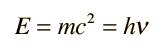
The relativistic energy expression attributes a mass to any energetic particle, and if applied to the photon with its zero rest mass: 相对论能量表达式给任何有能量的粒子赋予质量,如果应用于静止质量为零的光子:
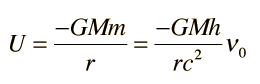
![]() The effective gravitational potential energy* is then 有效的引力势能则是
![]() If an emitted photon of frequency υ0 moves relative to the gravitational mass, it will have a measurably different frequency 如果一个发射的光子频率为υ₀,相对于引力质量运动,其频率将产生可测量的差异
![]() Since it is reduced in frequency, this is called the gravitational red shift or the Einstein red shift. The above expression is an approximation for weak gravity fields, which can be applied to small laboratory displacements on the Earth like the Harvard Tower experiment, but can be generalized for gravitational fields of any strength. 由于频率降低,这种现象称为引力红移或爱因斯坦红移。上述表达式是适用于弱引力场的近似式,可以应用于地球上的小实验室位移,如哈佛塔实验,但可以推广到任何强度的引力场。
*The idea of "gravitational potential energy" for a photon must be brought into consistency with general relativity, which would attribute the gravity effect to the local curvature of space-time. So any "effective mass" for the photon is subject to the same difficulties as the "relativistic mass" for a high speed particle.
‘光子的引力势能’的概念必须与广义相对论相一致,而广义相对论会将引力效应归因于时空的局部曲率。因此,光子的任何‘有效质量’都会遇到与高速粒子的‘相对论性质量’相同的困难。 |
Index General relativity ideas 索引 广义相对论思想 | ||
|
Go Back
返回 |
Escape Energy for Photon光子的逃逸能量
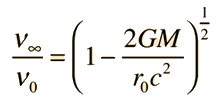
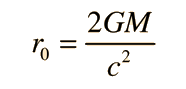
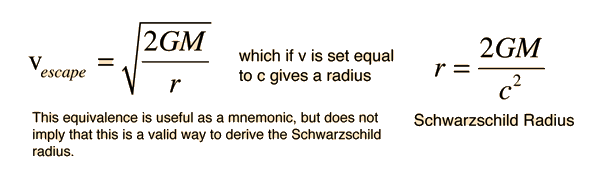
While the idea of an effective gravitational potential energy* for the photon is of some usefulness in weak gravitational fields or small displacements near the Earth, it is usually more useful to work with the general expression for the gravitational red shift. Presuming that a photon is emitted at radius r0 near a gravitational mass M and is measured at a great distance from the mass, the observed frequency is given by the relationship ![]() 尽管对于光子的有效引力势能*在弱引力场或地球附近的小位移中有一些用处,但通常更实用的是使用一般的引力红移表达式。假设一个光子在距离引力质量M的半径r₀处发射,并在远处被测量到,观测到的频率由以下关系给出 If the photon frequency and energy are essentially zero at the great distance of observation, then the expression on the right has approached zero and we have the condition ![]() 如果在观测的遥远距离上光子的频率和能量基本上为零,那么右边的表达式已趋近于零,我们有该条件 Note that this condition is independent of the frequency, and for a given mass M establishes a critical radius called the Schwarzschild radius at which photons cannot escape from the mass M. This is not a derivation of the Schwarzschild radius, which comes from the Schwarzschild metric, but shows the correlation with gravitational redshift. 需要注意的是,这一条件与频率无关,对于给定的质量M,它确定了一个临界半径,称为Schwarzschild半径,此时光无法从质量M逃逸。这并不是Schwarzschild半径的推导,后者来源于Schwarzschild度规,但展示了它与引力红移的相关性。 It is interesting historically that the Schwarzschild radius expression is coincidently equal to the gravitational escape velocity expression for velocity v=c. ![]() 历史上有趣的是,施瓦茨希尔德半径表达式恰好等于逃逸速度表达式,当速度v=c时。 In 1783 John Michell (1724-1793), an English clergyman and amateur astronomer considered the implications of Newton's corpuscular theory of light. Considering that such a stream of particles should be affected by gravity, he speculated that for a sufficiently massive body, light would not be able to escape. 1783年,英国神职人员兼业余天文学家约翰·弥切尔(1724-1793)考虑了牛顿光粒子理论的含义。考虑到这样的粒子流应受重力影响,他推测对于足够大的天体,光将无法逃逸。 *The idea of "gravitational potential energy" for a photon must be brought into consistency with general relativity, which would attribute the gravity effect to the local curvature of space-time. So any "effective mass" for the photon is subject to the same difficulties as the "relativistic mass" for a high speed particle.
‘光子的引力势能’的概念必须与广义相对论相一致,而广义相对论会将引力效应归因于时空的局部曲率。因此,光子的任何‘有效质量’都会遇到与高速粒子的‘相对论性质量’相同的困难。 |
Index General relativity ideas Reference: Carroll & Ostlie, Sec 17.3. 索引 广义相对论思想 参考:Carroll & Ostlie,第17章第3节。 | ||
|
Go Back
返回 |