Bilingual edition: English is preserved and Chinese follows each unit. Terminology uses the confirmed v20260916 glossary; automated semantic review remains traceable.
中英双语版:英文原文完整保留,中文紧随对应单元;术语采用 v20260916 确认表,自动语义审校结果可追溯。

Gravitational Red Shift

引力红移

According to the principle of equivalence from general relativity, any frequency shift which can be shown to arise from acceleration of a radiating source could also be produced by the appropriate gravitational field. If a photon of frequency υ0 is emitted radially outward from the surface of a gravitational mass M, then the photon energy observed at a distance from the mass will be observed to be lower, or "red shifted". If observed at a great distance, we could denote the observed frequency as υ∞. The result of general relativity using the Schwarzschild metric is
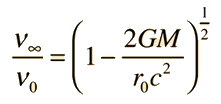
根据广义相对论中的等效原理,任何能够由辐射源加速所产生的频率变化,也可以由适当的引力场产生。如果一个频率为 υ₀ 的光子从引力质量 M 的表面径向向外发射,那么在距离该质量较远的地方观测到的光子能量会更低,或者说发生了‘红移’。如果在很远的距离处观测,我们可以将观测到的频率记为 υ ∞ 。广义相对论利用施瓦茨希尔德度量得出的结果是

which is valid for even strong gravitational fields. For weak gravitational fields or small displacements in a gravity field, one can make use of the approximation:
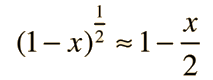
这在甚至强引力场中也成立。对于弱引力场或引力场中的小位移,可以利用近似式:

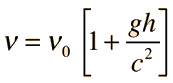
to express the frequency shift between two locations as
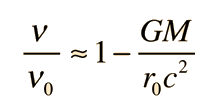
用以表达两个地点之间的频率偏移

Where υ0 represents a photon emitted closer to the gravitational mass. This form made practical some laboratory experiments using nuclear sources with the gravitational term expressed in terms of the gravitational acceleration g on the Earth's surface.

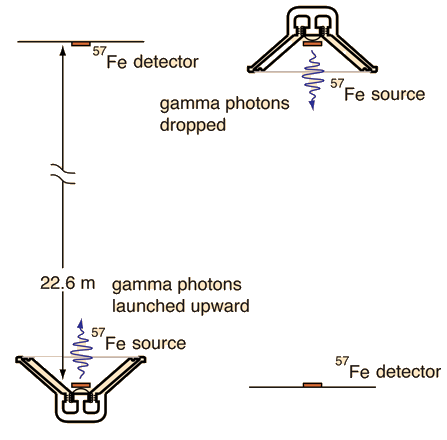
For the Harvard Tower experiment, the shifts in radiation frequency in the gravitational field were related to the relativistic doppler shift experienced from an accelerating light source.
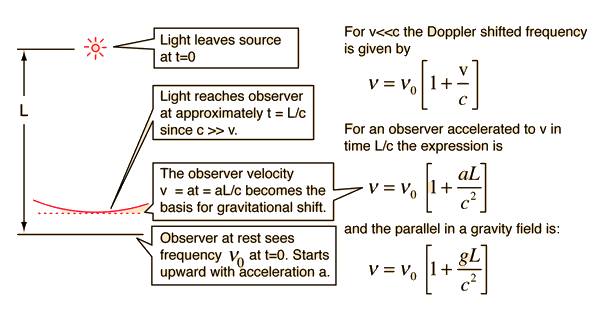
在哈佛塔实验中,引力场中的辐射频率变化与从加速光源经历的相对论多普勒效应有关。

Gravity and the photon

重力与光子
Applications:
Harvard tower experiment
哈佛塔实验
其中 υ₀ 表示一个更接近引力质量的光子。这种形式使一些利用核源的实验室实验得以实现,其中引力项以地球表面的重力加速度 g 表达。应用:
Index

General relativity ideas

References:
Carroll & Ostlie
Sec 17.1
索引 广义相对论思想 参考文献:Carroll & Ostlie 第17章第1节
 
HyperPhysics***** Relativity
HyperPhysics ***** 相对论
R Nave
Go Back
返回


Harvard Tower Experiment

哈佛塔实验
In just 22.6 meters, the fractional gravitational red shift given by
is just 4.92 x 10⁻¹⁵ , but the Mossbauer effect with the 14.4 keV gamma ray from iron-57 has a high enough resolution to detect that difference. In the early 60's physicists Pound, Rebka,and Snyder at the Jefferson Physical Laboratory at Harvard measured the shift to within 1% of the predicted shift.
在22.6米的范围内,由公式给出的分数引力红移仅为4.92×10⁻¹⁵,但铁-57的14.4 keV伽马射线的莫塞莱效应具有足够的分辨率,可以检测到这一差异。20世纪60年代初,哈佛大学的Jefferson物理实验室的Pound、Rebka和Snyder测量了该红移,其精度达到预测值的1%。

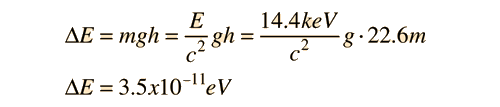
By just using the expression for gravitational potential energy near the Earth, and using the m in the relativistic energy expression, the gain in energy for a photon which falls distance h is

通过使用地球附近的引力势能表达式,以及相对论能量表达式中的m,可以得到一个光子下落高度h时能量增益的表达式。

Comparing the energy shifts on the upward and downward paths gives a predicted difference

比较上行和下行路径上的能量变化可预测出差异

The measured difference was

测得的差异是

The success of this experiment owed much to the care of Pound and Rebka in preparing the source. They electroplated cobalt-57 onto the surface of a thin sheet of iron and then heated the combination at 1220 K for an hour. The heat treatment caused the cobalt to diffuse into the iron to a depth of about 300 nm or 1000 atomic spacings. The source was then mounted on the cone of a loudspeaker driven at 10Hz to sweep the source velocity in a sinusoidal variation. The detector was a thin sheet of iron about 14 micrometers thick which was also annealed. The heat treatments were found to be crucial in obtaining high resolution.

这项实验的成功很大程度上归功于Pound和Rebka在准备源时的细心。他们将钴-57电镀在薄铁片的表面,然后将组合物在1220 K下加热一小时。热处理使钴扩散到铁中,深度约为300纳米或1000个原子间距。源被安装在扬声器的锥体上,扬声器以10Hz驱动,使源的速度呈正弦变化。探测器是一个约14微米厚的薄铁片,它也进行了退火处理。热处理被发现是获得高分辨率的关键。
Index

General relativity ideas

References: Harvard Tower
索引 广义相对论 概念 参考文献: 哈佛塔
 
HyperPhysics***** Relativity
HyperPhysics ***** 相对论
R Nave
Go Back
返回


Scout Rocket Experiment

侦察火箭实验
In 1976 the Smithsonian Astrophysical Observatory sent aloft a Scout rocket to a height of 10,000 km. At this height, a clock should run 4.5 parts in 1010 faster than one on the Earth. During two hours of free fall from its maximum height, the rocket transmitted timing pulses from a maser oscillator which acted as a clock and which was compared with a similar clock on the ground. This result confirmed the gravitational time dilation relationship to within 0.01%.

Gravity Probe A

重力探测器A
1976年,史密松天体物理观测站发射了一枚Scout火箭,升至10,000公里的高度。在这一高度,一个钟表应该比地球上的钟表快4.5个部分每10^10。在两小时的自由下落过程中,火箭从其最高点发射了定时脉冲,这些脉冲由一个微波振荡器产生,该振荡器充当了一个钟表,并与地面上的另一个类似钟表进行比较。这一结果将引力时间膨胀关系的确认精度控制在0.01%以内。
Index

General relativity ideas
索引 广义相对论思想
 
HyperPhysics***** Relativity
HyperPhysics ***** 相对论
R Nave
Go Back
返回


Gravitational Time Dilation

引力时间膨胀
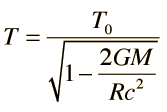
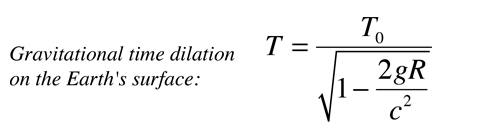
A clock in a gravitational field runs more slowly according to the gravitational time dilation relationship from general relativity
This is distinct from the time dilation from relative motion
这与相对运动引起的时间膨胀不同
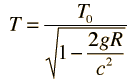
where T is the time interval measured by a clock far away from the mass. For a clock on the surface of the Earth, this expression becomes

This time dilation is about 1 part in 109. .....Show

这次时间膨胀大约是每十亿分之一。
Applications:
Commercial airline experiment
商业航空实验
Scout rocket experiment
侦察火箭实验
根据广义相对论中的引力时间膨胀关系,一个处于引力场中的钟走得更慢。其中T是远离质量的钟所测量的时间间隔。对于位于地球表面的钟,这个表达式变为应用:
Index

General relativity ideas
索引 广义相对论思想
 
HyperPhysics***** Relativity
HyperPhysics ***** 相对论
R Nave
Go Back
返回


Time Dilation on Earth

地球上的时间膨胀

The gravitational time dilation expression

引力时间膨胀表达式

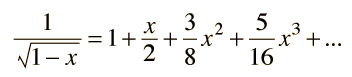
has such a small second term in the denominator that excessive numerical accuracy is required to evaluate it directly. Using a binomial expansion :

分母中有一个非常小的第二项,因此要直接计算它需要很高的数值精度。使用二项式展开:

so that the first approximation to the time expression is

使得时间表达式的第一近似为

The numerical values were calculated using g = 9.8 m/s2, R = 6.38 x 10⁶m (mean radius), and c= 3 x 10⁸m/s.

数值是使用g = 9.8 m/s²,R = 6.38 × 10⁶ m(平均半径),和c= 3 × 10⁸ m/s计算得到的。
Index

General relativity ideas
索引 广义相对论思想
 
HyperPhysics***** Relativity
HyperPhysics ***** 相对论
R Nave
Go Back
返回