Europa
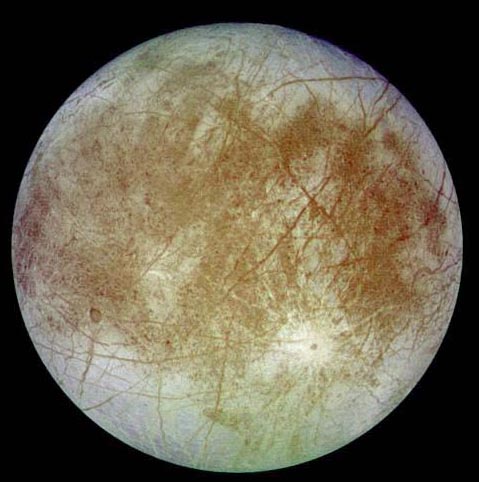
Europa, one of the moons of Jupiter, is about 3,160 kilometers (1,950 miles) in diameter, or about the size of Earth's moon. This image was taken on September 7, 1996, at a range of 677,000 kilometers (417,900 miles) by the solid state imaging television camera onboard the Galileo spacecraft during its second orbit around Jupiter. The bright feature containing a central dark spot in the lower third of the image is a young impact crater some 50 kilometers (31 miles) in diameter. This crater has been provisionally named 'Pwyll' for the Celtic god of the underworld.
| Closer view of Pwyll crater
Pwyll环形山的近距离观察 |
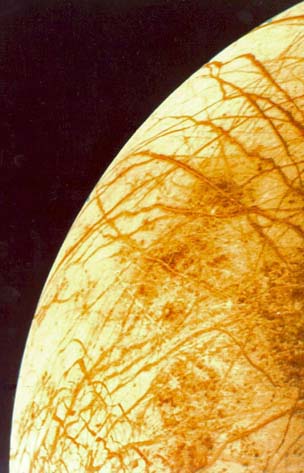
 NASA 从维京任务获得的图像 | Europa orbits at 9.4 Jupiter radii, compared to 5.9 for Io. Europa is very different, showing a vast network of lines on fields of water ice. Some of the lines (ridges, fractures?) extend halfway around the moon. There are similar ridges on ice floes in Earth's polar ridges, called "pressure ridges". There are very few impact features on Europa, suggesting a young surface. Modeling of Europa suggests a vast water ocean below the ice layer which itself may be several kilometers deep. Europa is the only body other than Earth in the solar system which has a water ocean. The possibility that this water might harbor some type of life was one motivation for extending the Galileo mission for another two years. With a surface temperature of only 130K, it is not a hospitable environment for life.
欧罗巴绕行在木星辐射的9.4倍处,而木卫一则为5.9倍。欧罗巴与木卫一非常不同,其表面显示出广阔的冰层上的裂纹网络。一些裂纹(条带、裂缝?)可延伸至月球的一半周长。在地球的极地冰架上也有类似的条带,称为'压力条带'。欧罗巴表面的撞击特征非常少,这表明其表面非常年轻。对欧罗巴的建模显示,在冰层下存在广阔的水海洋,该冰层可能有数公里深。欧罗巴是太阳系中除地球外唯一拥有水海洋的天体。这种水可能孕育某种生命的可能性,是延长伽利略任务两年的动机之一。尽管其表面温度仅为130K,但它并不适宜生命存在。 |
 伽利略轨道器的NASA图像 | Europa is one of the largest four moons of Jupiter. These moons are called the "Galilean moons" because they were first observed by Galileo. Drake reports modeling results suggesting a roughly 10-kilometer-thick crust of ice with perhaps a 160-km-deep water ocean beneath it. It is being studied as a candidate for life, and part of the modeling suggests a tenuous oxygen atmosphere and the possibility of oxygen diffusing through the ice layer to the inner salty sea. Life-candidacy studies focus on dark red, possibly sulfur-rich deposits on the surface which are thought to come from the interior, and might contain by-products of primitive life. Drake报告称,模型结果表明,其表面可能覆盖着约10公里厚的冰层,下方可能有一个深达160公里的水海洋。该天体被研究作为可能孕育生命的候选者,部分模型结果还表明可能存在一个脆弱的含氧大气层,氧气可能通过冰层扩散到内部的咸水海洋中。关于生命可能性的研究重点在于表面的暗红色、可能富含硫的沉积物,这些沉积物被认为来自内部,可能含有原始生命的副产品。
木卫二是在木星的四颗大卫星之一。这些卫星被称为‘伽利略卫星’,因为它们最初是由伽利略发现的。 |
References
"Alien-life hunters focus on moons in outer solar system", Nadia Drake, Science News 180, #8, Oct 8, 2011, p22.
| Images of Europa from Galileo
伽利略拍摄的木卫二图像 |
Jupiter Concepts
Solar System Illustration
Solar System Concepts
References
Chaisson & McMillan,
Ch 11.
| HyperPhysics********** Astrophysics
HyperPhysics ********** 天体物理学 | R Nave |