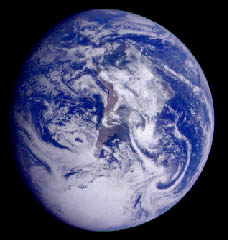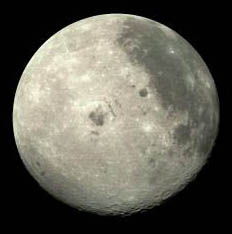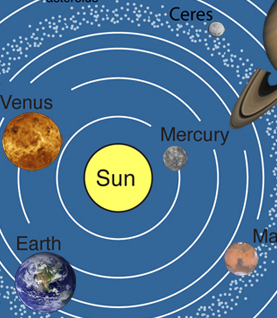
The Moon is our nearest neighbor, but it has evolved very differently from the Earth because it's gravity is too weak to hold an atmosphere. With no air, the lifeless Moon has no surface erosion from wind, rain, or snow, and thus lunar craters and even astronaut footprints last for millions of years.
月球是我们最近的邻居,但它与地球演化出了非常不同的特征,因为它重力太弱,无法留住大气。没有空气,死寂的月球没有风、雨或雪造成的表面侵蚀,因此月球上的陨石坑甚至宇航员的脚印都能持续数百万年。
Man first set foot on the Moon on July 20, 1969 when the landing craft from the Apollo 11 mission touched down on the Moon.
1969年7月20日,阿波罗11号任务的登月舱首次踏上月球。
The temperature extremes on the Moon are from about 107°C down to -153°C.
月球的温度范围从约107°C降至-153°C。
The moon's average orbital speed is 5700 km/hr. It's orbit is inclined at 5.2° to the ecliptic, so you don't get a lunar eclipse or solar eclipse every time the Moon and Sun are aligned with the Earth. The eccentricity of the Moon's orbit is about 5% so the Moon's apparent size changes. This affects solar eclipses: when the Moon's angular size is near a minimum, it doesn't completely cover the Sun's disc and you get an annular eclipse.
月球的平均轨道速率是5700公里/小时。由于其轨道与黄道面倾斜5.2°,因此当月球与太阳对齐时,并不每次都会发生月食或日食。月球轨道的偏心率约为5%,因此月球的视直径会变化。这会影响日食:当月球的角直径接近最小值时,它无法完全覆盖太阳的盘面,从而形成环食。
|