Seasons on Mars火星的季节
Mars' rotational axis is inclined 25° 11' with respect to the axis of its orbit compared to 23° 27' for the Earth. So the influences which cause Earth's seasons are comparable to those on Mars. But Mars has the additional influence of an orbit eccentricity that is over five times as large as that of the Earth. This moves the planet significantly further from the sun during summer at the south pole - so the south pole is colder than the north pole. The main visible change in the appearance of Mars is the cycling of the polar caps. 火星的自转轴相对于其轨道轴的倾角为25°11',这与地球的23°27'相比相似。因此,引起地球季节变化的因素在火星上也具有相似的影响。但火星还受到一个额外的影响,即其轨道偏心率是地球的五倍多。这使得火星在南半球的夏季显著远离太阳,因此南半球比北半球更冷。火星外观的主要变化是极地冰冠的周期性变化。 |
Index Mars Concepts Solar System Illustration Solar System Concepts Reference Fraknoi, Morrison, Wolff Ch 9 索引 火星概念 太阳系图示 太阳系概念 参考 Fraknoi, Morrison, Wolff 第9章 | ||
|
Go Back
返回 |
Mars' Polar Caps火星极地帽
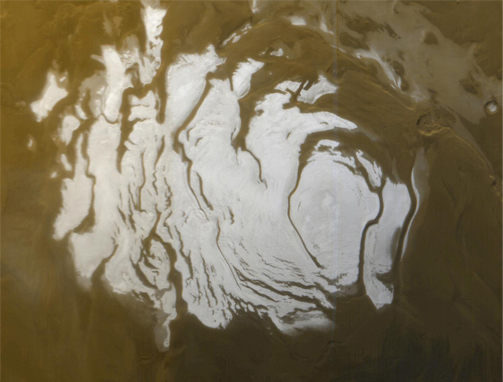
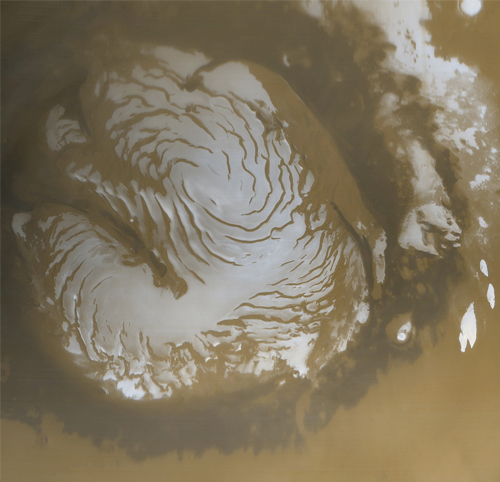
Mars has bright polar caps which make dramatic changes with the seasons. In the winter season for a pole, the cap becomes much larger as carbon dioxide freezes on the surface (dry ice). This happens when the temperature drops to about 150K. The cap gradually increases in size, extending down to about latitude 50° by the beginning of spring. 火星的极地有明亮的极冠,它们随着季节发生显著变化。在极地冬季,极冠会显著增大,因为二氧化碳在表面冻结(干冰)。这发生在温度降至约150K时。极冠逐渐增大,到春分时扩展到约纬度50°。
During the Martian summer, the caps recede but never completely disappear. The permanent cap at the Martian north pole is formed not of dry ice, but of ordinary water ice. The residual north polar cap has been measured to be about 1000 km in diameter. Measurements from Global Surveyor indicate a thickness of about 3 km for this ice cap. 在火星夏季,极地冰冠会退缩,但永远不会完全消失。火星北极的永久冰冠并非由干冰构成,而是由普通的水冰构成。残留的北极冰冠的直径已测量为约1000公里。全球勘测者号卫星的测量结果表明,这个冰冠的厚度约为3公里。
The south polar cap is quite different: it is about 350 km in size and thicker than the north cap. It is formed of dry ice with an unknown thickness of water ice. For the south cap, the temperature never gets above 150K, so the dry ice survives the "summer". The caps are different because of the eccentricity of the Martian orbit. Its eccentricity is over five times that of the Earth, and larger than all planets except Mercury and Pluto. This results in the planet being significantly further from the sun during summer at the south pole. 南极极冠与北极极冠有很大不同:它大约有350公里宽,比北极极冠更厚。它由干冰组成,含有未知厚度的水冰。对于南极极冠,温度从未超过150K,因此干冰能够度过“夏季”。极冠的不同是由于火星轨道的偏心率造成的。其偏心率是地球的五倍多,比除水星和冥王星外的所有行星都大。这导致火星在南半球的夏季时距离太阳显著更远。
|
Index Mars Concepts Solar System Illustration Solar System Concepts Reference Fraknoi, Morrison, Wolff Ch 9 Mars Polar Caps wiki 索引 火星概念 太阳系图解 太阳系概念 参考 Fraknoi, Morrison, Wolff 第9章 火星极冠 Wikipedia | ||||
|
Go Back
返回 |
Atmosphere of Mars火星大气层
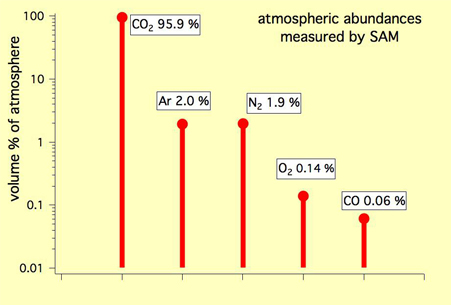
![]() The thin atmosphere of Mars produces an average surface pressure of only 0.007 bar or about 5 mmHg, less than 1% of Earth's atmospheric pressure. This pressure would correspond to that about 30 km above the Earth's surface. The Martian atmosphere is primarily carbon dioxide (95%) with smaller amounts of nitrogen(2%) and argon(2%). These proportions are similar to the atmosphere of Venus. 火星稀薄的大气层产生的平均表面压力仅为0.007 bar或约5 mmHg,不到地球大气压的1%。这种压力相当于地球表面上方约30 km处的气压。火星大气主要由二氧化碳(95%)组成,含有少量的氮气(2%)和氩气(2%)。这些比例与金星的大气层相似。
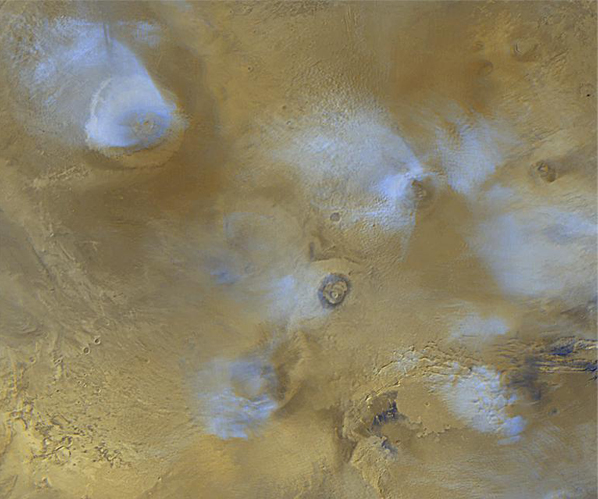
Two types of clouds form in Mars' atmosphere: water ice clouds and high altitude dry ice clouds. The water ice clouds often form around mountains. Examples of this type of cloud were imaged by the Viking orbiters around Olympus Mons. The CO2 clouds are in the form of thin hazes at temperatures around 150K. In addition to the clouds, there are sometimes spectacular dust storms which cover a large fraction of the planetary surface. 在火星大气中形成两种类型的云:水冰云和高海拔干冰云。水冰云通常形成在山脉周围。这种类型的云在奥利匹斯山附近的维京轨道器上被拍摄到。CO₂云在约150K的温度下呈薄雾状。除了云之外,有时还会出现覆盖行星表面大部分区域的壮观尘暴。
这张图像显示了覆盖在火星中央塔尔西斯地区火山峰上的水冰云,在这幅彩色拼接图中可以看到。奥利希斯山位于左上角。中间是三个塔尔西斯山峰:下方是阿西里亚山,中间是帕文尼斯山,上方是阿斯克雷乌斯山。版权所有 NASA/JPL-Caltech. |
Index Mars Concepts Solar System Illustration Solar System Concepts Reference Fraknoi, Morrison, Wolff Ch 9 索引 火星概念 太阳系图示 太阳系概念 参考 Fraknoi, Morrison, Wolff 第9章 | ||
|
Go Back
返回 |
Dust Storms on Mars火星上的沙尘暴
Even though the atmosphere of Mars is very thin, less than 1% of Earth's atmospheric pressure at the surface, it has been observed to produce spectacular dust storms. These dust storms are sometimes almost global in extent. When the Mariner 9 spacecraft arrived into martian orbit on November 13, 1971, it discovered an enormous dust storm which completely obscured the surface for weeks. 尽管火星的大气非常稀薄,仅相当于地球表面大气压的不到1%,但它已被观察到会产生壮观的沙尘暴。这些沙尘暴有时几乎覆盖整个星球。当“火星探路者9号”航天器于1971年11月13日进入火星轨道时,它发现了一场巨大的沙尘暴,这场沙尘暴持续数周完全遮蔽了地表。
|
Index Mars Concepts Solar System Illustration Solar System Concepts Reference Fraknoi, Morrison, Wolff Ch 9 索引 火星概念 太阳系图示 太阳系概念 参考 Fraknoi, Morrison, Wolff 第9章 | ||
|
Go Back
返回 |
Magnetic Field of Mars火星的磁场
Mars has no detectable global magnetic field, indicating that it has no internal dynamo like the Earth. Mars has a diameter of just over half that of the Earth. It has a density of 3.9 g/cm3 compared to 5.5g/cm3 for the Earth. This suggests that its composition is mostly silicates, but the density is high enough to suggest a small metallic core. With a rotation period similar to the Earth, 24 hours and 37 minutes, it would be expected to have some magnetic field if the metalic core were liquid, providing a rotating conductor. 火星没有可检测的全球磁场,这表明它不像地球那样有内部的发电机。火星的直径仅略大于地球的一半。它的密度为3.9 g/cm³,而地球为5.5g/cm³。这表明其成分主要是硅酸盐,但密度足够高,暗示其核心可能有一个较小的金属核。由于火星的自转周期与地球相似,为24小时37分钟,如果金属核心是液态的,它应该会像导体一样产生一些磁场。
|
Index Mars Concepts Solar System Illustration Solar System Concepts Reference Fraknoi, Morrison, Wolff Ch 9 索引 火星概念 太阳系图示 太阳系概念 参考 Fraknoi, Morrison, Wolff 第9章 | ||
|
Go Back
返回 |