Energy and Order in Biological Systems
The concept of entropy and the second law of thermodynamics suggests that systems naturally progress from order to disorder. If so, how do biological systems develop and maintain such a high degree of order? Is this a violation of the second law of thermodynamics?

Order can be produced with an expenditure of energy, and the order associated with life on the earth is produced with the aid of energy from the sun.
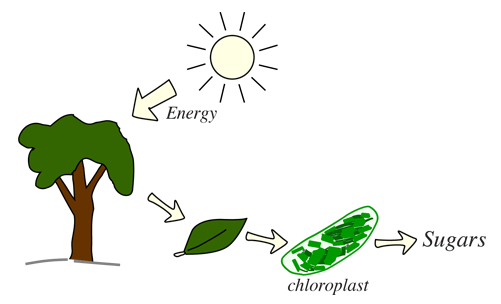
For example, plants use energy from the sun in tiny energy factories called chloroplasts. Using chlorophyll in the process called photosynthesis, they convert the sun's energy into storable form in ordered sugar molecules. In this way, carbon and water in a more disordered state are combined to form the more ordered sugar molecules.
In animal systems there are also small structures within the cells called mitochondria which use the energy stored in sugar molecules from food to form more highly ordered structures.
| A tree converts disorder to order with a little help from the Sun
一棵树在太阳的协助下将无序转化为有序 |
| Qualitative statements of the Second Law of Thermodynamics
热力学第二定律的定性陈述 |
Second law concepts
Heat engine concepts
| HyperPhysics***** Thermodynamics
HyperPhysics ***** 热力学 | R Nave |