Bilingual edition: English is preserved and Chinese follows each unit. Terminology uses the confirmed v20260916 glossary; automated semantic review remains traceable.
中英双语版:英文原文完整保留,中文紧随对应单元;术语采用 v20260916 确认表,自动语义审校结果可追溯。

Recording Studio Acoustics

录音室声学

The desired acoustic properties of a recording studio are in many ways the opposite of those of an auditorium. Instead of enhanced reverberation, it is usually desirable for the recording studio to be acoustically "dead", having a very short reverberation time. Not only does this require the enclosure itself to be very absorbent of sound, but soundproofing becomes very important. In order to prevent the passage of low frequency sounds such as traffic noise, aircraft noise, etc., the recording enclosure is often isolated from the main structure with a double wall. Since low frequency sounds are much more efficiently borne by solid structures than high frequencies, the suspended "room within a room" strategy minimizes the structural linking of the recording room to the foundation of the building. Careful sealing of the enclosure and careful design of the heating and air-conditioning system are necessary. Sometimes additional bass traps are employed to further reduce low-frequency background.

录音室的期望声学特性在许多方面与音乐厅相反。与其有增强的混响相反,录音室通常希望其在声学上“死”,即具有非常短的混响时间。这不仅要求 enclosure 本身非常吸声,而且隔音也变得非常重要。为了防止低频声音如交通噪声、飞机噪声等的传播,录音室通常用双层墙与主体结构隔离。由于低频声音比高频声音更有效地通过固体结构传播,因此“悬空的房间内房间”策略可以最小化录音室与建筑物基础之间的结构连接。对 enclosure 的仔细密封以及对供暖和空调系统的精心设计是必要的。有时还会采用额外的低频吸音材料以进一步降低低频背景噪声。
Index

Auditorium acoustics
索引 声学礼堂
 
HyperPhysics***** Sound
HyperPhysics ***** 声音
R Nave
Go Back
返回


Soundproofing

隔音

Soundproofing of a room involves the isolation of that room from audible sound from the outside and may be taken to include the acoustic damping of the room itself. Preventing the entrance of sound from the outside is accomplished by sealing openings, making the walls absorbent of sound, and minimizing the passage of sound energy through the solid structures of the walls. Sound absorbing materials such as foam insulation in the walls help with both the sealing and absorbing of mid-range to high frequency sounds, but bass frequencies tend to be efficiently borne through solid structures. To isolate a room such as a recording studio from low frequencies, the "room within a room" approach is often taken. A double wall structure can greatly reduce bass transmission.

对房间的隔音处理涉及将该房间与外界的可听声隔离,并可能包括对房间本身的声学阻尼。防止外界声音进入是通过密封开口、使墙壁吸声以及最小化声音能量通过墙壁的固体结构传递来实现的。如墙壁中的泡沫绝缘材料等吸声材料有助于同时密封和吸收中高频声音,但低频声音则倾向于通过固体结构有效传递。为了将录音室等房间与低频声音隔离,通常采用“房间中的房间”方法。双层墙结构可以显著减少低频声音的传递。

The difficulty of soundproofing is increased by diffraction of sound through small openings, so sealing of the structure is important. Also adding to the practical difficulty is the fact that an offending sound may have to be diminished by a factor of a million or more to make it inaudible because of the nature of human hearing.

声学隔音的难度因声波通过小开口发生衍射而增加,因此对结构进行密封是重要的。此外,实际操作中还存在另一个困难,即由于人耳的特性,要使某种噪声变得听不见,可能需要将其强度降低百万倍。
Index

Auditorium acoustics
索引 声学礼堂
 
HyperPhysics***** Sound
HyperPhysics ***** 声音
R Nave
Go Back
返回


The Ear and Soundproofing

耳朵与隔音

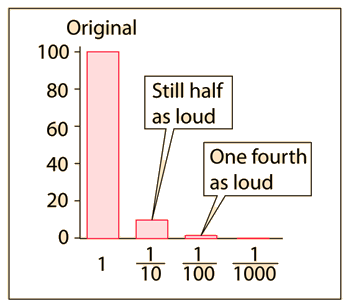
Soundproofing is rendered more difficult by the way the ear responds to sound intensity. The ear's response is roughly logarithmic, and a commonly used rule of thumb for sound loudness suggests that an offending sound must be reduced by a factor of ten in intensity to be reduced to half as loud. The reduction of the sound power entering a room by a factor of a thousand would certainly seem to be sufficient, but the rule of thumb suggests that its loudness would be one-eighth of the original and still audible.

声音的隔音变得困难,是因为耳朵对声音强度的反应方式。耳朵的反应大致是对数的,一个常用的粗略规则指出,要使一个令人不适的声音的响度减少一半,其强度必须减少到原来的十分之一。将进入房间的声音功率减少到原来的千分之一,似乎已经足够,但这个粗略规则表明,其响度仍会减少到原来的八分之一,但仍可听见。

A reduction by a factor of over a million may in fact be necessary for an intense external sound. Such reductions are typically expressed in decibels, with a factor of a million corresponding to 60 decibels.

为了使强烈的外部声音得以减弱,可能需要以百万分之一的幅度进行衰减。这种衰减通常用分贝表示,其中百万分之一的衰减对应60分贝。
Index

Auditorium acoustics
索引 声学礼堂
 
HyperPhysics***** Sound
HyperPhysics ***** 声音
R Nave
Go Back
返回


Bass Traps

低音陷阱

The damping of unwanted sounds is an important feature of recording studios. The bass frequencies are often troublesome because they diffract through small openings and are more efficiently structure-borne into the recording area. Bass traps which make use of the nature of cavity resonance are used to advantage. If a particular bass frequency range is troublesome, a large cavity can be constructed which will offer resonant absorption in that frequency range. Some recording studios have closet-like carpeted enclosures which have a movable baffle as the opening. Positioning the baffle can tune the absorption, since the area of the opening is one of the variables which determines the resonant frequency of a cavity. A tuned cavity which is reflective can enhance the sound at the resonant frequency, as in a bass-reflex speaker, but if the cavity is covered with absorbing material, it will selectively absorb sound energy at that frequency.

抑制不需要的噪音是录音棚的重要特征。低频声音往往令人困扰,因为它们会通过小开口衍射,并更有效地通过结构传播到录音区域。利用腔体共振特性的吸声结构被用来发挥优势。如果某个特定的低频范围令人困扰,可以建造一个较大的腔体,它会在该频率范围内提供共振吸收。一些录音棚设有类似壁橱的地毯覆盖空间,其开口处设有可移动的隔板。通过调整隔板的位置可以调节吸声效果,因为开口面积是决定腔体共振频率的一个变量。一个反射性的调谐腔可以增强共振频率处的声能,如在低音反射扬声器中所示,但如果腔体覆盖着吸声材料,它会有选择地吸收该频率的声能。
Index

Auditorium acoustics
索引 声学礼堂
 
HyperPhysics***** Sound
HyperPhysics ***** 声音
R Nave
Go Back
返回