Bilingual edition: English is preserved and Chinese follows each unit. Terminology uses the confirmed v20260916 glossary; automated semantic review remains traceable.
中英双语版:英文原文完整保留,中文紧随对应单元;术语采用 v20260916 确认表,自动语义审校结果可追溯。

Moving Microphone Closer to Source

将麦克风靠近声源

It is sometimes hard to convince a performer that one should move closer to the microphone rather than farther away if the system rings from feedback. Moving the source closer to the microphone and decreasing the amplification improves the chances of getting an adequate sound signal to the listener. The improvements obtainable by close-miking can be modeled fairly accurately from the simplified amplification system because the source is typically close enough for the microphone to be in the direct sound field where the inverse square law holds. When the performer doubles the distance to the microphone, their signal into the microphone drops by 6 decibels while the input from reverberant sound and noises in the auditorium do not change appreciably. Therefore holding the microphone closer not only strengthens the signal to the microphone but also increases the signal-to-noise ratio and the potential acoustic gain.
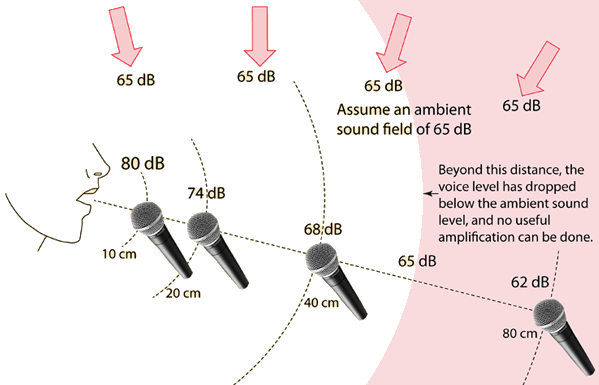
有时很难说服表演者靠近麦克风而不是远离麦克风,如果系统因反馈而产生啸叫的话。将声源靠近麦克风并降低放大倍数,可以提高将足够清晰的声音信号传送给听众的可能性。靠近麦克风所能获得的改进,可以从简化的放大系统中较为准确地模拟出来,因为声源通常足够接近,使得麦克风处于直接声场中,此时平方反比定律适用。当表演者将距离麦克风的距离加倍时,其进入麦克风的信号会下降6分贝,而来自混响声和观众厅内的噪音输入则不会有明显变化。因此,保持麦克风靠近不仅增强了麦克风接收到的信号,也提高了信噪比和潜在的声学增益。
Ways to increase P.A.G.
增加P.A.G.的方法
Index

Sound reproduction concepts
索引 声学再现概念
 
HyperPhysics***** Sound
HyperPhysics ***** 声音
R Nave
Go Back
返回


Moving Source Closer to Listener

移动声源靠近听众

The fact that the source-to-listener distance D0 appears in the expression for potential acoustic gain just practically factors in the size of the auditorium into the system design. In the P.A.G calculation the most meaningful value for D0 is usually that to the most distant listener. Varying D0 in that calculation is not particularly useful - if you decreased D0 by a factor of 2 without changing the other parameters, you would find that the P.A.G. decreases by 6dB. But since that point is half the distance from the source, the unamplified sound is 6dB higher so it doesn't represent an actual loss of sound intensity.

Varying D0 for systems with multiple speakers might help model their contributions. You would like to get about the same sound level to all listeners. If the sound is brought up to an ideal level at the back of the auditorium, it may be too loud for those who are closer. Sometimes this problem is addressed by using a high central cluster speaker which has horn-type speakers with a more directional pattern than ordinary cone-type loudspeakers. If the horn is pointed toward the distant listeners, then the drop-off of the sound off-axis can keep the amplified sound from being excessive for the closer listeners.

对具有多个扬声器的系统,通过改变D 0可能有助于模拟其贡献。你希望所有听众都能听到大约相同的声压级。如果将声音提升到理想水平以确保后排听众能听到,可能会让靠近的听众感到太响。有时这个问题通过使用一个高位置的中心集群扬声器来解决,该扬声器配备有更定向的号角型扬声器,其声辐射模式比普通锥形扬声器更集中。如果号角指向远处的听众,那么声束偏离轴线时的衰减可以防止靠近的听众听到过大的放大声音。
Ways to increase P.A.G.
增加P.A.G.的方法
源到听众的距离D0出现在潜在声增益表达式中的事实,实际上是在系统设计中考虑了 auditorium 大小的实用因素。在P.A.G.计算中,通常最有意义的D0值是到最远听众的距离。在该计算中改变D0并不特别有用——如果你在不改变其他参数的情况下将D0减小到原来的1/2,你会发现P.A.G.降低6dB。但因为该点距离源点只有原来的一半,未放大的声音会高6dB,因此这并不表示实际的声强损失。
Index

Sound reproduction concepts
索引 声学再现概念
 
HyperPhysics***** Sound
HyperPhysics ***** 声音
R Nave
Go Back
返回


Using More Directional Microphones

使用更多定向麦克风

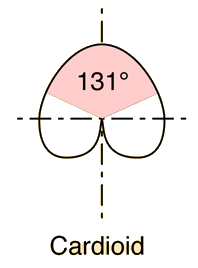
Directionality in both microphones and loudspeakers can be used to advantage to increase the potential acoustic gain. The relaxing of the omnidirectional assumption in the simplified amplification system can yield significant increases in useful gain. The most common microphone pattern used in general auditorium systems is the cardioid pattern illustrated at left. It gives higher useful gain if the peak of the pattern is pointed toward the source, but if the microphone is held straight up it becomes effectively omnidirectional and the increase is lost. Assuming that the cardiod pattern is directed toward the source, then if the sound feedback from the loudspeakers is at an angle of 90° with respect to that direction, you can get 6 dB more gain. The microphone discriminates against sound at 90° by 6 dB and by an even greater amount if the angle is greater than 90° .

麦克风和扬声器的指向性可以被利用以增加潜在的声学增益。在简化放大系统中放松全向假设可以带来显著的增益提升。一般音响系统中最常用的麦克风指向性是图中所示的心形指向性。如果麦克风的峰值指向声源,它能提供更高的有用增益,但如果麦克风直立持放,则会变得几乎全向,增益提升就会丧失。假设心形指向性指向声源,那么如果扬声器的声反馈与该方向成90°角,则可以增加6 dB的增益。麦克风对90°角的声波有6 dB的衰减,如果角度大于90°,衰减会更大。

Higher gain can be obtained with unidirectional microphones, but it is more difficult the keep the narrow microphone pattern centered on the source.

使用单向麦克风可以获得更高的增益,但要保持窄指向性麦克风的中心位置对准声源则更加困难。
Microphone directional patterns
麦克风的方向性模式
Ways to increase P.A.G.
增加P.A.G.的方法
Index

Sound reproduction concepts
索引 声学再现概念
 
HyperPhysics***** Sound
HyperPhysics ***** 声音
R Nave
Go Back
返回


Using More Directional Loudspeakers

使用更定向的扬声器

Directionality in both microphones and loudspeakers can be used to advantage to increase the potential acoustic gain. It is more difficult to get narrow directional patterns with loudspeakers, but various types of horn loudspeakers achieve signigicant increases in useful gain plus the reduction of echoes and a more uniform sound level over the audience. Another approach is to use a vertical column of loudspeakers to spread sound in the horizontal plane, achieving some directionality.

麦克风和扬声器的指向性都可以用来提高潜在的声学增益。但用扬声器获得狭窄的指向性模式更为困难,然而各种类型的号角式扬声器能够显著提高有用的增益,同时减少回声,并使观众席上的声音水平更加均匀。另一种方法是使用垂直列的扬声器将声音扩散到水平面上,实现一定程度的指向性。
Microphone directional patterns
麦克风的方向性模式
Ways to increase P.A.G.
增加P.A.G.的方法
Index

Sound reproduction concepts
索引 声学再现概念
 
HyperPhysics***** Sound
HyperPhysics ***** 声音
R Nave
Go Back
返回


Notch Filters

notch 滤光器

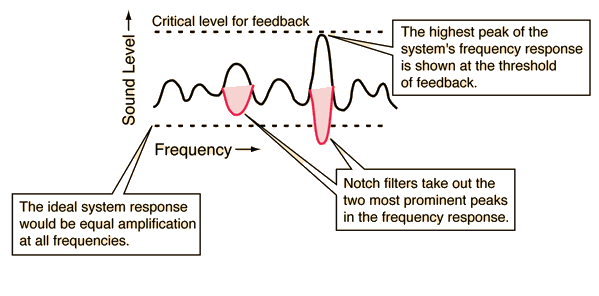
When a non-uniform frequency response of an amplification system/room combination causes the system to "ring" before giving adequate amplification, the potential acoustic gain can sometimes be improved with the use of notch filters to take out the offending frequencies as illustrated below. Shown is the use of two notch filters to discriminate against the two most prominent peaks in the frequency response.

当放大系统/房间组合的非均匀频率响应导致系统在提供足够放大之前出现共振时,可以通过使用陷波滤波器消除这些有害频率来有时改善潜在的声学增益,如下面所示。图中展示了使用两个陷波滤波器来抑制频率响应中两个最显著的峰值。

Often several such tunable notch filters are packaged together and marketed as "feedback suppressors" . Sometimes such feedback suppressors are used to smooth out the roughest spots before undertaking a full-fledged equalization of the sound system.

通常,多个这样的可调陷波滤波器会被封装在一起,并作为‘反馈抑制器’进行营销。有时,这样的反馈抑制器会被用来平滑出最粗糙的区域,然后再进行完整的音响系统均衡调整。
Ways to increase P.A.G.
增加P.A.G.的方法
Index

Sound reproduction concepts
索引 声学再现概念
 
HyperPhysics***** Sound
HyperPhysics ***** 声音
R Nave
Go Back
返回