Bilingual edition: English is preserved and Chinese follows each unit. Terminology uses the confirmed v20260916 glossary; automated semantic review remains traceable.
中英双语版:英文原文完整保留,中文紧随对应单元;术语采用 v20260916 确认表,自动语义审校结果可追溯。

NADH-Coenzyme Q oxidoreductase (Complex I)

NADH-Coenzyme Q氧化还原酶(复合体I)

The first protein complex in the electron transport chain is named NADH-Coenzyme Q oxidoreductase and is commonly labeled Complex I. It is also called NADH dehydrogenase. It is a large L-shaped multiunit protein complex which accepts the high energy electrons from NADH. The NADH molecule donates two electrons to an acceptor group flavin mononucleotide (FMN) which is found on the vertical arm of the complex as shown below. The FMN is reduced to the form FMNH2.

电子传递链中的第一个蛋白质复合物称为NADH-辅酶Q氧化还原酶,通常称为复合物I。它也被称为NADH脱氢酶。它是一个大型的L形多亚基蛋白质复合物,接受来自NADH的高能电子。NADH分子将两个电子传递给接受体基团黄素单核苷酸(FMN),该基团位于复合物的垂直臂上,如图所示。FMN被还原为FMNH₂形式。

From this point the electrons move along a series of iron-sulfur groups (about eight of them) and are transferred to the associated coenzyme Q (ubiquinone). The ubiquinone also extracts two protons from the matrix to form the fully reduced ubiquinol (QH2). As the electrons are moving through the series of FeS clusters, they use the provided electrical energy to pump 4 H+ ions out of the mitochondrial matrix and into the intermembrane space to provide them for the production of the high energy molecule ATP in the oxidative phosphorylation process.
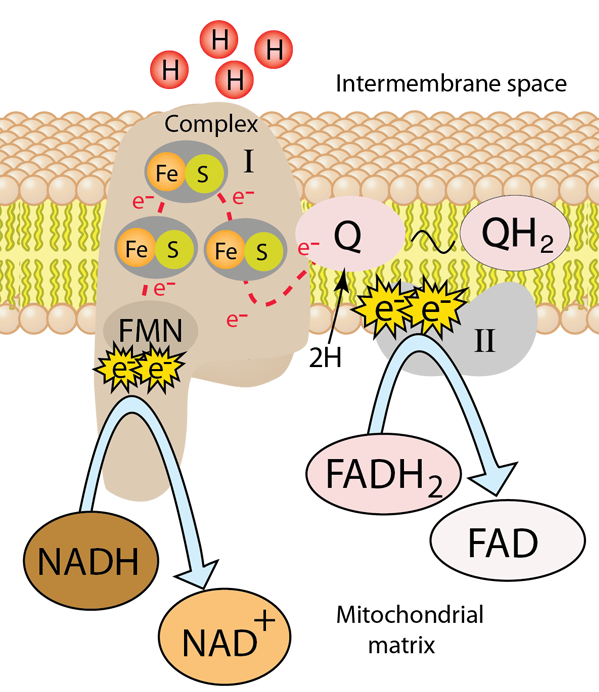
to Complex II
向复杂II转移
从这一点开始,电子沿着一系列铁硫簇(大约八个)移动,并被转移到相关的辅酶Q(泛醌)。泛醌还从基质中提取两个质子,形成完全还原的泛醌(QH₂)。当电子通过这些FeS簇移动时,它们利用提供的电能将4个H⁺离子从线粒体基质泵出到膜间空间,为氧化磷酸化过程中高能分子ATP的生成提供所需的质子。
Index

Photosynthesis Concepts

Reference
Moore, et al.
Ch 7

Ahern
Biochemistry.., Ch14

Karp
Ch 5.3

AK Lectures
Complex I & II
索引 光合作用概念 参考 Moore 等,第7章 Ahern 生物化学,第14章 Karp 第5.3节 AK 讲座 复杂I与II
 
HyperPhysics***** Biology
HyperPhysics ***** 生物学
R Nave
Go Back
返回


Flavin Mononucleotide (FMN)

黄素单核苷酸 (FMN)
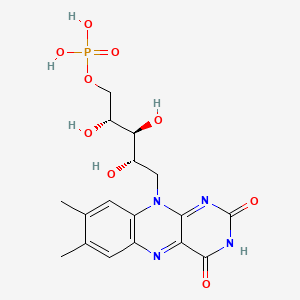
Flavin mononucleotide (FMN) is a biomolecule produced from riboflavin (vitamin B2) by the enzyme riboflavin kinase and functions as the prosthetic group of various oxidoreductases, including NADH dehydrogenase. Prosthetic groups are cofactors which take an active part in enzyme catalytic processes. FMN acts as an electron carrier in Complex1 and delivers the electrons from NADH to the Fe-S for further transport.
黄素单核苷酸(FMN)是由维生素B2(核黄素)通过酶核黄素激酶生成的生物分子,它作为多种氧化还原酶的辅基发挥作用,包括NADH脱氢酶。辅基是辅因子的一种,积极参与酶促反应过程。FMN在复合体1中作为电子载体,将电子从NADH传递到Fe-S,以便进一步运输。
Index

Photosynthesis Concepts

Reference
Moore, et al.
Ch 7

Ahern
Biochemistry.., Ch14

Karp
Ch 5.3

FMN wiki
索引 光合作用概念 参考 Moore 等,第7章 Ahern 生物化学,第14章 Karp 第5.3节 FMN wiki
 
HyperPhysics***** Biology
HyperPhysics ***** 生物学
R Nave
Go Back
返回


Iron-Sulfur Clusters

铁-硫簇

Iron-sulfur proteins play a part in oxidation-reduction reactions in the electron transport chain in mitochondria and chloroplasts. Both Complex I and Complex II have multiple Fe-S clusters for electron transport.

铁硫蛋白在线粒体和叶绿体中的电子传递链氧化还原反应中起作用。复杂I和复杂II均含有多个铁-硫簇用于电子传递。
Index

Photosynthesis Concepts

Reference
Moore, et al.
Ch 7

Ahern
Biochemistry.., Ch14

Karp
Ch 5.3

Iron-sulfur protein
wiki
索引 光合作用概念 参考 Moore 等人,第7章 Ahern 生物化学,第14章 Karp 第5.3节 铁硫蛋白 wiki
 
HyperPhysics***** Biology
HyperPhysics ***** 生物学
R Nave
Go Back
返回


Coenzyme Q (Ubiquinone)

辅酶Q( ubiquinone)

Ubiquinone is often just indicated by Q in discussions of the electron transport chain. It is used to collect electrons from both Complex I and Complex II, and collects protons to form the fully reduced form ubiquinol, indicated as QH2. In the QH2 form it enters Complex III to transfer electrons to cytochrome c and pump protons into the intermembrane space of the mitochondrian.

泛醌通常在讨论电子传递链时用Q表示。它从复合体I和复合体II收集电子,并收集质子形成完全还原的泛醌醇形式,表示为QH₂。在QH₂形式下,它进入复合体III,将电子传递给细胞色素c,并将质子泵入线粒体的膜间空间。
Coenzyme Q, also known as ubiquinone, is a coenzyme family that is ubiquitous in animals and most bacteria (hence the name ubiquinone). It is a 1,4-benzoquinone, where Q refers to the quinone chemical group and 10 refers to the number of isoprenyl chemical subunits in its tail. In natural ubiquinones, the number can be anywhere from 6 to 10. It is present in all respiring eukaryotic cells, primarily in the mitochondria. It is a component of the electron transport chain and participates in aerobic cellular respiration, which generates energy in the form of ATP. Ninety-five percent of the human body's energy is generated this way (Wikipedia).
辅酶Q,也称为 ubiquinone,是广泛存在于动物和大多数细菌中的辅酶家族(因此得名 ubiquinone)。它是一种1,4-苯醌,其中Q指的是醌化学基团,10表示其尾部含有10个异戊烯基化学亚基。在天然的 ubiquinones 中,数字可以从6到10不等。它存在于所有进行有氧呼吸的真核细胞中,主要存在于线粒体中。它是电子传递链的组成部分,并参与有氧细胞呼吸,这种过程通过ATP形式生成能量。人体95%的能量都是通过这种方式生成的(Wikipedia)。

The ubiquinol form QH2 is a two-electron carrier, but part of its role in Complex III is to transfer electrons to cytochrome c, which can only accept one electron. This difficulty is overcome partly with the use of the fact that coenzyme Q can also take the form ubisemiquinone with the capacity to transfer just one electron. This is central to its role in the electron transport through iron-sulfur complexes which can accept only one electron.

ubiquinol 形式 QH₂ 是一个双电子载体,但其在复合体 III 中的部分作用是将电子传递给细胞色素 c,而后者只能接受一个电子。这一困难部分通过利用辅酶 Q 还可以以 ubisemiquinone 形式存在这一点来克服,而该形式具有仅能传递一个电子的能力。这在铁硫复合物中传递电子的过程中起着关键作用,因为这些复合物只能接受一个电子。

Another useful biological function of coenzyme Q is it's capacity to act as an antioxidant by scavenging free radicals.

另一种辅酶Q的生物功能是它作为抗氧化剂的能力,通过清除自由基来实现。
Index

Photosynthesis Concepts

Reference
Moore, et al.
Ch 7

Ahern
Biochemistry.., Ch14

Karp
Ch 5.3

Coenzyme Q
wiki
索引 光合作用概念 参考 Moore 等,第7章 Ahern 生物化学,第14章 Karp 第5.3节 辅酶Q维基
 
HyperPhysics***** Biology
HyperPhysics ***** 生物学
R Nave
Go Back
返回