Bilingual edition: English is preserved and Chinese follows each unit. Terminology uses the confirmed v20260916 glossary; automated semantic review remains traceable.
中英双语版:英文原文完整保留,中文紧随对应单元;术语采用 v20260916 确认表,自动语义审校结果可追溯。

Light Emitting Diode Structure

发光二极管结构
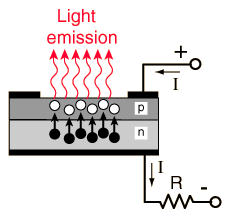
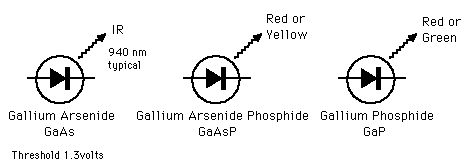
LEDs are p-n junction devices constructed of gallium arsenide (GaAs), gallium arsenide phosphide (GaAsP), or gallium phosphide (GaP). Silicon and germanium are not suitable because those junctions produce heat and no appreciable IR or visible light. The junction in a LED is forward biased and when electrons cross the junction from the n- to the p-type material, the electron-hole recombination process produces some photons in the IR or visible in a process called electroluminescence. An exposed semiconductor surface can then emit light.

LEDs 是由砷化镓(GaAs)、砷化镓磷(GaAsP)或磷化镓(GaP)构成的 p-n 结器件。硅和锗不适合,因为这些结会产生热量,并且不会产生显著的红外或可见光。LED 中的结处于正向偏置状态,当电子从 n 型材料跨过结进入 p 型材料时,电子-空穴复合过程会产生一些红外或可见光,这一过程称为电致发光。暴露的半导体表面随后可以发出光。
Circuit symbol
电路符号
Packaging
包装
Characteristics
特性
More detailed structure of device
设备更详细的结构
Index


LED concepts

Reference
Floyd
Electronic Devices, Sec. 3-4
索引 LED 概念 参考 Floyd 电子器件,第3-4节
 
HyperPhysics*****Electricity and magnetism***** Quantum Physics ***** Optics
HyperPhysics ***** 电磁学 ***** 量子物理 ***** 光学
R Nave
Go Back
返回


Electroluminescence in LEDs

LEDs中的电致发光

When the applied forward voltage on the diode of the LED drives the electrons and holes into the active region between the n-type and p-type material, the energy can be converted into infrared or visible photons. This implies that the electron-hole pair drops into a more stable bound state, releasing energy on the order of electron volts by emission of a photon. The red extreme of the visible spectrum, 700 nm, requires an energy release of 1.77 eV to provide the quantum energy of the photon. At the other extreme, 400 nm in the violet, 3.1 eV is required.

当施加在LED二极管上的正向电压将电子和空穴驱动到n型和p型材料之间的活性区域时,能量可以转化为红外或可见光子。这表明电子-空穴对会进入一个更稳定的束缚态,通过光子发射释放约电子伏特的能量。可见光谱的红色端点,700 nm,需要释放1.77 eV的能量以提供光子的量子能量。在另一端,400 nm的紫色,需要3.1 eV的能量。
The search for a blue LED
蓝光LED的寻找
Index

LED concepts

Reference
Floyd
Electronic Devices, Sec. 3-4
索引 LED 概念 参考 Floyd 电子器件,第3-4节
 
HyperPhysics*****Electricity and magnetism***** Quantum Physics ***** Optics
HyperPhysics ***** 电磁学 ***** 量子物理 ***** 光学
R Nave
Go Back
返回


Search for a Blue LED

寻找蓝光LED

After a decade of intense research, a bright blue LED was successfully produced by Nichia Chemical of Japan in 1994. The material used for the diode was gallium nitride GaN. Nichia has also produced an InGaN laser diode which lases in the blue-violet region of the spectrum.

经过十年的深入研究,日本Nichia化学公司于1994年成功研制出一种明亮的蓝色LED。该二极管所用的材料是氮化镓GaN。Nichia公司还生产了另一种InGaN激光二极管,其激光波长位于光谱的蓝紫色区域。

Blue LEDs are important for the development of high-information-density storage on optical disks, as well as a host of other applications such as high-resolution television and computer displays, image scanners and color printers, biomedical diagnostic instruments, and remote sensing.

蓝色LED对光学盘高信息密度存储的发展至关重要,同时也广泛应用于其他领域,如高分辨率电视和计算机显示器、图像扫描仪和彩色打印机、生物医学诊断仪器以及遥感技术。

Other ways of producing blue light from solid state sources involve doubling the frequency of red or infrared laser diodes. Hitachi and Matsushita have taken this approach to producing blue light for optical disks and digital versatile disks (DVD).

其他产生蓝色光的方法涉及将红色或红外激光二极管的频率加倍。日立和松下公司采用这种方法来产生蓝色光,用于光盘和数字视频光盘(DVD)。

Reference: The Elusive Blue Laser, The Industrial Physicist, 3, September 1997, p16

参考:《 elusive Blue Laser 》,《The Industrial Physicist》,3,1997年9月,第16页
LED electroluminescence
LED 电致发光
Index


LED concepts
索引LED概念
 
HyperPhysics*****Electricity and magnetism***** Quantum Physics ***** Optics
HyperPhysics ***** 电磁学 ***** 量子物理 ***** 光学
R Nave
Go Back
返回