Bilingual edition: English is preserved and Chinese follows each unit. Terminology uses the confirmed v20260916 glossary; automated semantic review remains traceable.
中英双语版:英文原文完整保留,中文紧随对应单元;术语采用 v20260916 确认表,自动语义审校结果可追溯。

Acoustic Guitar

吉他

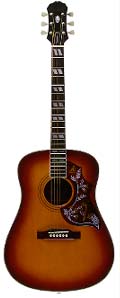
"Acoustic guitar" refers to hollow-bodied guitars without electric amplification. They may have nylon or steel strings. The strings of a six-string guitar are tuned to E, A, D, G, B, E, a fourth apart except for the major third interval between B and G. Frets are placed by the fret rule "one-eighteenth the remaining length of the string". This makes them a semitone apart.

“原声吉他”指的是没有电动放大器的空心吉他。它们可能配备尼龙弦或钢弦。六弦吉他的弦音调为E、A、D、G、B、E,除了B和G之间是大三度外,其他弦之间相隔四度。品柱的位置由“琴弦剩余长度的十八分之一”来确定,这使它们之间相隔半音。

Top plate made of spruce or cedar. Spruce more prevalent in steel string "folk" acoustics while cedars are more prevalent in classical guitars. (Williams, Jim, A Guitar Makers Manual). Since these woods are light but with a tight grain, they enhance the capacity of the top plate to vibrate and serve as a sound source that is much more efficient than the strings themselves. The vibrating strings couple energy into this top plate. Brazilian rosewood is favored for making the backs and sides of a guitar because it is very hard and tends to contribute to a brighter sound.

顶部板采用松木或 cedar 制作。松木在钢弦“民间”声音学中更为常见,而 cedar 则更多用于古典吉他。(Williams, Jim, A Guitar Makers Manual)。由于这些木材较轻且纹理紧密,它们增强了顶部板的振动能力,并作为比琴弦本身更高效的发声源。振动的琴弦将能量耦合到这个顶部板上。巴西玫瑰木因其非常坚硬且有助于产生更明亮的声音,而被用于制作吉他的背板和侧板。

A round hole 3 1/4" to 3 1/2" in diameter in the top plate creates a cavity resonance which strengthens the sound produced.

顶部板上有一个直径3 1/4英寸至3 1/2英寸的圆形孔,形成一个共振腔,增强了产生的声音。
Guitar details
吉他细节
Index

String instruments

Musical instruments

Online guitar tuner
索引字符串乐器 音乐乐器 在线吉他调音器
 
HyperPhysics***** Sound
HyperPhysics ***** 声音
R Nave
Go Back
返回


Some Guitar Details

一些吉他细节

The strings of a guitar allow control of the pitch and harmonic content of the sound produced. The pitch is determined by the length, mass and tension of the strings. The produced frequencies are resonant frequencies of the strings, which depend inversely on the length (eg., cutting the length in half by depressing the string to the 12th fret will double the frequency to the note one octave up from the fundamental frequency of the string.) The mass and tension together determine the speed of the wave in the string. Since it is desirable to have about the same tension in each of the strings to keep from putting any distorting torque on the instrument, a matched set of strings will have carefully adjusted masses so that the strings are tuned to the correct intervals when the tensions are the same. According to Sloane, the string tensions for steel strings are on the order of 160 to 200 lbs. The "gut" strings (actually usually made of nylon) of classical guitars have somewhat lower tensions on the order of 120 lbs (Hunter).

吉他弦允许对声音的音调和谐波内容进行控制。音调由弦的长度、质量和张力决定。所产生的频率是弦的共振频率,这与弦的长度成反比(例如,通过将弦按到第12品,将长度减半,频率会加倍,从而得到比弦基本频率高一个八度的音调)。质量和张力共同决定了弦中波的传播速度。由于希望每根弦的张力大致相同,以免对乐器施加任何扭曲力矩,因此一组匹配的弦会经过精心调整质量,使得在张力相同的情况下,弦能够调到正确的音程。根据Sloane的说法,钢弦的张力大约在160到200磅之间。古典吉他中的“肠弦”(实际上通常由尼龙制成)的张力稍低,大约在120磅(Hunter)。

The bridge transfers the vibrational energy of the strings to the top plate of the instrument - the strings alone can't effectively move air to produce sound, but the vibrating top plate can do that quite efficiently. The air cavity resonance produced by the round hole can be demonstrated by singing a note somewhere between F#2(87 Hz) and A2(110 Hz) (depending on the guitar) while holding your ear close to the sound hole. You will hear the air in the body resonating. Another way to hear the effect of this resonance is to play the open A string while slipping a piece of paper or cardboard back and forth across the soundhole. Because this stops the resonance or shifts it to a lower frequency, you will notice the loss of bass response when you close the hole. The coupled resonance of the front and back plates produces a resonance about an octave above the main air resonance.

桥梁将弦的振动能量传递给乐器的顶部板——仅靠弦本身无法有效地使空气振动以产生声音,但振动的顶部板却能非常有效地做到这一点。通过在琴身的圆形孔附近唱一个音高在F#2(87 Hz)到A2(110 Hz)之间的音(根据吉他而定),并将耳朵贴近声音孔,可以观察到由空气腔共振产生的效果。你将听到琴身内的空气共振。另一种听到这种共振效果的方式是弹奏开放的A弦,同时将一张纸或卡片来回滑过声音孔。因为这会停止共振或将其移至较低频率,当你关闭孔时,你会注意到低音响应的丧失。前后面板的耦合共振会产生一个大约比主要空气共振高一个八度的共振。

The Spaniard Antonio de Torres Jurado is credited with considerable enhancements of the modern classical guitar in the mid nineteen hundreds. The body and the sound hole were enlarged and the fretboard widened. Perhaps his most important contribution was the development of "fan strutting", a series of struts which diverge from the sound hole on the top plate of the instrument. This design gave it a considerably stronger, more sustained tone.

西班牙人安东尼奥·德·托雷斯·胡拉多在20世纪中叶对现代古典吉他进行了显著的改进。琴身和音孔被扩大,琴枕也被拓宽。他最重要的贡献可能是开发了“扇形支撑结构”,即一系列从音孔向琴板顶部延伸的支撑条。这种设计使其音色更加有力且持续。
Guitar illustration
吉他示意图
Tuning the guitar
调音吉他
Index

String instruments

Musical instruments

Reference
Evans, Tom and Mary

Sloane

Hunter

Joe Wolfe, Guitar acoustics
索引 弦乐器 音乐乐器 参考 Evans, Tom and Mary Sloane Hunter Joe Wolfe, 吉他声学
 
HyperPhysics***** Sound
HyperPhysics ***** 声音
R Nave
Go Back
返回


Fret Rule for Guitars

吉他泛音规则

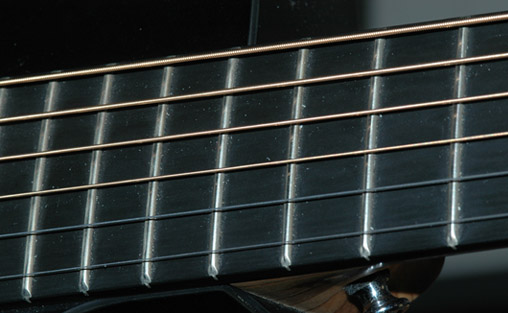
To provide for definite pitch relations between notes, metal inserts called frets are inset in a fretboard on the neck of guitars. The raised edges of the frets provide fixed lengths of string when the string is held down against them with a finger. The interval between successive frets is normally one equal tempered semitone. There are typically 19 frets on classical guitars, which with reference to the equal tempered octave can be seen to be and octave and a fifth. Electric guitars may have up to 23 frets.

为使音符之间具有确定的音调关系,吉他琴颈上的琴板上会嵌入称为品的金属部件。当琴弦被手指按在品上时,品的边缘会提供固定的琴弦长度。相邻品之间的音程通常是一个等音律半音。古典吉他通常有19个品,相对于等音律八度,可以看作是一个八度加一个五度。电吉他可能有高达23个品。

Frets on guitars are placed by the fret rule "one-eighteenth the remaining length of the string". This makes them approximately a semitone apart. If the musical interval produced by this rule is expressed in cents, then a string of length 17/18 of its original length will be higher by an interval of 98.9 cents compared to a precise semitone of 100 cents. Since the just noticeable difference in pitch is about 5 cents, then the fret rule could be applied for one change of fret with no problems in intonation. One would have to be careful about cumulative errors if the rule were applied repeatedly, so it should be checked at intervals such as the musical fourth which should be precisely 3/4 of the length of the open string.

吉他琴码的位置是根据“琴码规则”确定的,即每个琴码位于弦长的十八分之一处。这使得琴码之间的音高间隔大约为一个半音。如果用音高单位(cents)来表示这个规则产生的音程,则当弦长为原长的17/18时,其音高将比精确的半音(100 cents)高98.9 cents。由于人耳能察觉的音高差异大约为5 cents,因此在单次琴码调整时应用此规则不会产生音准问题。但如果反复应用此规则,则需注意累积误差,因此应定期检查,例如在音乐中的纯四度音程,它应精确为原弦长的3/4。

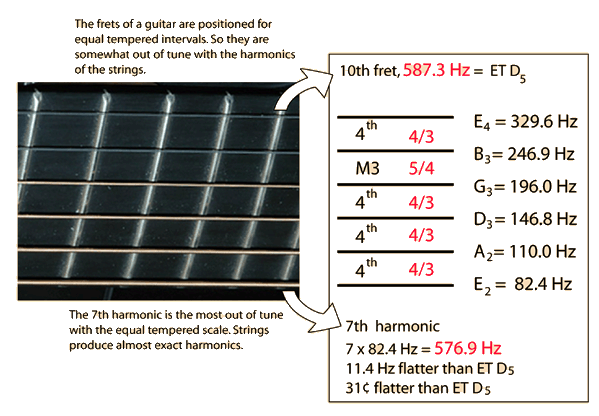
The above example is an extreme case, but it is designed to show that there are some intonation problems with guitars which arise from the fact that the frets are tuned to equal tempered intervals while the harmonics of the strings are almost exact integer multiples which correspond with just intonation. In this example, consider that the low E2 string has been plucked, sounding the E2 at 82.4 Hz, but also producing all harmonics of that pitch. This will include a small amount of the 7th harmonic, which from the list of harmonics expressed in cents you can see to be the most out-of-tune with equal temperament. That 7th harmonic will be a D5, but as you can see from the equal tempered frequency list, it is 11.4 Hz flatter than the equal tempered D5. The equal tempered D5 can be produced with the 10th fret of the high E4 string, but if you sounded those two strings together using the 10th fret of the E4 and the open E2 string, they would be 31 cents out of tune. Compared to the just noticeable difference in pitch of 5 cents, this is seriously out-of-tune. A far fetched example, no doubt, but it shows that the use of equal temperament along with acoustic systems that produce exact harmonics can produce some intonation problems.

上述例子是一个极端情况,但其目的是展示吉他上存在一些音调问题,这些问题源于琴枕被调至等音律音程,而琴弦的谐波几乎都是精确的整数倍,这与纯律相吻合。在本例中,考虑低E2弦被拨响,发出E2音,频率为82.4 Hz,同时产生该音的全部谐波。这将包括一小部分的第七谐波,从谐波以厘为单位的列表中可以看出,这个第七谐波在等音律中是最不准确的。这个第七谐波是一个D5音,但根据等音律频率列表,它比等音律的D5低11.4 Hz。等音律的D5可以用高E4弦的第十品发出,但若用E4弦的第十品和开放的E2弦同时发声,它们将相差31 cents。与音调的可察觉差5 cents相比,这显然是严重不和谐的。无疑这是一个夸张的例子,但它展示了使用等音律与产生精确谐波的声学系统可能会产生一些音调问题。
Guitar illustration
吉他示意图
Index

String instruments

Musical instruments
索引 弦乐器 音乐乐器
 
HyperPhysics***** Sound
HyperPhysics ***** 声音
R Nave
Go Back
返回


Tuning the 6-String Guitar

调谐6弦吉他

A standard tuning for the strings of the guitar would be E2, A2, D3, G3, B3, E4, referring to the equal tempered set of notes based on A440Hz. They are usually numbered in the descending order (i.e., the E4 is called string 1). The strings are tuned a fourth apart except for the major third interval between strings 2 and 3. Here is a basic procedure for tuning the guitar:

吉他弦的标准调谐通常是E2,A2,D3,G3,B3,E4,这些音符基于A440Hz的等音阶系统。它们通常按降序编号(即E4称为第一弦)。除了第二弦和第三弦之间为大三度外,其他弦之间相隔纯四度。以下是一个基本的吉他调谐步骤:

  1. Tune string 5 (A2) to 110 Hz using an electronic metronome or tuning fork, etc.
    用电子节拍器或音叉等将第5弦(A2)调谐至110 Hz。
  2. Tune string 6 (E2) by depressing it at fret 5 (A2) and matching this pitch to the pitch of open string 6 (A2).
    通过在第五品(A2)按弦,调节第六弦(E2)的音高,使其与开放第六弦(A2)的音高一致。
  3. Tune string 4 (D3) by depressing string 5 at fret 5 (D3) and matching these pitches.
    调节第4弦(D3):通过在第5品处按压第5弦(D3)并匹配这两个音高来调整。
  4. Tune string 3 (G3) by depressing string 4 at fret 5 (G3) and matching these pitches.
    调节第三弦(G3):通过在第五品处按压第四弦(G3),使两者的音高一致。
  5. Tune string 2 (B3) by depressing string 3 at fret 4 (B3) and matching these pitches.
    调节弦2(B3):将弦3在第4品(B3)处按住,并使其音高与之匹配。
  6. Tune string 1 (E4) by depressing string 2 at fret 5 (E4) and matching these pitches.
    调节弦1(E4):在第五品(E4)处按压弦2,并使这两个音高一致。
  7. If you are a fortunate person, your guitar now might be in tune.
    如果你是幸运的人,你的吉他现在可能已经调音了。

If the frets of the guitar are set for equal temperament ), then the 5th fret is 5 semitones or an equal tempered musical fourth. That frequency should equal the open string frequency of the next string up in pitch. They can be matched by "zero beating", adjusting the string so that no beat is heard. After tuning for the zero beat, you should be able to pluck the lower string (held at the fifth fret) and the higher string should start to vibrate, driven by the vibrations in the bridge.

如果吉他品格设置为等音律,则第五品格对应5个半音或一个等音律的四度音。该频率应等于上一弦的音调频率。可以通过"零拍"进行匹配,调整琴弦使得不产生拍音。在进行零拍调整后,你应该能够拨动较低的弦(按在第五品格处)并使较高的弦开始振动,由桥的振动驱动。

The uncertain ending in step 7 above is caused by a number of "real world" complications. One of the complications is that the upper harmonics of the lower strings will not necessarily sound in tune with the upper strings, even when their fundamentals are tuned to the prescribed interval. One of the reasons is that perfect harmonics from the strings produce intonation problems with equal temperament. If you examine the intervals in cents for a harmonic sequence, you find that the upper harmonics are out of tune with equal temperamment, with the 7th harmonic being notably bad. So one kind of problem arises if the harmonics are perfect, but another arises if they depart too far from perfect harmonics. Because of the stiffness of the bass strings, their upper resonances tend to be sharp compared to exact whole number multiples (harmonics). The upper harmonics of the lower strings may beat with the upper strings in such a way to produce an unpleasant sound. This sometimes leads to a process which is called "octave stretching" in piano tuning. The upper notes of the instruments are tuned a little sharp to sound better when played with the lower strings. The measurements and calculations involved to optimize the tuning are unreasonable for a simple tuning process, so in practice you follow a basic procedure like that described above, and then adjust the tuning by ear to get the most pleasing blend.

步骤7中不确定的结尾是由许多“现实世界”问题引起的。其中一个问题是,低音弦的高次谐波不一定能与高音弦音调一致,即使它们的基频被调到规定的音程。其中一个原因是,弦产生的完美谐波会产生与等 temperament(十二平均律)的音准问题。如果你检查谐波序列中的音程(以厘音为单位),你会发现高次谐波与等 temperament 不一致,其中第七谐波尤为明显。因此,如果谐波是完美的,就会出现一种问题;如果它们偏离完美的谐波太远,又会引发另一种问题。由于低音弦的刚性,其高次共振倾向于比精确的整数倍(谐波)更尖锐。低音弦的高次谐波可能会与高音弦产生拍音,从而产生不愉快的声音。这有时会导致一种被称为“八度扩展”的钢琴调音过程。乐器的高音音符会被稍微调高,以便与低音弦一起演奏时听起来更好。优化调音所需的测量和计算对于简单的调音过程来说是不合理的,因此在实践中,你遵循上述基本程序,然后通过听觉调整调音,以获得最悦耳的融合。

After going through the procedure above for relative tuning of the strings, it should be mentioned that inexpensive digital tuning devices are readily available which allow you to tune each string individually. Some give an LED indicator when you are in tune and a readout of how many cents sharp or flat you are with respect to the standard pitch. Even after tuning to one of these devices, you might yet have to deal with the difficulties described above in getting the most pleasant sound out of the instrument. But once you found a mixture that you like, you could use the digital tuner to note how many cents sharp or flat you tuned each string to get that optimum sound.

在完成上述相对调弦程序后,应指出便宜的数字调音器 readily available,允许你单独调音每根弦。一些调音器在你调音准确时会发出LED指示灯,并显示你与标准音高相差多少音分(cents)。即使你已经用这些设备调音,你仍可能需要应对上述提到的困难,以获得最悦耳的音色。但一旦你找到一种你喜欢的混合调音方式,你可以使用数字调音器记录每根弦调音到多少音分以获得最佳音色。
Guitar illustration
吉他示意图
Index

String instruments

Musical instruments
索引 弦乐器 音乐乐器
 
HyperPhysics***** Sound
HyperPhysics ***** 声音
R Nave
Go Back
返回