Quantized Energy States量子化能量状态
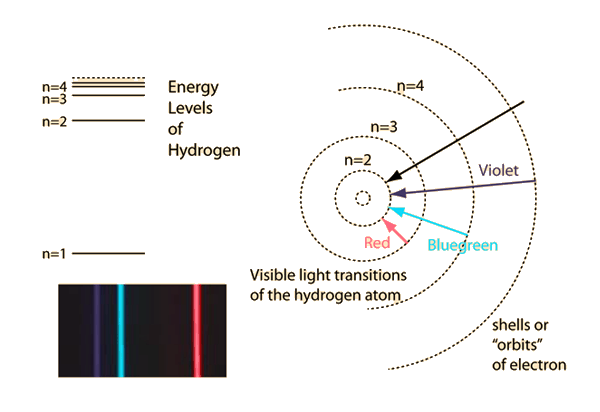
The electrons in free atoms can only be found in certain discrete energy states. These sharp energy states are associated with the orbits or shells of electrons in an atom, e.g., a hydrogen atom. One of the implications of these quantized energy states is that only certain photon energies are allowed when electrons jump down from higher levels to lower levels, producing the hydrogen spectrum. The Bohr model successfully predicted the energies for the hydrogen atom, but had significant failures that were corrected by solving the Schrodinger equation for the hydrogen atom.
![]()
自由原子中的电子只能处于某些离散的能量状态中。这些明确的能量状态与原子中电子的轨道或壳层有关,例如氢原子。这些量化能量状态的一个后果是,当电子从较高能级跃迁到较低能级时,只允许特定的光子能量,从而产生氢原子光谱。玻尔模型成功预测了氢原子的能量,但也有显著的失败,这些失败通过求解氢原子的薛定谔方程得到了修正。 |
Index Bohr model concepts 索引:玻尔模型概念 | ||
|
Go Back
返回 |
Angular Momentum Quantization角动量量子化
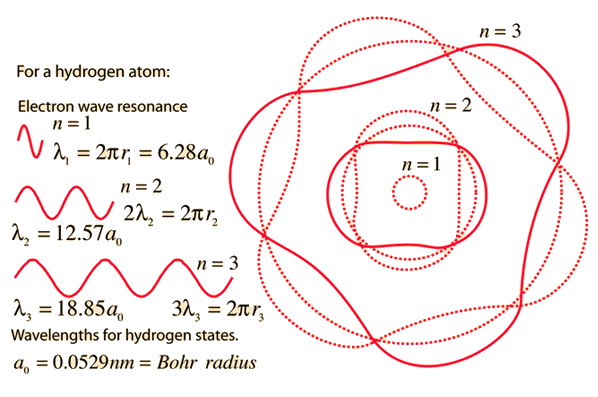
In the Bohr model, the wavelength associated with the electron is given by the DeBroglie relationship
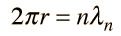
![]() and the standing wave condition that circumference = whole number of wavelengths. In the hydrogenic case, the number n is the principal quantum number. 并满足驻波条件,即圆周等于整数倍的波长。在氢原子情况下,这个数n是主量子数。
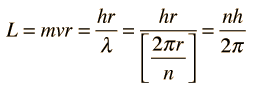
![]() These can be combined to get an expression for the angular momentum of the electron in orbit. (Note that this assumes a circular orbit, a generally unwarranted assumption.) 这些可以结合起来得到电子轨道角动量的表达式。(注意,这一假设是圆轨道,通常是没有根据的。)
Thus L is not only conserved, but constrained to discrete values by the quantum number n. This quantization of angular momentum is a crucial result and can be used in determining the Bohr orbit radii and Bohr energies. 在玻尔模型中,电子的波长由德布罗意关系给出。因此,角动量不仅守恒,而且由量子数n被限制在离散的值上。角动量的量子化是关键结果,可以用来确定玻尔轨道半径和玻尔能量。 |
Index Bohr model concepts 索引:玻尔模型概念 | ||
|
Go Back
返回 |
Classical Electron Orbit经典电子轨道
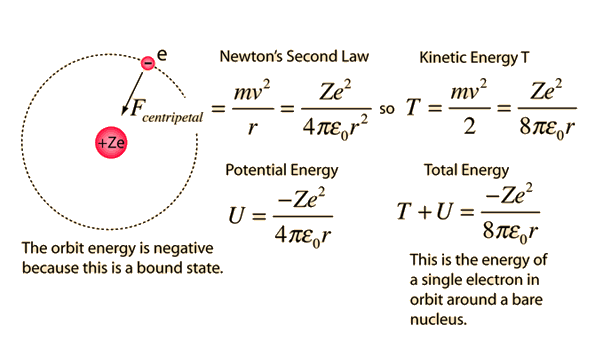
![]() In the Bohr theory, this classical result was combined with the quantization of angular momentum to get an expression for quantized energy levels. 在玻尔理论中,这一经典结果与角动量的量子化相结合,得到了量化的能量级表达式。
|
Index Bohr model concepts 索引:玻尔模型概念 | ||||
|
Go Back
返回 |
Bohr Orbit玻尔轨道
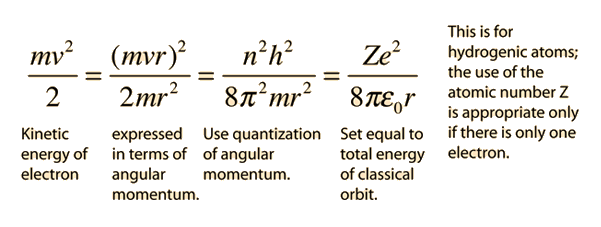
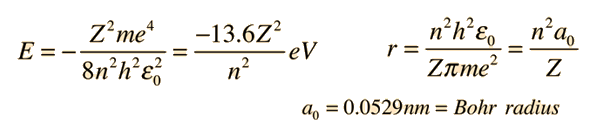
Combining the energy of the classical electron orbit with the quantization of angular momentum, the Bohr approach yields expressions for the electron orbit radii and energies:![]() Substitution for r gives the Bohr energies and radii: ![]() Although the Bohr model of the atom was shown to have many failures, the expression for the hydrogen electron energies is amazingly accurate. The Schrodinger equation for the hydrogen atom actually gave the same energies, so the Bohr model was a helpful step along the way to developing a quantum mechanical model for hydrogen.
尽管玻尔模型被证明有许多不足之处,但氢原子中电子的能量表达式却异常准确。氢原子的薛定谔方程实际上给出了相同的能量,因此玻尔模型在发展氢原子的量子力学模型过程中起到了积极作用。
将经典电子轨道的能与角动量的量子化结合在一起,玻尔方法得出电子轨道半径和能量的表达式:代入r可得玻尔能量和半径: |
Index Bohr model concepts 索引:玻尔模型概念 | ||
|
Go Back
返回 |
Wavelengths for Different States不同状态的波长
![]()
|
Index Bohr model concepts 索引:玻尔模型概念 | ||
|
Go Back
返回 |
Failures of the Bohr Model波尔模型的失败
While the Bohr model was a major step toward understanding the quantum theory of the atom, it is not in fact a correct description of the nature of electron orbits. Some of the shortcomings of the model are: 尽管玻尔模型是向理解原子的量子理论迈出的重要一步,但它实际上并不是电子轨道性质的正确描述。该模型的一些不足之处是:
1. It fails to provide any understanding of why certain spectral lines are brighter than others. There is no mechanism for the calculation of transition probabilities. 它未能解释为何某些谱线比其他谱线更明亮。没有计算跃迁概率的机制。
2. The Bohr model treats the electron as if it were a miniature planet, with definite radius and momentum. This is in direct violation of the uncertainty principle which dictates that position and momentum cannot be simultaneously determined. 玻尔模型将电子视为一个微型行星,具有确定的半径和动量。这直接违反了不确定性原理,该原理指出位置和动量不能同时被确定。
The Bohr model gives us a basic conceptual model of electron orbits and energies. The precise details of spectra and charge distribution must be left to quantum mechanical calculations, as with the Schrodinger equation. 玻尔模型为我们提供了一个关于电子轨道和能量的基本概念模型。光谱和电荷分布的精确细节必须留给量子力学计算,如薛定谔方程。
|
Index Bohr model concepts 索引:玻尔模型概念 | ||
|
Go Back
返回 |