Bilingual edition: English is preserved and Chinese follows each unit. Terminology uses the confirmed v20260916 glossary; automated semantic review remains traceable.
中英双语版:英文原文完整保留,中文紧随对应单元;术语采用 v20260916 确认表,自动语义审校结果可追溯。

Image from Principal Planes

主平面的图像

The thin lens equation can be used with thick lenses if the principal planes are found. The equivalent focal length of the thick lens can be found from Gullstrand's equation, and the front and back vertex focal lengths obtained. Once that is done, the principal planes can be located by subtracting the vertex focal lengths from the equivalent focal length. The equivalent focal length and the distance from first principal distance H1 to the object can be used to calculate the image distance from the second principal plane H2. From that distance, the image distance from the back vertex can be deduced.
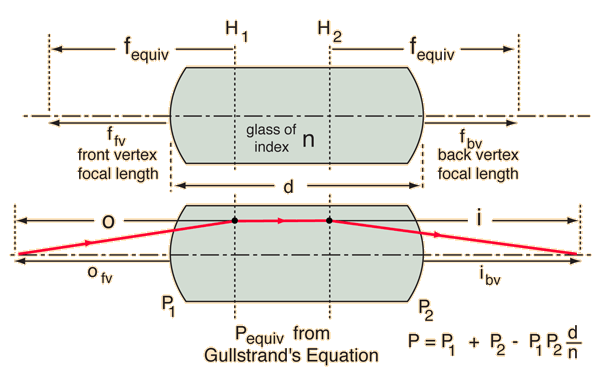
薄透镜方程可以在找到主平面的情况下用于厚透镜。厚透镜的等效焦距可通过Gullstrand方程求得,并可获得前顶点和后顶点焦距。一旦完成这些步骤,就可以通过从等效焦距中减去顶点焦距来确定主平面的位置。等效焦距和从第一个主平面到物体的距离H1可以用来计算从第二个主平面H2到像的距离。从该距离可以推导出从后顶点到像的距离。

Note that the calculation below does not take into account the change in lens thickness with the angle of the incoming ray. It is typical to do the calculation only for the paraxial rays where the departure from full thickness is negligible. The segments in boxes below are the limiting cases where the lens thickness is taken as zero (thin lens approximation).

需要注意的是,下面的计算未考虑入射光线角度变化对透镜厚度的影响。通常只对近轴光线进行计算,因为偏离完整厚度的情况可以忽略不计。下面方框中的段落是极限情况,即假设透镜厚度为零(薄透镜近似)。

For glass with index of refraction nlens =

对于折射率为n的透镜,
中文译文中的待填/计算数值依次对应:1:n。实际数值以上方原输入框为准。

the front surface power for lens radius R1 = m is P1 = m-1

透镜半径 R₁ 的前表面功率为 m 时,P₁ = m - 1
中文译文中的待填/计算数值依次对应:1:r1 2:p1。实际数值以上方原输入框为准。

and the back surface power for lens radius R2 = m is P2 = m-1

以及透镜半径R₂ = m时的后表面功率P₂ = m - 1
中文译文中的待填/计算数值依次对应:1:r2 2:p2。实际数值以上方原输入框为准。

(Note that for a double convex lens, the front surface radius R1 is positive and the back surface radius R2 is negative according to the Cartesian sign convention.)

(注意,对于双凸透镜,根据笛卡尔符号约定,前表面半径R1为正,后表面半径R2为负。)

A thin lens would have approximate power Pthin lens = P1 + P2 = m-1.

薄透镜的近似功率 P_{thin lens} = P_1 + P_2 = m - 1.
中文译文中的待填/计算数值依次对应:1:pt。实际数值以上方原输入框为准。

The thin lens focal length would be f = m = cm.

薄透镜的焦距应为 f = m = cm。
中文译文中的待填/计算数值依次对应:1:ft 2:ftcm。实际数值以上方原输入框为准。

A thick lens of thickness d = cm = m would have effective power given by Gullstrand's equation:

厚度为 d = cm = m 的厚透镜,其有效功率由 Gullstrand 方程给出:
中文译文中的待填/计算数值依次对应:1:dcm 2:d。实际数值以上方原输入框为准。

Pthick lens = m-1

厚透镜的公式为:P = m - 1
中文译文中的待填/计算数值依次对应:1:ptk。实际数值以上方原输入框为准。

The equivalent focal length for the thick lens would be fequiv = m = cm.

厚透镜的等效焦距为 f_equiv = m = cm。
中文译文中的待填/计算数值依次对应:1:ftk 2:ftkcm。实际数值以上方原输入框为准。

Sometimes for thick lenses it is more useful to state the back vertex power and focal length. For this lens:

有时对于厚透镜来说,使用后顶点功率和焦距可能更为有用。对于这个透镜:

Pfront vertex = m-1.

前顶点的动量为 $ P_{ ext{front vertex}} = m^{-1} $。
中文译文中的待填/计算数值依次对应:1:pfv。实际数值以上方原输入框为准。

Front vertex focal length = ffront vertex = m = cm.

前顶点焦距 = f 前顶点 = m = cm。
中文译文中的待填/计算数值依次对应:1:ffv 2:ffvcm。实际数值以上方原输入框为准。

Pback vertex = m-1.

P back vertex = m -1 .(专名或术语)
中文译文中的待填/计算数值依次对应:1:pbv。实际数值以上方原输入框为准。

Back vertex focal length = fback vertex = m = cm.

For the thin lens, we can calculate the image distance from the simpler form of the lens equation. For object distance

对于薄透镜,我们可以利用更简单的透镜公式计算像距。对于物距

o = m, the image distance is

o = m,像距是
中文译文中的待填/计算数值依次对应:1:o。实际数值以上方原输入框为准。

i = m.

Remember that an object in front of the lens gives a negative object distance. Also remember that an object inside the focal length does not form a real image. A negative image distance impies a virtual image.

记住,物体位于透镜前方时,物体距离为负。也记住,物体位于焦距以内时不会形成实像。负的像距意味着形成虚像。

For the thick lens, we will specify the distance of the object from the front surface of the lens:

对于厚透镜,我们将指定物体到透镜前表面的距离:

ofv = m.

o fv = m.(专名或术语)
中文译文中的待填/计算数值依次对应:1:ofv。实际数值以上方原输入框为准。

To use the lens equation for the thick lens, we must find the object distance to the first principal plane H1, so we must calculate the distance from the front vertex to that plane. That distance is the difference between the equivalent focal length and the front vertex focal length, fequiv - ffv.

要使用厚透镜的透镜公式,我们必须找到物体到第一个主平面H1的距离,因此必须计算从前顶点到该平面的距离。该距离是等效焦距与前顶点焦距之差,即f equiv - f fv。

The distance from the front vertex to H1 = m so othick lens = m.

从前顶点到H₁的距离为m,因此厚透镜=m。
中文译文中的待填/计算数值依次对应:1:vh1 2:otk。实际数值以上方原输入框为准。

The lens equation, using Pthick lens, then gives the image distance

厚透镜的透镜方程则给出像距

ithick lens = m.

厚透镜的焦距等于物距。
中文译文中的待填/计算数值依次对应:1:itk。实际数值以上方原输入框为准。

This locates the image for us, but if we want the image distance from the back vertex, we have to calculate the distance from H2 to that vertex. That distance is the difference between the equivalent focal length and the back vertex focal length, fequiv - fbv.

这个定位了图像,但如果我们想要从后顶点到图像的距离,就必须计算从H2到该顶点的距离。这个距离是等效焦距与后顶点焦距之差,即f equiv - f bv。

H2 to back vertex = m.

H2 到背顶点 = m。
中文译文中的待填/计算数值依次对应:1:vh2。实际数值以上方原输入框为准。

The image distance from the back vertex is then

则从后顶点到像的距离是

ibv = m.

i bv = m.(专名或术语)
中文译文中的待填/计算数值依次对应:1:ibv。实际数值以上方原输入框为准。

Note that the use of the lens equation in this setting leaves out the separation between the principal planes.

需要注意的是,在这种情况下使用透镜方程会忽略主平面之间的分离。

H2 - H1 = m.

The total distance from the object to the image for the thick lens is

厚透镜的物像总距离为

othick + (H2 - H1) + ithick = m.

o thick + (H 2 - H 1 ) + i thick = m.(专名或术语)
中文译文中的待填/计算数值依次对应:1:oitk。实际数值以上方原输入框为准。

For the thin lens, this distance would be just o+i = m. In many practical cases this distance is very close to just the thick lens total distance minus the thickness of the lens.

对于薄透镜,这个距离就是 o+i = m。在许多实际情况下,这个距离非常接近厚透镜的总距离减去透镜的厚度。
中文译文中的待填/计算数值依次对应:1:oi。实际数值以上方原输入框为准。
后顶焦距 = f_back vertex = m = cm。
中文译文中的待填/计算数值依次对应:1:fbv 2:fbvcm 3:i 4:hsep。实际数值以上方原输入框为准。
Compare to same calculation by:
与通过以下方式计算的结果进行比较:
Vergence tracing
汇聚追踪
Principal planes, two thin lenses
主平面,两个薄透镜
Vergence Example
汇聚示例
Matrix definitions
矩阵定义
Index

Lens concepts

Thick lens concepts

Reference
Meyer-Arendt
索引透镜概念 厚透镜概念 参考 Meyer-Arendt
 
HyperPhysics***** Light and Vision
HyperPhysics ***** 光与视觉
R Nave
Go Back
返回