Bilingual edition: English is preserved and Chinese follows each unit. Terminology uses the confirmed v20260916 glossary; automated semantic review remains traceable.
中英双语版:英文原文完整保留,中文紧随对应单元;术语采用 v20260916 确认表,自动语义审校结果可追溯。

Nuclear Spin

核自旋

It is common practice to represent the total angular momentum of a nucleus by the symbol I and to call it "nuclear spin". For electrons in atoms we make a clear distinction between electron spin and electron orbital angular momentum, and then combine them to give the total angular momentum. But nuclei often act as if they are a single entity with intrinsic angular momentum I. Associated with each nuclear spin is a nuclear magnetic moment which produces magnetic interactions with its environment.

通常习惯用符号I表示核的总角动量,并称之为“核自旋”。对于原子中的电子,我们明确区分电子自旋和电子轨道角动量,然后将它们结合起来得到总角动量。但核往往像一个整体一样,具有内在的角动量I。每个核自旋都伴随着一个核磁矩,它与环境产生磁相互作用。

The nuclear spins for individual protons and neutrons parallels the treatment of electron spin, with spin 1/2 and an associated magnetic moment. The magnetic moment is much smaller than that of the electron. For the combination neutrons and protons into nuclei, the situation is more complicated.

质子和中子的核自旋与电子自旋的处理方式类似,具有自旋1/2和相应的磁矩。磁矩远小于电子的磁矩。对于中子和质子组成原子核的情况,情况更为复杂。

A characteristic of the collection of protons and neutrons (which are fermions) is that a nucleus of odd mass number A will have a half-integer spin and a nucleus of even A will have integer spin. The suggestion that the angular momenta of nucleons tend to form pairs is supported by the fact that all nuclei with even Z and even N have nuclear spin I=0. For example, in the nuclear data table for iron below, all the even A nuclides have spin I=0 since there are even numbers of both neutrons and protons. The half-integer spins of the odd-A nuclides suggests that this is the nuclear spin contributed by the odd neutron.

质子和中子(都是费米子)的集合的一个特征是,质量数A为奇数的核素具有半整数自旋,而质量数A为偶数的核素则具有整数自旋。核子角动量倾向于成对出现的假说得到了支持,因为所有质子数Z和中子数N均为偶数的核素其核自旋I=0。例如,在铁的核数据表中,所有质量数A为偶数的核素其自旋I=0,因为其中中子和质子的数量均为偶数。奇数质量数核素的半整数自旋表明,这种自旋是由奇数个中子贡献的。
Isotopes of Iron
Z
A
Atomic
Mass (u)
原子质量(u)
Nuclear
Mass(GeV/c2
核质量(GeV/c²)
Binding
Energy(MeV)
结合能(MeV)
Spin
自旋
Natural
Abund.
天然丰度
Half-life
半衰期
Decay
衰变
Q
MeV
Q值(MeV)
26
54
53.939613
50.2315
471.77
0
0.059
stable
稳定
...
...
26
55
54.938296
51.1618
481.07
3/2
...
2.7y
EC
电子俘获(EC)
0.23
26
56
55.934939
52.0902
492.26
0
0.9172
stable
稳定
...
...
26
57
56.935396
53.0221
499.91
1/2
0.021
stable
稳定
...
...
26
58
57.933277
53.9517
509.96
0
0.0028
stable
稳定
...
...
26
60
59.934077
55.8154
525.35
0
...
1.5My
1.5My(专名或术语)
b-
0.24

The nuclear data of cobalt, just above iron in the periodic table, shows dramatically different nuclear spins I. The nuclides with even neutron number show half-integer spins associated with the odd proton, while those with odd neutron number show large integer spins associated with the two nucleons which are unpaired.

元素周期表中位于铁之后的钴的核数据表明,其核自旋I有显著差异。中子数偶数的核素表现出与奇数质子相关的半整数自旋,而中子数奇数的核素则表现出与未配对的两个核子相关的较大整数自旋。
Isotopes of Cobalt
Z
A
Atomic
Mass (u)
原子质量(u)
Nuclear
Mass(GeV/c2
核质量(GeV/c²)
Binding
Energy(MeV)
结合能(MeV)
Spin
自旋
Natural
Abund.
天然丰度
Half-life
半衰期
Decay
衰变
Q
MeV
Q值(MeV)
27
56
55.939841
52.0943
486.92
4
...
77.7d
b+
4.57
27
57
56.936294
53.0225
498.29
7/2
...
271d
EC
电子俘获(EC)
0.84
27
59
58.933198
54.8826
517.32
7/2
1.00
stable
稳定
...
...
27
60
59.933820
55.8147
524.81
5
...
5.272y
b-
2.82
Nuclear magnetic moments
核磁矩
铁的同位素钴的同位素
Index

Nuclear Structure Concepts

Reference
Krane
Ch 3
索引 核结构概念 参考 Krane 第3章
 
HyperPhysics***** Nuclear
HyperPhysics ***** 核物理
R Nave
Go Back
返回


Nuclear Magnetic Moments

核磁矩

Associated with each nuclear spin is a magnetic moment which is associated with the angular momentum of the nucleus. It is common practice to express these magnetic moments in terms of the nuclear spin in a manner parallel to the treatment of the magnetic moments of electron spin and electron orbital angular momentum.

每个核自旋都对应一个磁矩,该磁矩与核的角动量相关。通常的做法是用核自旋来表达这些磁矩,这与处理电子自旋和电子轨道角动量的方式相似。

For the electron spin and orbital cases, the magnetic moments are expressed in terms of a unit called a Bohr magneton which arises naturally in the treatment of quantized angular momentum.
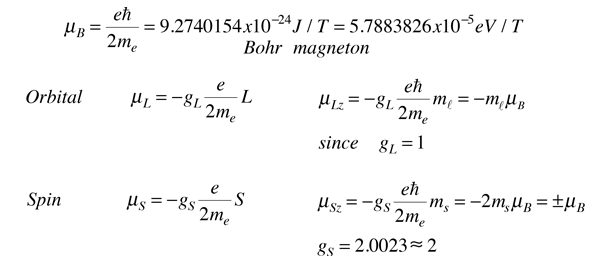
对于电子自旋和轨道情况,磁矩用一个称为玻尔磁子的单位来表示,该单位自然地出现在量化角动量的处理中。

Generally, the measured quantity is proportional to the z-component of the magnetic moment (the component along the experimentally determined direction such as the direction of an applied magnetic field, etc. ). In this treatment, the use of a "gyromagnetic ratio" or "g-factor" is introduced. The g-factor for orbital is just gL = 1, but the electron spin g-factor is approximately gS = 2.

通常,测量量与磁矩的z分量成正比(即沿实验确定的方向,如外加磁场方向等)。在本处理中,引入了“旋磁比”或“g因子”。轨道的g因子仅仅是g_L = 1,但电子自旋的g因子约为g_S = 2。

For the nuclear case we proceed in a parallel manner. The nuclear magnetic moment is expressed in terms of the nuclear spin in the form

对于核的情况,我们采用类似的方法处理。核磁矩可表示为核自旋的函数

where we have now introduced a new unit called a nuclear magneton.

其中我们已经引入了一个新的单位,称为核磁子。

For free protons and neutrons with spin I =1/2, the magnetic moments are of the form
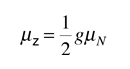
对于自旋I=1/2的自由质子和中子,磁矩的形式为

where

其中

Proton: g = 5.5856947

质子的磁矩比值 g = 5.5856947

In 2014 a direct measurement of the magnetic moment of the proton gave 2.792847350(9) nuclear magnetons. (Mooser et al, Nature, May 29, 2014). Efforts are underway to measure the magnetic moment of the antiproton with comparable accuracy, since a measured difference between the proton and antiproton could be a valuable clue toward unraveling the mystery of why matter greatly dominates antimatter in the universe (antimatter problem).

Neutron: g = -3.8260837 +/- 0.0000018

中子:g = -3.8260837 ± 0.0000018

The proton g-factor is far from the gS = 2 for the electron, and even the uncharged neutron has a sizable magnetic moment! For the neutron, this suggests that there is internal structure involving the movement of charged particles, even though the net charge of the neutron is zero. If g=2 were an expected value for the proton and g=0 were expected for the neutron, then it was noted by early researchers that the the proton g-factor is 3.6 units above its expected value and the neutron value is 3.8 units below its expected value. This approximate symmetry was used in trial models of the magnetic moment, and in retrospect is taken as an indication of the internal structure of quarks in the standard model of the proton and neutron.

质子的g值远不同于电子的g_S = 2,甚至带电的中子也有显著的磁矩!对于中子来说,这表明内部存在涉及带电粒子运动的结构,尽管中子的净电荷为零。如果质子的g值预期为2,中子的g值预期为0,那么早期研究者注意到质子的g值比预期高3.6个单位,而中子的g值比预期低3.8个单位。这种近似的对称性曾被用于磁矩的试模型中,并回顾来看,这是标准模型中质子和中子夸克内部结构的一个指示。

Note that the maximum effective magnetic moment of a nucleus in nuclear magnetons will be the g-factor multiplied by the nuclear spin. For a proton with g = 5.5857 the quoted magnetic moment is μ = 2.7928 nuclear magnetons.

注意,核素的 maximum effective magnetic moment 将是 g 因数乘以核自旋。对于质子,g = 5.5857,其磁矩为 μ = 2.7928 nuclear magnetons。
Nuclide
核素
Nuclear
spin I
核自旋 I
Magnetic moment
μ in μN
磁矩 μ 在 μ N
n
1/2
-1.9130418
p
1/2
+2.7928456
2H(D)
1
+0.8574376
17O
5/2
-1.89279
57Fe
57Fe
1/2
+0.09062293
57Co
57钴
7/2
+4.733
93Nb
9/2
+6.1705

Data from V. S. Shirley, Table of Isotopes, Wiley, New York, 1978, Appendix VII.

数据来自V. S. Shirley,《同位素表》,Wiley,纽约,1978年,附录VII。
Nuclear magnetic resonance
核磁共振
2014年,对质子磁矩的直接测量结果为2.792847350(9)个核磁子。(Mooser等,《自然》,2014年5月29日)。目前正努力以相似的精度测量反质子的磁矩,因为若能测出质子与反质子之间的差异,将可能为解释为何物质在宇宙中远多于反物质(反物质问题)提供重要线索。
Index

Nuclear Structure Concepts

Reference
Krane
Ch 3
索引 核结构概念 参考 Krane 第3章
 
HyperPhysics***** Nuclear
HyperPhysics ***** 核物理
R Nave
Go Back
返回