Calcite
|
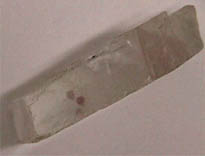
The mineral calcite, also known as Iceland spar, is a widely used material in optics because of its birefringence. Its birefringence is so large that a calcite crystal placed over a dot on a page will reveal two distinct images of the dot. One image will remain fixed as the crystal is rotated, and that ray through the crystal is called the "ordinary ray" since it behaves just as a ray through glass. However, the other image will rotate with the crystal, tracing out a small circle around the ordinary image. This ray is called the "extraordinary ray". 碳酸钙矿物,也称为冰洲石,因其双折射性而被广泛用于光学领域。其双折射性非常显著,当将一块冰洲石置于书页上的一个点上方时,会显示出该点的两个不同影像。其中一个影像在晶体旋转时保持固定,通过晶体的这束光线称为‘寻常光’,因为它在晶体中的行为类似于通过玻璃的光线。然而,另一个影像会随着晶体的旋转而转动,在寻常影像周围画出一个小圆。这束光线称为‘非寻常光’。 |
The indices of refraction for the o- and e-rays are 1.6584 and 1.4864 respectively. This gives total internal reflection critical angles of 37.08° for the o- and 42.28° for the e-rays when in contact with air. This means that for any angle between these two values, the o-ray will be totally reflected but the e-ray will be partially transmitted. This gives linear polarization since only the e-ray emerges.
Calcite is used in polarizing prisms such as the Nicol prism, the Glan-Foucault prism, and the Wollaston prism.
|
A simple demonstration of the large birefringence of calcite is to put a dot on a piece of paper and put the calcite crystal over it. You see two distinct dots. By putting a piece of polaroid over the crystal and rotating it, you can show that the two images of the dot are made up of light polarized at 90° with respect to each other. Rotating the polaroid will show one dot, then both in transition, and then just the second dot as you reach 90°. 一个简单的双折射现象的演示是将一个点放在一张纸上,然后将方解石晶体放在其上。你会看到两个明显的点。通过在晶体上放置一块偏振片并旋转它,可以显示这两个点是由相互垂直偏振的光组成的。旋转偏振片时,你会看到一个点,然后是两个点逐渐过渡,最后当旋转到90°时,只显示第二个点。
|
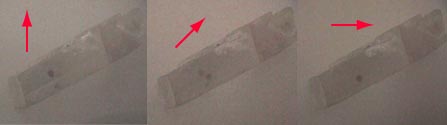
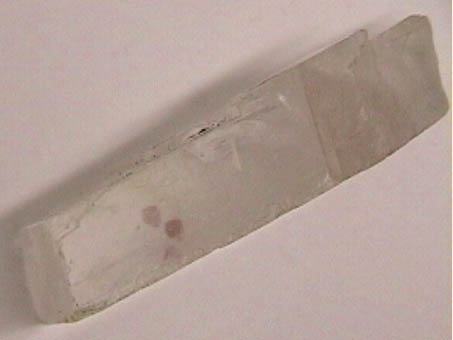
| Double imaging in calcite
方解石中的双重成像 |
| Mineral varieties of calcite
方解石的矿物种类 |
| Very large calcite crystal!
非常大的方解石晶体! |
| Load video of polarizer rotation
极化器旋转的视频 |
Polarization concepts
| HyperPhysics***** Light and Vision
HyperPhysics ***** 光与视觉 | R Nave |