Air Column Instruments空气柱乐器
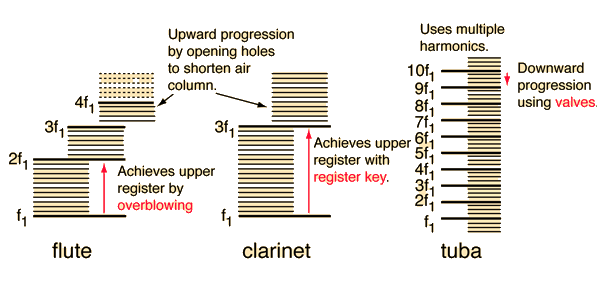
The woodwind instruments use only the first few resonances of air columns and depend upon opening holes in the sides of the air columns to ascend in pitch. The brass instruments employ a large number of resonances (harmonics) of their air columns and make use of valves or slides to lengthen the air columns for a downward progression of pitches. 木管乐器只利用空气柱的前几个共振,依靠空气柱侧面的开孔来升高音调。铜管乐器则利用空气柱的大量共振(泛音),并通过阀门或滑管来延长空气柱以实现音调的下降。
![]()
|
Index Musical instruments Musical acoustics foundations 索引 音乐乐器 音乐声学基础 | ||||||
|
Go Back
返回 |
Air Column Excitation空气柱激发
While the frequencies produced by an air column instrument depend upon the type of column, the timbre of the sound is significantly influenced by the method of excitation of the air column. The flute and the recorder, as well as diapason organ pipes, are excited by blowing air over an edge. This edgetone can be altered by changing airstream velocity or the distance between slit and edge, so that an upper register is possible. 尽管空气柱乐器产生的频率取决于柱子的类型,但声音的音色显著受到空气柱激励方法的影响。 flute 和 recorder,以及 diapason 型管风琴,都是通过气流吹过边缘来激励的。这种边缘激励可以通过改变气流速度或缝隙与边缘之间的距离来调整,因此可以产生高音区。
Other woodwinds may use a single reed (clarinet, saxophone) or a double reed (oboe, bassoon) to excite the air column. Such instruments achieve their upper register with the use of a register key which destroys the lowest mode of vibration of the air column and forces the column to vibrate at its next highest harmonic. For the clarinet this upper register is the third harmonic, but for the other woodwinds, it is an octave up because they are conical air columns. 其他木管乐器可能使用单簧(如单簧管、萨克斯管)或双簧(如英国管、大管)哨片来激发空气柱。这类乐器通过使用注册键来实现高音区,该键会破坏空气柱的最低振动模式,并迫使空气柱在下一个最高泛音上振动。对于单簧管来说,高音区对应的是第三泛音,但对于其他木管乐器来说,由于它们是圆柱形空气柱,高音区则高一个八度。
Brass instrument air columns are excited by the action of the player's lips on the mouthpiece. 铜制乐器的气柱是通过演奏者嘴唇对喇叭口的作用而激发的。
|
Index Musical instruments Musical acoustics foundations 索引 音乐乐器 音乐声学基础 | ||||||
|
Go Back
返回 |
Air Column Registers空气柱记录
The playing range of woodwind instruments is extended by the existence of upper registers which allow them to excite upper harmonics of the air columns. In the flute the process is called overblowing. The upper register is an octave up in such instruments since they act as open-ended cylinders. 木管乐器的演奏范围通过存在高音区而得以扩展,这些高音区允许它们激发空气柱的高 harmonics。在 flute 中,这一过程称为 overblowing。由于这些乐器相当于开放管,因此高音区比标准音域高一个八度。
Other woodwinds achieve their upper register with the use of a register key which destroys the lowest mode of vibration of the air column and forces the column to vibrate at its next highest harmonic. For the clarinet this upper register is the third harmonic, but for the other woodwinds, it is an octave up because they are conical air columns. 其他木管乐器通过使用注册键来实现高音区,该键会破坏空气柱的最低振动模式,并迫使空气柱在下一个最高谐波上振动。对于单簧管来说,高音区对应的是第三谐波,但对于其他木管乐器来说,由于它们是锥形空气柱,高音区则高一个八度。
|
Index Musical instruments Musical acoustics foundations 索引 音乐乐器 音乐声学基础 | ||||||
|
Go Back
返回 |
The Brass Mouthpiece and the Players Lips黄铜管与演奏者嘴唇
The brass player's lips are the source of excitation for the air column of a brass instrument. As described by Scott Whitener in his "A Complete Guide to Brass", "The sound of a brass instrument is created by the vibration of the lips initiating and maintaining a longitudinal standing wave in air enclosed within the instrument's tubing. ... The player's embouchure may be seen as a flow-control valve acting on the steady airflow coming from the lungs. The closed lips are blown apart, setting them into vibration. Puffs of air are thereby emitted into the mouthpiece, setting in motion a sound wave that eventually reaches the instrument's expanding bell." 铜管乐器演奏家的嘴唇是铜管乐器空气柱的激励源。如Scott Whitener在其《铜管乐器全书》中所述:'铜管乐器的声音是由嘴唇的振动引发并维持空气柱内纵向驻波产生的。... 演奏家的嘴唇形状可以被视为对来自肺部持续气流的流量控制阀。闭合的嘴唇被吹开,从而产生振动。空气脉冲因此被发射到嘴孔,引发声波的产生,最终传达到乐器扩大的喇叭口。
As Whitener points out, the sound waves reflect from the open end at the bell and travel back and forth between the mouthpiece and players lips and the bell, producing a longitudinal vibration of the air column at the frequency of the player's lips. This efficient standing wave can be produced only at or near the resonant frequencies of the instrument, giving the characteristic sequence of harmonics of the instrument. 正如Whitener指出的,声音波在喇叭口和演奏者嘴唇以及喇叭口处反射,来回在喇叭口和演奏者嘴唇之间传播,产生空气柱在演奏者嘴唇频率下的纵向振动。这种高效的驻波只能在乐器的共振频率或附近产生,从而产生乐器的特征谐波序列。
|
Index Musical instruments Musical acoustics foundations Reference Whitener 索引 音乐乐器 音乐声学基础 参考 白化 | ||
|
Go Back
返回 |