Atoms and Elements
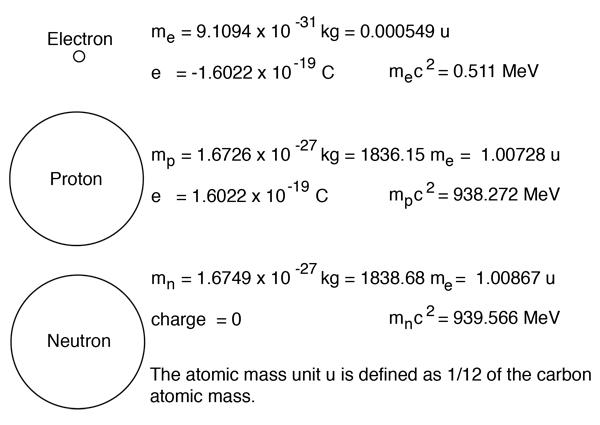
Ordinary matter is made up of protons, neutrons, and electrons and is composed of atoms. An atom consists of a tiny nucleus made up of protons and neutrons, on the order of 20,000 times smaller than the size of the atom. The outer part of the atom consists of a number of electrons equal to the number of protons, making the normal atom electrically neutral.
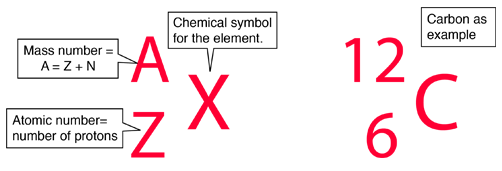
A chemical element consists of those atoms with a specific number of protons in the nucleus; this number is called the atomic number. The atoms of an element may differ in the number of neutrons; atoms with different neutron numbers are said to be different isotopes of the element.
Elements are represented by a chemical symbol, with the atomic number and mass number sometimes affixed as indicated below. The mass number is the sum of the numbers of neutrons and protons in the nucleus.
The elements can be identified unambiguously by the "spectral fingerprints" of their line spectra and in some cases by the flame colors given off by excited atoms.
| Atomic properties
原子性质 | Ionization energies
电离能 | Atomic radii
原子半径 |
| Periodic table of the elements
元素周期表 | Element abundance, Earth's crust
元素丰度,地球的 crust |
| Measured properties of the constituents
构成粒子的性质测量 |
| Visualizing Electron Orbitals
可视化电子轨道 |
| HyperPhysics***** Chemistry
HyperPhysics ***** 化学 | R Nave |